Contact Information

E-mail: brucefrancismacdonald@gmail.com

Thursday, 26 April 2012

Lt. Sholto Douglas Morrison - A Royal Flying Corps Pilot's Story

Date of Birth: June 27, 1894

Place of Birth: Canso, NS

Mother's Name: Margaret Waterston (Simpson)

Father's Name: John Aitken Morrison

Dates of Enlistment: December 21, 1914 (initial enlistment) & January 6, 1916 (after receiving officer's commission)

Previous Military Experience:  94th Battalion (militia unit)

Regimental Number: 2012

Rank: Lieutenant

Forces: Canadian Expeditionary Force; Royal Flying Corps

Names of Units: 2nd Divisional Engineers; 5th Field Coy. Canadian Engineers; 2nd Signal Coy. Canadian Engineers; 106th Battalion (Nova Scotia Rifles); 26th Reserve Battalion; 15 Squadron, Royal Flying Corps

Location of service: Canada, England & France

Occupation at Enlistment: Cable Operator

Marital Status at Enlistment:  Single
*****
Lt. Sholto Douglas Morrison, Canso, NS
The arrival of the Commercial Cable Company in the 1880s brought an influx of new families to Canso, Nova Scotia.  Amongst the new arrivals were John Aitken Morrison, a submarine cable man born in Dundee, Scotland, and his wife Margaret, a native of Glasgow, Scotland.  John and Margaret raised a family in this small fishing community and made Nova Scotia their home.  Their oldest child, Sholto Douglas, was born in Canso on June 27, 1894.  Three more children joined the Morrison household in the ensuing years - a daughter Mona (1895) and sons Gilbert (1903) and John (1906).

Sholto received his early education in Canso and England and followed his father into the communication field as a cable operator.  Like many young men of his day, he joined the Canadian Expeditionary force shortly after the outbreak of the war.  On December 21, 1914, Sholto enlisted as a "sapper" with the 2nd Divisional Engineers, 5th Field Company, CEF at Ottawa.  He spent the next year in the national capital - five months with the 2nd Division Signal Corps, followed by six months at the Engineers' Training Depot - preparing for an overseas assignment.

Unfortunately, health issues delayed a transfer to overseas duty.  A case of acute appendicitis in May 1915 resulted in two operations and a period of convalescence that extended into November 1915.  On November 30, Sholto was formally discharged from the Canadian Engineers, pending receipt of an officer's commission.  He was appointed a Lieutenant in the 94th Regiment on December 16, 1915 and promptly re-enlisted at Truro, NS on January 6, 1916.   Lt. Morrison was assigned to "light duty" until April 1916 as he continued his recovery.

On July 15, 1916, Sholto was transferred to the 106th Battalion - Nova Scotia Rifles - and appointed Signalling Officer in its Signal Corps.  Two other Guysborough natives - Pte. R. J. Feltmate of Canso and Pte. Charles R. Keating of Mulgrave - were amongst the men under his command.  The Maritimes' first rifle regiment, the 106th was founded in November 1915 and was based in Truro, with additional companies located in Springhill and Pictou.
106th Battalion (Nova Scotia Rifles) portrait
The day following Sholto's transfer, the 106th Battalion departed from Halifax on board the SS Empress of Britain, disembarking at Liverpool on July 25.  The battalion trained for several months at Lower Dilgate, Shorncliffe after arriving in England.  Its personnel were eventually dispersed among other regiments, the majority being absorbed by the 40th Battalion.

On July 31, Sholto was attached to the 1st Co. Signal Base, where he completed the "First Class 34 Field Telegraph Sig. Course" from August 16 to September 21.  He then returned to the 106th Battalion on October 5 and was assigned to "1st CTB Signal Base".  He  spent the next three months at the battalion's Bedfordshire camp near Folkestone, nicknamed "Caesar's Camp" because of its proximity to the famous Roman Emperor's 55 BC encampment.

On January 1, 1917, Sholto was transferred to the 26th Reserve Battalion.  Having spent almost five months in England, no doubt he was eager to put his communication skills into action with a signalling corps.  Fate, however, would take his wartime experience in a very unique direction.

Signal Corps, 106th Battalion (Nova Scotia Rifles)
*****
On April 23, 1917, Sholto Morrison was formally transferred to the Royal Flying Corps and commenced training to become a "flying officer".  He thus became one of more than 23 000 Canadians who served with the RFC in various capacities during the war. Several became legendary pilots - William "Billy" Bishop, Raymond Collishaw, "Wop" May and Roy Brown are well known for their aerial combat accomplishments.  In later years, Sholto expressed the highest admiration for  Lt. Col. William Barker, a fellow Canadian pilot and 15 Squadron colleague whose combat record earned him a Victoria Cross.  Sholto's role would be less spectacular but no less significant - his communication skills made him an ideal candidate for a reconnaissance pilot.

The Royal Flying Corps had been created in May 1912.  By the end of the year, it consisted of one squadron of airships and three aircraft squadrons, each equipped with twelve planes.  With the war's outbreak, its size increased rapidly, reaching a total of 166 aircraft by mid-1915.  The Corps, however, was still significantly smaller than its French counterpart, which boasted a fleet of 1150 aircraft by that time.

RFC aircraft initially focused on directing artillery gunfire and taking aerial photographs for intelligence purposes.  While its planes did engage in the occasional "dogfight" with German foes, such encounters were largely coincidental.  Aircraft were primarily considered to be "forward eyes" for infantry units on the ground, observing German positions and movements and passing this information to military headquarters.  As the war progressed, however, new roles emerged and specific planes were eventually designed for these purposes.
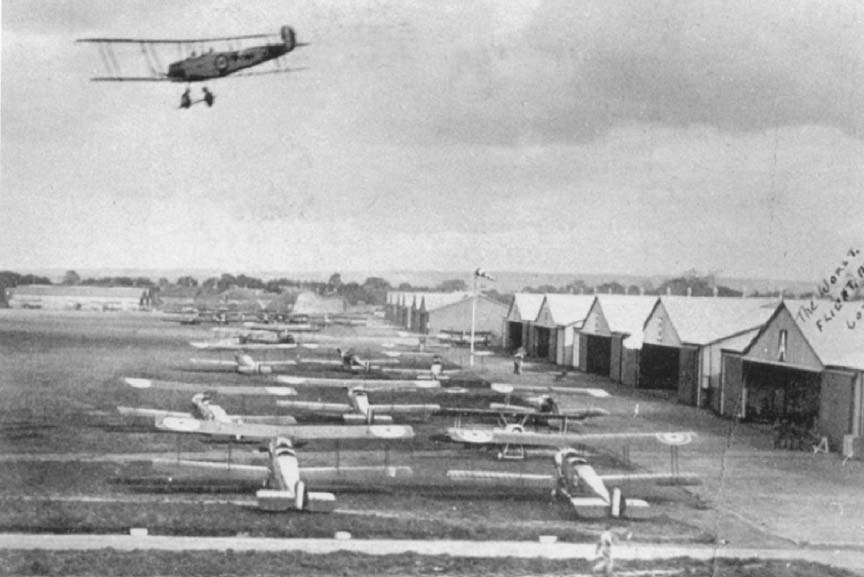
RFC Pilot Training School, Gosford, England (c. 1917)
In August 1915, the RFC adopted a strategy of continuous patrols over enemy lines, resulting in significant casualties.  When the major Allied assault at the Somme was launched in July 1916, the Corps consisted of 27 squadrons of 421 aircraft organized into four brigades, each assigned to a British infantry division.  The Corps' more aggressive role resulted in the loss of two air crew daily throughout 1916, a statistic that increased the following year.

By the spring of 1917, the RFC was losing nearly 50 aircraft a week.  The month of April saw its greatest losses - 245 airplanes shot down, 211 air crew killed and another 108 taken prisoner - in what came to be known as the "Fokker Scourge", a reference to the famous German aircraft manufacturer.  This dramatic increase finally prompted the development and adoption of aircraft designed for specific military tasks, particularly fighters and bombers.  The situation improved significantly during the summer of 1917 with the arrival of the Sopwith Pup, Sopwith Camel and Bristol Fighter, planes specifically designed for aerial combat.  By year's end, the British and French had managed to achieve aerial superiority over their German opponents.
*****
On July 30, 1917, Sholto Morrison was "received for duty" with the RFC.  He proceeded to France on September 1 and was attached to the 2nd Aircraft Depot, where he awaited deployment at the front.  On September 17,  he was assigned to 15 Squadron RFC.  Founded on March 1, 1915, the squadron had crossed the English Channel to the front in December 1915 and participated in reconnaissance missions in preparation for the Battle of the Somme.  Its planes continued in this role throughout 1916, conducting risky, low-level flights over enemy lines.  The results were predictable - its fleet suffered heavy casualties and its pilots faced the strain of constant exposure to enemy fire from the ground in addition to German aircraft.

RFC members with aerial photography cameras
A typical squadron air station consisted of an open, grassy field that served as an airstrip, with canvas hangars along its edge.  The officers' mess was usually the only "solid construction" building.  All other structures - including living quarters - were "under canvas".  Two squadrons often shared the same air field, erecting facilities on opposite sides of the airstrip.   Crews flew year round, in summer heat and dust, spring and autumn mud and rain, winter snow and cold.  Dysentery, fever, nerve and stomach problems were commonplace amongst air service members.  A pilot's life expectancy was estimated at three weeks in the early days of the war and declined to a few days for new pilots entering the Corps in 1918.  These were the circumstances - physical and psychological - in which Sholto received his combat experience.

By the time of Sholto's arrival in France, RFC squadrons had been outfitted with a new aircraft, the R.E. 8 .  Nicknamed the "Harry Tate" because of its initials' phonetic resemblance to a popular British comedian of the day, the two-seater biplane was designed to replace the widely used BE 2 (Bleriot Experimental).  Its primary weapons were a synchronized, forward-facing Vickers machine gun operated by the pilot and one or two 303 calibre Lewis guns mounted in the rear gunner position.  While it could also carry a small bomb rack under each wing, its primary role was aerial reconnaissance.  By war's end, over 4000 "Harry Tates" had rolled off the assembly line, making it one of the most common aircraft flown on the Western Front. 

The cockpit contained a small radio and photographic equipment.  On a typical mission, the pilot operated the camera and directed artillery fire using a Morse code key connected to the plane's radio.  Meanwhile, the observer in the rear seat scanned the skies for enemy aircraft and strafed enemy positions on the ground.  One can imagine the strong bond that formed between the air crew during combat.  Family sources state that "the pilot-observer partnership of Sholto Douglas Morrison with [observer] Ted Wrelton Smith became a life-long friendship".  It also explains the "strong allegiance" that Sholto felt to 15 Squadron in the years after the war.  A pilot's survival was indeed dependent on the individuals who repaired and maintained his plane, in addition to the observer who quite literally "watched his back".

Aerial photograph of Passchendaele battlefield, November 1917
By September 1917, 15 Squadron was located in Longavesnes, France, where it carried out nightly bombing raids on ammunition dumps behind the German front lines.  Later in the year, its planes participated in the battle of Cambrai (November 20 - December 7, 1917), conducting low-level reconnaissance missions and bombing raids on German positions.  These were the circumstances in which Sholto flew his first combat missions.

It was not long before Sholto and Ted experienced the dangers of reconnaissance flying.  On November 25, the crew suffered its first plane crash while participating in the attack on Cambrai.  Sholto was "rendered unconscious…, being hit on the head and back".  Later medical reports state that he was "unconscious for several hours".  He quickly recovered and was back in the air, only to endure a second "bad crash" on December 12.

Despite these incidents, Sholto continued to fly reconnaissance missions throughout the early months of 1918.  During the German "Spring Offensive" of March 1918, 15 Squadron was constantly in the air, primarily carrying out artillery observation.  Pilots recorded positions hit by Allied shells and reported their observations to artillery batteries by Morse code, all the while receiving anti-aircraft fire from the ground.  On one occasion in late March, the squadron was forced to relocate its airfield three times as German forces advanced through Allied positions.  By mid-April, the German offensive ground to a halt, allowing Sholto and other RFC pilots an opportunity for a much-needed rest.  On April 28, he was granted 7 days' leave to the UK, no doubt a much-appreciated break from the strains of combat.

The R. E. 8 ("Harry Tate")
After returning from leave, Sholto resumed his flying duties only to endure a third crash in which his aircraft "came down partially in flames" on May 14, 1918.  While he continued to fly after this incident, the pressures of aerial combat and three crashes began to affect his health.  He reportedly suffered from back pain connected to the November 1917 crash.  The strain of ten month's flying at the front also took its toll.  In total, Sholto logged over 320 flying hours in 200 missions, half of which were conducted over German trenches during combat.  On July 17, 1918, Sholto Morrison was relieved of his flying duties due to"flying fatigue" and sent to the United Kingdom for medical treatment.

The Royal Flying Corps continued its operations throughout the remaining months of the war.  On April 1, 1918, the Corps amalgamated with the Royal Naval Air Service to form the Royal Air Force.  By war's end, it consisted of over 114 000 personnel operating 4000 combat aircraft.  Its pilots logged over 900 000 combat hours as part of the Allied war effort.  Its contribution came at the cost of  9375 men lost, 1563 of whom were Canadians.  An additional 7245 men were wounded as a result of aerial combat.
*****
On July 22, 1918, Sholto Morrison was granted two months' sick leave, which was later extended to December 22.  After five weeks in medical facilities at Hampstead, England, he traveled to Canada in early September, where he received "out-patient" treatment.  Sholto returned to England by year's end for further observation.  A February 20, 1919 Royal Air Force assessment concluded that his flying fatigue was now "slight, not permanent", and recommended that he was fit for discharge from flying service.  On April 29, Sholto relinquished his commission with the RAF and remained in Hampstead, England with the CEF on leave for three months.  He boarded the transport Saxonia at Liverpool, England on August 13, arriving in Halifax ten days later.  On August 31, 1919, Sholto Morrison was formally discharged from military service and returned to the family home in Hazel Hill. 

Sholto returned to his pre-war occupation in civilian life, working with the Commercial Cable Company in Hazel Hill.  He married Meta Frances Morris of St. John's, Nfld. and they raised a family of two children, daughter Joan and son Douglas.  Sholto worked at the Cable Company's St. John's office during the Second World War and eventually retired to Carritt House, Pleasant St., Guysborough. 

In civilian life, Sholto was an active member of the Guysborough community, serving as master of Canso Lodge, president of the Guysborough Board of Trade, a warden of Christ Church, and a member of Guysborough Memorial Hospital's board.  From 1950 to 1965, he held the position of High Sheriff for Guysborough County.  In 1971, he attended a reunion of surviving RFC/RAF World War I pilots hosted by Her Majesty, Queen Elizabeth II and Prince Philip at Buckingham Palace, London.

Vintage R. E. 8 (restored)
Sholto Douglas Morrison passed away at Camp Hill Hospital, Halifax, on Saturday, September 23, 1978 at age 84 and was buried in Evergreen Cemetery, Guysborough.  He was awarded the British War Medal and Victory Medal in recognition of his military service.  His story is an excellent example of the unique contributions that Guysborough County natives made to the Allied cause in the "Great War".

*****
Sources:

15th Sqn Royal Flying Corps.  Great War Forum

Canadians in Service with the Royal Flying Corps and Royal Navy Air Service.  Canada at War

No. 15 Squadron RAF.  Wikipedia

RE.8 Reproduction.  The Vintage Aviator. 

R.E. 8.  Rise of Flight

Regimental Documents of Lt. Sholto Douglas Morrison.  Library and Archives Canada.  RG 150, Accession 1992-93/166, Box 6414 - 17 .

Royal Flying Corps.  Spartacus Educational

The Royal Flying Corps.  History Learning Site

XV Squadron Association History.  XV Squadron Association

Photographs and family information provided by daughter Joan Morrison, Halifax, NS.

Friday, 13 April 2012

The Canadian Signal Corps

The First World War marked the birth of modern warfare.  While advances in weaponry were perhaps the most obvious - and deadly - development, armies consisting of millions of soldiers dramatically increased the need for effective communication.  As the war progressed, traditional methods proved increasingly ineffective, leading to dramatic changes in communications organization and technology.

The need for a focused approach to communication was apparent years before the war's outbreak, and governments were quick to respond.  By the end of the Boer War, commanders recognized that "signalling" was a critical component of military effectiveness.  As a result, in 1903 the Canadian government authorized the creation of the "Canadian Signalling Corps", the first independent signal corps in the British Empire.  Captain Bruce Carruthers, Assistant Adjutant-General for Signalling, was the first to advocate a separate signalling branch within the Canadian army and was assigned the task of creating the unit.  Eventually re-named the Royal Canadian Signal Corps, it shared communication responsibilities with the Royal Canadian Corps of Engineers until the two units were amalgamated in 1919.

Portrait photograph of World War I signallers
It is not surprising that several soldiers from Guysborough County played a role in battlefield communications.  A trans-Atlantic telegraph cable connecting Europe and continental North America made landfall at Canso on May 23, 1881.  The Commercial Cable Company's relay station at nearby Hazel Hill made the small community a hub in the communication network connecting the two sides of the Atlantic, as cables were extended by water to New York and by land across the entire continent.  By the turn of the century, the cable company employed approximately 75 men in its Hazel HIll facility.  Their communication expertise was in great demand during the war.

Commercial Cable Company office, Hazel Hill, Guysborough County
The occupations of numerous Guysborough veterans at the time of enlistment reflect the cable's presence in their native county.  Amongst the men who gave their occupation as "cable operator" were Cecil Otis Boyd, John Murray Brown, Thomas Herbert Chapman, Clarence Leslie Cousins and Sholto Douglas Morrison, all natives or residents of the Canso area.  Others - Arthur Elroy Cousins, Lawrence Hartley Earle, his brother Vernon, and Reginald John Feltmate of Canso, along with James Joseph Crittenden and Charles Redmond Keating of Mulgrave - listed their occupation as "telegraphist".  While not all put these civilian skills to use in combat, several became members of the various signal corps attached to Canadian battalions in the field.
*****
In 1913, the Canadian Signal Corps was given full responsibility for communication within military brigades.   Its primary goal was to ensure that military headquarters at each level could communicate with commanders above  and below them in the chain of command.  At the beginning of the war, the military relied on a combination of traditional and emerging technologies.  While artillery units received messages from "spotters" on the front lines through telephone lines, infantry brigades still relied on traditional signal flags and lamps.

Members of the Canadian Signal Corps training in Toronto
The Signal Corps explored several alternative messages of communication during the war's early years.  A Pigeon Service was established as a special branch of the Signal Corps in 1915.  Canadian units used approximately one hundred messenger pigeons daily, eventually introducing mobile, vehicle-mounted pigeon lofts to accommodate the shifting front lines.  The birds also proved to be immune to the poison gases occasionally used at the front.  However, messenger pigeons could be used only in daylight, as they became disoriented after dark.  The Corps experimented with the use of "messenger dogs" to compensate for this limitation.  Unfortunately, animals were subject to the same dangers as humans in the midst of combat.  Neither innovation provided a permanent solution to the challenge of establishing rapid, dependable communication between front line positions and military headquarters.
 
Signallers in action on the front lines
Infantry signal corps adopted the Lucas lamp - a lighter, more portable unit - in 1916.  Its narrower, more focused beam improved the effectiveness of this means of communication.  Units also continued to use signal flags, although both of these methods were difficult to conceal from the enemy.  As the war progressed, these "traditional" methods were gradually enhanced or replaced by emerging technologies.

Typical signalling lamp and battery
By 1916, the telephone had become the main means of communication at the front.  The main challenge for the Signal Corps was establishing and maintaining the required lines.  Wires strung on the ground were vulnerable to artillery fire, and lines suspended in the air were not much safer.  The most reliable approach was to bury lines at a depth of six feet, a labor-intensive job that required units specifically assigned to the task.  Signallers eventually developed a technique called "laddering" to extend the life of their lines.  Parallel telephone cables were laid 60 yards apart and connected by lateral lines, a system that minimized - but did not eliminate - the impact of enemy shelling.  By war's end, Canadian Corps signallers had laid 7000 miles of buried cable in a line grid system and an additional 43,000 miles of overhead wire.

Sending a message from the front by telephone
In the later years of the war, Allied signal corps adopted "wireless" communication technology that was still in its infancy.  In 1916, the Canadian Corps Wireless Section was created to implement the technology at the front.  Improved radios replaced the earlier "spark gap" wireless sets.  Even the newest products, however, came with limitations.  One common brand, ironically named "Trench", required a fifty-foot antenna stretched along the ground in addition to a three-foot vertical aerial and had a broadcast range of less than 3000 yards.  A newer brand - Wilson - could communicate over a distance of 4000 yards but required a 60-foot ground antenna and 12-foot vertical aerial, making widespread use on the front lines impractical.

Radio transmitters were first installed in aircraft in 1917.  Pilots acted as artillery observers, sending "blind" (i.e., one-way) messages to ground stations.  Cloth panels laid out on the ground confirmed receipt of their messages!  After the capture of Vimy Ridge in April 1917, Canadian signallers used the elevated location known as Hill 70 as a "forward observation" post for artillery fire.  Wireless radio operators sent messages to a central communication station, which in turn relayed the information by telephone to each artillery position.  This system allowed for rapid adjustment of gun fire during an assault.

Signalling post at the front
While wireless units held great promise, their use during World War I was limited by range and availability.  Manufactured in small quantities, demand for radios greatly exceeded supply.  As a result, the military continued to rely on a variety of communication methods - old and new - throughout the war.  Messenger dogs, message rockets and motorcycle dispatch riders were used at various times, in addition to visual signalling (flags and lights), pigeons, human "runners", telephone and wireless.  Front line units still relied on visual signals and runners for communication during attacks.  Wireless emerged as a primary means of communication during the closing days of the war as the front lines and military headquarters became increasingly more "mobile".  However, both units on the battlefront and commanders in the rear remained heavily dependent on fixed telephone lines for basic communication at war's end.
*****
Click here to view a National Film Board of Canada video (5 minutes, b/w, no sound) of Canadian signalers and engineers in action at the front lines during World War I.

Sources:

A Signaller in World War I.  The Worcestershire Regiment.  Available online.

The Cable Story in Canso.  History of the  Atlantic Cable & Undersea Communications.  Available online.

The History of Canadian Military Communications and Electronics: Chapter 3 - World War One 1914-1918.  National Defence Canada.  Available online.
 
On the home front: Toronto in WWI.  The Toronto Star.  Available online.

Rawling, Bill (Historian, Department of National Defence). Battlefield Communications.  National Film Board of Canada: Images of A Forgotten War.  Available online.
 
Sutton, Col. P. H.. A Hundred Years of Canadian Military Communications and Electronics.  Available online.

Wednesday, 28 March 2012

Pte. Clayton R. Mills - A 'Battle of Amiens' Soldier's Story

Date of Birth: January 15, 1888

Place of Birth: Port Hillford, Guys. Co., NS 

Mother's Name: Anne Scott (McKeen) Mills

Father's Name: Robert Bruce Mills

Date of Enlistment: January 7, 1916

Regimental Number: 760760

Rank: Private

Force: Canadian Expeditionary Force

Name of Units: 121st Battalion ("Western Irish") & 29th Battalion ("Tobin's Tigers")

Location of service: England, France & Belgium

Occupation at Enlistment: Carpenter

Marital Status at Enlistment:  Single

Next of Kin: Robert Mills, Glenelg, Guys. Co., NS

*****
For many of the young Guysborough County men who enlisted in the armed forces during the First World War, the passage across the Atlantic to Europe was their first - often only - journey to locations far from their native communities.  This was not the case for Clayton Mills, who excursions to destinations far from home began several years before his military service.

Clayton was the youngest of five children born to Robert Bruce and Anne Scott Mills.  His father was a native of Indian Harbour, the son of Robert and Elizabeth (Suttis) Mills.  His mother was born at "Cross Roads", the daughter of Alex and Sarah (MacMillan) McKeen of Aspen.  The 1901 census lists his older siblings: sister Bessie (November 11, 1880), twins Sarah M. and Alexander (October 12, 1883) and brother Frank (June 23, 1886), the sibling closest to Clayton in age and a companion on some of his pre-war travels.  Sometime before 1901, the family moved to Sherbrooke, where father Robert worked at the saw mill.  By 1911, the family had relocated to the Forks (Glenelg), where Robert and Anne would spend the remainder of their days on the family farm.

This small Guysborough community, however, would not be "home" to Clayton.  Like many of his generation, he was drawn to other parts of North America in search of work.  In the pre-war years, able-bodied Maritimers boarded the "excursion train" in late summer and travelled to farms in western Canada, where they worked in the fields harvesting crops.  Most returned to their Maritime homes before winter, heading west again the following year.  Older brother Frank accompanied Clayton on several of these "excursions" - perhaps he was the first to venture west.  Clayton decided to remain out west on at least one occasion prior the war.  While the 1911 census lists Frank as residing in the family home in Glenelg, Clayton was living in a Calgary, Alta. boarding house.

"Harvest Train" Advertisement
At some point after 1911, Clayton journeyed further westward to British Columbia.  Perhaps he was seeking employment as a "carpenter", the occupation listed on his attestation papers.  It was here - in a province and city far from the small community of Glenelg - that Clayton made the fateful decision to enlist in the Canadian military.  On January 7, 1916, listing his permanent address as "General Delivery, Vancouver", he joined the 121st ("Western Irish") Overseas Battalion at New Westminster, BC.  Thus began a military adventure that lasted more than two and a half years, taking Clayton to places even further from his Guysborough County home.  Sadly, it was also a journey from which he did not return.
*****
Clayton spent the first months of military service at Vernon Camp, BC, honing the military skills required at the front.  A medical examination conducted at the camp on July 4, 1916, confirms that he was still in Canada, but Clayton soon embarked on the long journey to the front lines.  Sometime later that summer, the members of the 121st Battalion travelled by train across Canada.  On August 14, 1916, they departed Halifax for England, docking in Liverpool ten days later.  The men were then transported to the CEF military base at Bramshott, where they continued training.

121st Battalion ("Western Irish") - Vernon Camp, BC, 1917
The 121st was one of two battalions that provided manpower for the 29th British Columbia infantry battalion.  The latter was organized and commanded by Lt.-Col. Henry Seymour Tobin, a veteran of the RCMP and Boer War, and given the nickname "Tobin's Tigers". Upon arrival in Europe, the 29th was assigned to the 6th Infantry Brigade, 2nd Canadian Division and first saw action near Ypres, Belgium in October 1915.  By the time Clayton reached France, the battalion had served one year on the front lines in Belgium and France and fought in the bloody Battle of the Somme (July 1916).  No doubt, the newly arrived recruits benefitted immensely from their comrades' fighting experience.
121st ("Western Irish") Battalion Badge
The 29th Battalion reinforcements drawn from the 121st left England for France on November 28, 1916.  After several months at reserve bases in France, Clayton joined the battalion in the trenches on March 5, 1917.  While there was no "ideal time" to arrive at the front lines, the timing of Clayton's arrival proved significant.  The battalion was located near the French village of Maisnil, north of Amiens and west of Arras, in the northwest corner of France.  On March 9, Canadian Prime Minister Robert Borden personally inspected the ranks of the 6th Brigade as the Canadian Corps completed preparations for a major Allied offensive.  Scheduled for early April, its objective was to capture a strategic area of high ground known as Vimy Ridge.  Held and heavily fortified by the Germans since the early days of the war, its capture would be a significant accomplishment for Allied forces and a major blow to their German enemy.

On April 3, the men of the 29th Battalion moved into their designated assembly area in preparation for the Vimy assault.   Delayed one day by uncooperative weather conditions, the Canadian Corps launched its attack on the ridge at 5:30 am April 9 - Easter Monday 1917.  The 29th Battalion was part of the third phase of attack, proceeding up the ridge four hours after the battle's commencement.  It succeeded in capturing its objective with minimal opposition and light casualties, a positive beginning to Clayton's battlefield experience.

The 29th Battalion advances at Vimy Ridge - April 9, 1917
The 29th spent the following two months on duty in the front lines near Vimy, with occasional periods of rest in nearby support positions.  After a break for training in June, it was back to the front lines for the summer months, where Clayton and his comrades manned trenches near the French city of Lens, east of Vimy.  No major military assaults occurred during this period, the only noteworthy event being a "heavy gas bombardment" in the early hours of August 11.  The men were required to wear their uncomfortable gas masks from 12:15 to 2:15 am as "chlorine, phosgene and a new kind of gas were smelt by different parties".  Fortunately, a combination of wind and early morning rain dispersed the gas and the battalion recorded no casualties.

After a break for training in September, Clayton returned to the front lines near Lens.  On October 24, the battalion moved to Cassel, northwest of Lens, and then on to Belgium, arriving at Ypres on November 3.  The following day, the men assumed positions along the front lines at Passchendaele.  The fighting at this mud-strewn battlefield had commenced in July and was over by the time of the battalion's arrival.  No doubt, Clayton and the men of the 29th were relieved to return to the more "hospitable" trenches of Lens on November 22.

Members of the 29th Battalion in France (date and location unknown)
The following month, Clayton joined all Canadian soldiers at the front in voting in the controversial Canadian wartime federal election, held on December 7, 1917.  The outcome saw the re-election of Prime Minister Borden as leader of a "Union" government committed to implement conscription. 

As there was little military activity at the front during the winter months, battle weary soldiers were often granted leave at this time.  Clayton was amongst the fortunate soldiers chosen for such a break, departing for 14 days' leave - likely to England - on December 12 and returning to the battalion on December 29.   His Christmas holiday was no doubt more comfortable than the one his comrades experienced in the front lines!

The battalion spent the first few months of 1918 in the trenches near Lens.  The lull in fighting provided time for training when weather permitted.  Clayton's dedication to his military duties is reflected in the "Good Conduct Badge" awarded to him on January 9, 1918.  The remaining winter months passed quietly.  The spring of 1918, however, would bring a return to battle as the German command put into action a bold plan it hoped would end the stalemate on the Western Front.
*****
In early 1918, the German command saw an opportunity to "knock the Allies out of the war before the United States' forces [recent entrants in the conflict] were fully committed to battle". (Cook 383)  A December 1917 peace treaty with the new Communist government of Russia ended fighting on the Eastern Front, allowing Germany to move 33 divisions to the Western Front in support of a "spring offensive".  German ranks along the front lines  in Belgium and France swelled to 4 million men in almost 200 Divisions.

29th Battalion Badge
British, French and other Allied forces were soon aware of - and actually welcomed - the upcoming assault.  Some military commanders believed that a successful defence might mark the beginning of the war's end.  Despite this military intelligence, Allied forces were poorly prepared when the German assault was launched.

On March 21, the German offensive commenced with a massive artillery and machine gun barrage.  German forces advanced 20 kilometres into Allied-held territory over a period of three days, capturing the strategically important city of Amiens.  One reason for their success was the Allied decision to retreat in the interest of reducing the number of casualties, rather than "fight to the death" to hold ground.  This strategy proved successful as the German infantry quickly advanced beyond the point where it could be supported by artillery.  Overextended and vulnerable to counterattack, the offensive ground to a halt by late April, having failed to achieve a permanent breakthrough.  Germany suffered 800 000 casualties in the fighting, many of whom were its best trained troops.  As a result, its forces were much weaker by summer - a situation that eventually had severe consequences.

Clayton and his comrades spent March and April in the front lines southwest of Arras.  The battalion was fortunate that this location was not a major target during the German offensive.  Other than a severe gas and artillery attack on April 20, the 29th was relatively unscathed by the spring fighting and fortunate to be called into reserve on April 21.  The months of May and June were spent in the Arras area, following a rotation of front line duty, rest and training in reserve.
 
On July 1 - Dominion Day - the battalion participated in the Canadian Corps Sports competition at Tinquex, winning the tug of war championship.  The following day, the 6th Brigade was inspected by Lt. General Sir Arthur Currie and Prime Minister Borden at nearby Givenchy-Le Noble.  The battalion spent the remainder of the month in training before returning to reserve positions behind the front lines near Amiens.   For the men of the Canadian Corps - and for Clayton in particular - the war's events were about to take a significant turn.

The victorious 29th Battalion tug of war team at Tinquex, France - July 1, 1918
*****
The Canadian Corps was fortunate not to have borne the brunt of Germany's "Spring Offensive".  While they endured heavy artillery bombardment, their lines were not the target of infantry assault.  Their role, however, was critical in that they held down significant parts of the Allied lines not under direct attack.  By mid-April, Canadian troops occupied one-fifth of the front trenches assigned to the British Expeditionary Force, allowing British units to concentrate on slowing and finally stopping the German offensive.  Holding such an extensive stretch of the front line was no small feat for a fighting force of 100 000 men.

The early summer months provided a much welcomed period of rest and training.  The Canadian Corps, largely intact after the spring fighting, would form a key part of an Allied counter-offensive.  Rebuilt to full strength with men drawn from reserve units in addition to the arrival of the first "conscripts", the Canadians were ready for battle by mid-summer.  Their military skills would indeed be put to the test in the remaining months of the war.

By late summer, Allied commanders had completed plans for a counter-attack.  German forces were physically exhausted, demoralized and weakened by the Spring Offensive's failure.  A major assault might - indeed, did - bring the war to an end.  The target chosen for its launch was the city of Amiens.  This battle marked the beginning of "Canada's 100 Days" - the Canadian Corps' pivotal role in the campaign that brought the war to an end.  It was also a battle that - fatally - involved Clayton and the men of the 29th Battalion.

Captured by the Germans during the Spring Offensive, Amiens was a critical railway junction between Paris and the port city of Boulogne, France.  The Germans considered the area a "quiet sector" and therefore thinly spread their defensive forces along the front lines.  The main part of the Canadian Corps, located in nearby trenches, formed for battle near Amiens in early August.  The well rested Canadians joined American and Australian forces in what was intended to be a breakthrough assault on the city. 

On the night of August 6-7, the 29th Battalion joined the rest of the Canadian Corps in positions at Tronville Wood in preparation for an attack on the village of Rosieres, adjacent to Amiens.  An officer from the battalion's Company D described "the neighbouring woods [as] a seething mass of all branches of a present-day army: infantry, tanks, cavalry, and all the auxiliary services.  In the daytime nothing could be seen… but at night all was bustle yet orderly,… just far enough behind the lines to be out of hearing of the enemy."  No doubt, Clayton and the men of the 29th experienced a sense of nervous anticipation as the time for battle approached.

The Allied attack was launched at 4:30 am August 8.  The 29th was not involved in the initial assault as Canada's 4th Brigade advanced an astonishing 13 kilometres into German territory - the greatest single day advance of the war.  However, the question remained: Could this initial success be turned into a "knockout" blow on the following day?  Several factors combined to make this unlikely.  First of all, the Germans quickly moved much needed reinforcements into the Amiens area.  The greater problem, however, proved to be a breakdown in co-ordination among Allied forces when the advance resumed on the morning of August 9.

Company B, 29th Battalion prepares for battle - Amiens, August 8, 1918
The Canadian Corps 2nd Division's 5th and 6th Brigades were scheduled to attack Rosieres at 10 am.  The 1st Division, due to advance on their right, was not prepared to attack until 11 am, and did not launch its assault until after noon.  More critically, the Australians, assigned to attack to the left of the 2nd Division, were also delayed.  As a result, the 2nd Division's men faced the unenviable prospect of advancing across the battlefield on their own, dangerously exposed to counter-attack on both flanks.  This situation would prove deadly for many of the men taking part in the assault.

The 29th and 31 Battalions were ordered to advance through the village of Rosieres and capture section of light railroad just beyond its boundaries.  To do so, Clayton and his comrades had to advance across more than1000 metres of open ground in broad daylight.  To further complicate matters, artillery fire was weak and scattered, as the guns that had supported the previous day's successes had not yet been fully relocated.  In fact, some of the shells fired in support of the August 9 attack fell behind the Allied front lines.  To make matters even worse, a detachment of tanks scheduled to advance with the ground assault failed to reach the battlefield by the appointed time.

Despite this lack of support, the men of the 29th were ordered "over the top" at 10 am April 9.  They were met with a hail of bullets from an estimated 40 Maxim machine guns located on their left flank, along with German artillery shells.  Reports from the 29th Battalion's four companies provide a sense of the battle that took place on that morning.  Company A reported that "great opposition was met from two lines of defence: riflemen and machine guns in rifle pits dug across our front which gave excellent cover to the enemy…. We found it difficult to locate the… machine guns which were often well concealed in the bushes and brush."  Company B's report described the morning's events somewhat more positively:  "The enemy continued the heavy machine gun and rifle fire until we had reached within about fifty yards of his outpost line, when a great many of them threw down their arms and ran.  Others remained in the trench, and as we came closer rushed forward with their hands up." 

The battalion's other two companies also encountered stiff resistance as they moved across the open battlefield.  An officer from Company C reported: "During the whole advance we were under heavy artillery and machine gun fire from the ridge north-east of the railroad…. We also encountered heavy machine gun fire from the town in front and from snipers in the trees."  Company D's report states: "[Upon advancing] we were immediately met with heavy machine gun fire…. our left flank was held up by machine gun nests all along the railway."  The men of the 29th pushed on nonetheless, one of its scouts observing that "our men were dropping in considerable numbers all down the line, though no hesitation was shown.  On the left in particular heavy machine gun fire was thinning our ranks…."

Destroyed German transport on Amiens battlefield - August 8, 1918
The tanks eventually reached the battlefield , overtook the advancing infantry and assisted in silencing most of the German machine guns.  By 2:30 pm, the entire village of Rosieres was in Canadian hands.  The men continued their advance for another 6 kilometres, further than any other national force involved in the day's fighting.   But this success came at a terrible price.  A total of 2,574 members of the Canadian Corps were killed or wounded in the day's fighting.  The 29th Battalion reported 159 men lost in the initial attack alone.  Pte. Clayton R. Mills, regimental number 760760, was amongst its casualties, most likely killed in the wave of machine gun and artillery fire that greeted the battalion as it advanced across the battlefield on that fateful August morning.

Gravestone of Pte. Clayton R. Mills, Rosieres Communal Cemetery, France
*****
Amiens indeed proved to be a turning point in the war.  By the following day, battle lines once again solidified and the attack ground to a halt by August 13.  However, Allied forces had advanced more than 24 kilometres and captured almost 30 000 German prisoners in the Amiens offensive, indicating that the German army was much weaker than its spring successes had suggested.  While the Canadian Corps suffered significant casualties, its numbers were quickly replenished by 12 000 conscripts, returning wounded soldiers, and elements of the dispersed 5th Division.  Over the next three months,  the Corps spearheaded the Allied attack that resulted in the Armistice of November 11, 1918.  All of this was made possible by the sacrifice made by the men who fought and died at Amiens.

Grave of Pte. Clayton R. Mills (marked with flower), Rosieres Communal Cemetery, France
But the war was over for Clayton.  The journeys that had taken him far from his birthplace did not bring him home.  Rather, his final resting place is a small patch of foreign soil.  In the days after the battle, Pte. Clayton R. Mills was buried at Rosieres Communal Cemetery Extension, Somme, France, alongside the comrades who lost their lives in the service of their country on that fateful August day.

*****
Sources:

Cook, Tim.  Shock Troops: Canadians Fighting in the Great War 1917 - 1918.  Toronto: Penguin Group, 2008.

McWilliams, James & Steel, R. James.  Amiens: Dawn of Victory.  Toronto: Dundurn Press, 2001.

Regimental Documents of Pte. Clayton R. Mills.  Library & Archives Canada.  RG 150, Accession 1992-93/166, Box 6211 - 57.

War Diaries of the 29th Battalion.  Library and Archives Canada.  Available online.

Background information and images of Pte. Mills' grave courtesy of his nephew John Selwyn Mills, Riverview, NB.