Contact Information

E-mail: brucefrancismacdonald@gmail.com

Thursday, 30 April 2015

Private Alexander Angus Fraser - An Inverness County Soldier's Story

Date of Birth: July 6, 1888

Place of Birth: Port Hastings, Inverness County

Mother's Name: Margaret McKillop

Father's Name: Angus Fraser

Date of Enlistment: July 14, 1915 at Vernon, BC*

Regimental Number: 442380

Rank: Private

Force: Canadian Expeditionary Force (Infantry)

Unit: 54th Battalion (Kootenay)

Location of service: England, France & Belgium

Occupation at Enlistment: Miner

Marital Status at Enlistment: Single

Next of Kin: Angus Fraser, Port Hastings, Inverness County (father)

* Alex's military record indicates that he initially joined the 54th Battalion at Camp Vernon, Kaslo, BC on May 31, 1915 and was assigned to "A" Company.  He officially attested for overseas service with the battalion at Camp Vernon, BC on July 14, 1915.

Author's Note:  A busy April 2015 schedule and delays in obtaining supporting information for several incomplete profiles made it impossible for me to post a Guysborough County soldier's profile.  Alex Fraser's story, researched and written for a family member, provides a most appropriate replacement.

*****

Alexander Angus Fraser was the second youngest of 11 children born to Angus and Margaret (McKillop) Fraser.  The family initially resided on a farm at Lower South River, Antigonish County, where nine of Angus and Margaret's children — five girls and four boys — came into the world.

Alexander Angus Fraser, Port Hastings, NS.
In the late 1880s, the Frasers relocated to Port Hastings, where Angus worked as a telegraph lineman.  Alex was the first of two children born in their new home, followed a year later by a daughter, Agnes.  Tragically, Margaret died of a heart attack on January 25, 1894, at the young age of 44 years.  Angus never remarried, entrusting the care of his youngest children to their older siblings.

Alex remained in the local area into early adulthood.  According to 1911 census records, he was living with his father and older brother, Archibald in Port Hastings, the trio working as telegraph linemen.  His younger sister Agnes, her husband Archibald McIsaac, and their your son, Fraser, also resided in the family home.


Sometime after 1911, Alex headed west, eventually finding employment at a mining camp in British Columbia's Kootenay district.  After the outbreak of war in Europe in August 1914, the province's abundant supply of able-bodied, young men attracted the attention of military recruiters.  Caught up in the wave of excitement, Alex enlisted for service with the 54th Battalion at Kaslo, north of Nelson, BC, on May 31, 1915.

*****

The 54th Battalion (Kootenay) was authorized on May 1, 1915 and recruited its ranks from British Columbia's southern interior communities.  Its personnel spent more than a year in training at nearby Camp Vernon before traveling across the country by rail and departing for England on November 22, 1915.

Military authorities assigned the 54th to the 4th Canadian Division's 11th Brigade, along with the 75th (Mississauga), 87th (Canadian Grenadiers) and 102nd (Northern BC) Battalions.  Alex and his comrades spent nine more months training at Camp Bramshott, England and were no doubt impatient to see action at the front after such a lengthy wait.

Their opportunity finally came in the early days of August 1916, when the 54th received orders to break camp.  On August 7, Canada's Minister of Militia, Sir Sam Hughes, and British Minister of Munitions, David Lloyd George, reviewed 990 of its "other ranks" (OR) in "brilliant weather" at Hankley Common, north of Bramshott.  That same day, the unit's war diary reported: "Preparations for departure overseas are going on rapidly."

On August 13, the 54th's 34 Officers and 1111 OR entrained at Liphook for Southampton, arriving in the early afternoon.  Alex followed his chums up the gangway onto SS Connaught for the passage to France, arriving at Le Havre in the early morning hours of August 14.  The men disembarked at 7:00 a.m. and marched to a nearby rest camp.

Alex Fraser (center) and co-workers, Kootenay, BC mining camp.
The following day, personnel completed a short route march and gas drill.  Twenty-four hours later, they boarded train cars at Le Havre and made their northward toward the Belgian frontier.  Upon arriving at Houpoutre, Belgium at 8:30 p.m. August 17, the men marched to nearby Wippenhoek, where they set up tents in a camp that the war diary described as "very dirty".

Two days later, the first group of personnel — the Officer Commanding (OC) and 200 OR from "A" Company — "left for 48 hours duty in the trenches (24 hours instruction and 24 hours taking over Front Line) with 24th [Victoria Rifles, Montreal] and 25th [Nova Scotia] Battalions."  Over the following three days, each of the 54th's remaining three Companies left camp for similar tours.

The unit's war diary recorded its first casualties — one OR killed and five wounded — on August 21, as the 54th received orders to enter the front trenches in three days' time.  "A" and "B" Companies departed camp at 5:00 p.m. August 24, relieving the 25th Battalion and joining the two remaining Companies already deployed in the "South Centre, Sub-Sector, St. Eloi", near Ypres, Belgium.

Alex and his comrades received a blunt introduction to the perilous Belgian trenches.  The unit's war diary described "heavy bombardment on [the] afternoon of [the] first full day", although casualties were "very slight, there being only five wounded."  Personnel experienced heavy shelling once more on August 28 before being relieved two nights later and retiring to Brigade Reserve.

The 54th provided work and carrying parties for the 11th Brigade's front line units for several nights, returning to the firing line at St. Eloi on September 6 for five days before once again retiring to Brigade Reserve.  On September 16, Alex and his chums moved out to rest billets on farms near Westoutre, having completed their first rotation on the Western Front.

Two days later, the soldiers exchanged their Canadian-manufactured Ross Rifles for British Lee-Enfields.  Initially designed for target shooting, the Ross's lengthy barrel made it difficult to manoeuvre in cramped trenches.  Its tendency to overheat and jam when fired repeatedly made it most unpopular amongst Canadian soldiers, who were delighted to dispose of the unreliable weapon.

The 54th departed the Ypres area on September 20, making its way to St. Omer, France.  Personnel encamped at nearby Mentque-Nortbécourt for training on September 21, remaining in the small village for almost two weeks.  The unit moved out by train to Doullens on the night of October 3/4 and marched to billets at Gézaincourt in "very wet" conditions.  The following day, the battalion continued on to Harponville, where its soldiers established camp and resumed training in preparation for deployment on the battlefields of the Somme.

Private Alexander Angus Fraser.
Alex and his comrades marched out to "The Brickfields", near Albert, France, on October 10, moving forward to "advance positions" at 3:00 p.m. the following day.  "B" and "C" Companies entered the trenches in front of the village of Courcelette during the evening of October 13, while "A" and "D" Companies assumed support positions.

Personnel endured considerable artillery shelling for several days, the Companies briefly exchanging positions before being relieved in the early morning hours of October 17 and retiring to "bivouacs".  The men once again provided work and carrying parties for front line duty over several days.  Small groups also assisted in "clearing [the] battlefield and carrying wounded" as their Brigade mates launched an attack on German positions at a strategic location known as Regina Trench.

The 54th returned to the front line on the night of October 23, enduring particularly heavy artillery fire for three days before once again retiring to support positions.  Alex and his mates were no doubt relieved to withdraw to billets at Albert on October 30 for a brief rest.  It was back into the line on the night of November 2/3, the unit's personnel occupying sections of the newly captured Regina Trench and the "Old Front Line".

The men laid out stakes for a new section of front line trench, withdrawing to Brigade Support the following night.  The 54th provided work parties for trench construction for one week amidst "very wet" conditions, withdrawing to billets at Albert on November 11 as Canadian units captured several more positions along the German Regina Trench defensive line.

On November 13, the 54th commenced preparations to return to the trenches as part of an operation slated for two days hence.  The attack was subsequently rescheduled for the early hours of November 18.  In the interim, the men endured consistent artillery shelling as they awaited orders to move forward.

Alex and his comrades returned to the front trenches on November 17, "all Companies [digging an] Assembly trench in preparation for [the scheduled] attack."  The weather the following morning — November 18, 1916 — was particularly uncomfortable: "Very cold and commenced snowing in early morning, which later turned into rain."  Preparations for the assault nevertheless proceeded as 12 Officers and 500 OR gathered in two trenches about 100 yards in front of Regina Trench.

Alex's older brother, Frank, served overseas with the American Expeditionary Force.
A routine, fifteen-minute artillery bombardment commenced at 5:45 a.m., the "real barrage" resuming at 6:10 a.m..  The 54th's war diary described the ensuing attack:

"The Battalion moved out from the trenches and formed up close behind the barrage, opening out into four waves as the barrage advanced.  Rate of advance of barrage, 50 yards every two minutes.  The objective, Desire Support Trench, was taken according to program and a line established 100 yards beyond it."

One German Officer and 51 OR were taken prisoner in the attack.  The battalion held and consolidated the newly captured position until relieved in the early morning hours of November 20, its war diary praising its soldiers' performance: "The operation was conducted with great precision and exactly in accordance with orders received, the men showing the greatest intelligence, endurance and courage."

The 54th's success at Regina Trench was overshadowed by its human cost.  Two of its Officers were killed and 11 wounded in the attack.  The impact on its OR was even more devastating: 42 were killed, 160 wounded and 23 missing in the battle's aftermath.

Private Alexander Angus Fraser was amongst the 42 OR killed in action at Regina Trench on November 18, 1916.  His remains were laid to rest in Adanac Military Cemetery, Miramount and Pys, France.  Several years after the war, Alex's father, Angus, received his British War and Victory Medals, in addition to a Memorial Plaque and Scroll bearing his name.
Alex's CEF Death Certificate.
The loss of Angus's youngest son was only one of several tragedies to strike the Fraser family during the war years.  Colin — the older brother closest in age to Alex — died unexpectedly in Spokane, Washington in 1915.  An older sister, Florence, passed away at Creignish, Inverness County on February 6, 1917, nine days shy of her thirty-sixth birthday. 

Angus's health was no doubt affected by the loss of three adult children.  He passed away at Port Hastings, Inverness County on January 13, 1920 and was laid to rest beside his wife, Margaret, in Creignish Catholic Cemetery, Inverness County.

*****
Sources:

Service Record of Private Alexander Angus Fraser, No. 442380.  Library & Archives Canada, Ottawa: RG 150, Accession 1992-93/166, Box 3274 - 22.  Attestation papers available online.

War Diary of the 54th Canadian Infantry Battalion, CEF.  RG9, Militia & Defence, Series III-D-3, Volume 4942, Reel T-10748-10749, File: 445.  Available online.

Photographs and family information courtesy of Debbie Helm, Antigonish, NS, great-niece of Alexander Angus Fraser.


Tuesday, 31 March 2015

Gunner George Edward Croft - A "Siege Battery" Soldier's Story

Date of Birth: August 5, 1897*

Place of Birth: Gegogan, Guysborough County

Mother's Name: Bessie Jack

Father's Name: Edward George Croft

Date of Enlistment: January 20, 1917 at Halifax, NS

Regimental Number: 2163305

Rank: Gunner

Force: Canadian Expeditionary Force (Artillery)

Units: 1st Reinforcement Draft, No. 8 Siege Battery, Royal Canadian Garrison Artillery (RCGA); No. 9 Siege Battery, RCGA

Location of service: England & France

Occupation at Enlistment: Labourer

Marital Status at Enlistment: Single

Next of Kin: Edward Croft, Gegogan, Guysborough County (father)

* Date of birth obtained from 1901 census and family genealogy records.  George's attestation papers list his year of birth as 1898.

George's youngest sibling, Harold Reginald Croft, was born on October 20, 1917, eight months after George's departure for England.  Harold enlisted with the Canadian Armed Forces during the Second World War and was a member of the 1st Canadian Parachute Battalion.  He was amongst the first paratroopers dropped behind German lines at Caen, France on the night of June 5/6, 1944, as part of the Allied D-Day invasion of Normandy.  Although wounded in action, he returned to active duty before fighting came to an end.  After returning to Canada, Harold relocated to Boston, MA, where he married and raised a family of three children.  Harold passed away on July 25, 2007 and was laid to rest in Easton, MA.

*****

George Edward Croft was the oldest of nine children — five boys and four girls — born to Edward and Bessie (Jack) Croft of Gegogan, Guysborough County.  Edward supported his growing family by fishing out of Gegogan Harbour and harvesting timber in the Liscomb area.  He was also known locally for his finely constructed rowboats.

Some time after the outbreak of war in Europe, young George relocated to Halifax in search of employment.  He enlisted for service with the Royal Canadian Garrison Artillery (RCGA) — a non-permanent, active militia unit — on October 27, 1916.  George's cousin, Percy Ellis Croft, likely accompanied him to Halifax, as Percy joined the militia unit three days prior to George's enlistment.

Gunners George Edward (standing) and Percy Ellis Croft.
The Gegogan boys spent the next several months training with the RCGA at Halifax Citadel.  On January 9, 1917, Lieutenant H. H. Lawson, an RCGA Officer, wrote the following letter to George's mother, Bessie:

"Mrs. Croft:

"Your son is in my company and I have been talking to him about going overseas.  He tells me he wants to go very much but that you don't wish him to go, so I thought I would write you about it.

"We are sending 50 men overseas in 2 or 3 months.  They will probably train in England for 6 months or so.  Nearly all the men in his company are going and it would be nice for your son to go over with his friends.

"Thousands of mothers have let their sons go overseas, so don't you think it is your turn now?  His cousin [Roy] wants to go too so I am writing his mother as well.

"Siege Artillery is the best part of the army to be in and by far the safest.  There are not very many casualties in siege artillery because their guns are over a mile behind the trenches and so the men live very comfortably.

"Please talk the matter over with your husband because your son wants to go very badly and doesn't think he should stay when nearly all his friends here are going.

"Remember he wouldn't be going for 2 or 3 months. I hope you will agree to let him come with us — he will be well looked after.  Please answer as soon as you can."

Apparently, both mothers agreed to Lt. Lawson's request.  George attested for overseas service with the 1st Reinforcement Draft, No. 8 Siege Battery, RCGA on January 20, 1917.  Eleven days later, Percy Ellis Croft enlisted with the same unit.  The cousins and their colleagues boarded SS Southland at Halifax on February 17, 1917 for the trans-Atlantic voyage, arriving at Liverpool, England after 10 days at sea.

On February 28, George and Percy reported to Siege Depot C, Royal Garrison Artillery, Stowlangtoft, east of Cambridge, England.  After completing the required training program, the cousins made their way to the Royal Canadian Artillery Reserve Brigade at Shorncliffe on May 25, but as fate would have it they soon parted ways.  The day following the cousins' arrival at Shorncliffe, Roy was "taken on strength" by the 23rd Battery, Reserve Brigade, Canadian Field Artillery.

Before year's end, Canadian military officials received notice that Roy had misrepresented his age at enlistment by one year.  Declared a "minor" as he would not reach the minimum requirement for service at the front — 19 years of age — until May 15, 1918, Roy was assigned to the Canadian Artillery Reserve Depot at Étaples, France.  Several subsequent health issues prevented him from serving with a front line unit during the war's remaining months.

Meanwhile, George passed the summer at Shorncliffe, finally receiving a transfer to the Canadian Reserve Artillery's 2nd Brigade on October 17, 1917.  The following day, he proceeded across the English Channel to Boulogne, France.  Before month's end, however, illness delayed George's journey to the front.  Upon reporting to No. 3 Australian Casualty Clearing Station on October 29, he was diagnosed with a bacterial infection.

On November 2, George was transferred to No. 51 General Hospital, Étaples, France for treatment.  He was discharged from hospital on December 15 and immediately reported to the Canadian Base Depot at Étaples.  One week later, he joined No. 9 Siege Battery, RCGA in the field.

*****

When Great Britain declared war on Germany and Austria-Hungary on August 4, 1914, the Royal Canadian Garrison Artillery (RCGA) immediately mobilized at forts in the Halifax area and assumed responsibility for the strategic harbour's defence.  Its personnel could not proceed overseas, as no other troops were available to replace them.  As time passed and the possibility of coastal attack diminished, Halifax became a bustling departure point for troop transport vessels and thus still required a defensive presence.

In mid-1916, Lieutenant-Colonel S. A. Heward, Acting Commander of Halifax Citadel, proposed recruitment of a Siege Battery from RCGA ranks.  Military officials agreed, on condition that Heward recruit and train men to take their place at Halifax's forts.  The resulting unit — No. 9 Siege Battery, Canadian Field Artillery (CFA) — consisted of Officers and men belonging to the Royal Canadian Garrison Artillery.  The majority of its initial "other ranks" (OR) personnel came from No. 1 and 2 Companies RCGA, Halifax, supplemented by a small number from No. 5 Company, Esquimault, BC, while RCGA Halifax provided all of the unit's Officers.

No. 9 Siege Battery departed for England on September 27, 1916.  Upon arrival, the unit was equipped with six-inch howitzer guns.  It personnel consisted of six Officers, a Warrant Officer, seven Staff Sergeants, and 144 OR.  The unit spent the winter of 1916-17 in England, departing for France on March 22, 1917.

The battery initially deployed at Mont. St. Eloi, France during the Battle of Arras (Vimy Ridge), and saw action at Cabaret Rouge, Angres and Hill 70 (Lens) in subsequent months.  During its time in France, the unit reportedly fired more rounds, received more shelling, and was the closer to the German front line than any other siege battery on the Western Front.

No. 9 Siege Battery relocated to Belgium for the Canadian Corps' attack on Passchendaele Ridge (October - November 1917).  Upon being relieved on December 13, its personnel retired to Ham-en-Artois, France, 60 kilometres from Ypres, Belgium, for a period of rest and training.  Nine days later, Gunner George Edward Croft arrived in camp.  On December 26, the battery relocated to Villers-au-Bois, France, where training continued until January 10, 1918.

The following day, No. 9 Siege Battery relieved No. 6 Canadian Siege Battery, assuming operation of two guns at Angres and four guns at Petit Vimy, France.  According to the unit's war diary, its initial assignment was "wholly counter-battery", targeting German artillery positions.

In subsequent days, the unit executed all of the typical siege battery "shoots".  When subjected to hostile artillery fire, infantry units in the front line placed an "SOS" call, requesting retaliatory fire on the active gun positions.  The battery's guns also conducted routine "harassing fire" on specific enemy locations, such as roads and supply lines.  On occasion, its guns carried out "targeted shoots", in which observation balloons or aircraft directed fire.

January 13, 1918 — George's third day "in the line" — provides an example of a routine day.  According to No. 9's daily war diary, its guns responded to one "SOS" call, firing four rounds, while "several shoots of neutralizing fire were carried out on Hostile Batteries, about 150 rounds being expended."  Personnel also carried out "harassing fire" on specific targets from 3:00 to 5:00 p.m..  In return, German artillery shelled the battery position and vicinity from 12:00 to 4:00 p.m., but inflicted neither casualties nor damage.

The January 21 diary entry described a common problem caused by the howitzer's powerful recoil: "Concrete gun pits giving trouble.  Roofs cracking up under concussion, causing guns and slides to be filled up with debris…[;] all guns put out of action for 24 hours to enable repairs to be effected."  The following day, personnel were back in action, launching neutralizing fire on hostile batteries, along with harassing fire on "enemy roads, dugouts and train movement".

On January 30, the battery conducted a relatively new tactic: "Our first attempt at a shoot by 'sound ranging' was carried out, and reported on as very successful.  At least 6 O. K.'s being noted.  A total of 60 rounds were fired."  Four days later, the unit relieved No. 326 Siege Battery, Royal Garrison Artillery, at Cité de Colonne, assuming responsibility for two guns at the new location, in addition to a pair at nearby Maroc.

Australian unit operating 9.2" Mark I Howitzer at Fricourt, Somme (August 1916)
Over the following three weeks, personnel conducted "neutralizing fire", airplane-coordinated shoots, harassing fire and occasional "SOS" shoots.  On February 11, "a wire-cutting shoot was carried out… but the result was unsatisfactory on account of the high wind."  For the first time since George's arrival, the battery fired "10 rounds of Gas shells" on February 19, followed by another 20 rounds three days later.

No. 9 Siege Battery was relieved on February 25, at which time personnel returned to billets at Thèlus and resumed operation of gun positions at Petit Vimy.  Once again, the battery was its Brigade's most advanced unit and thus called upon to fire at the most distant targets.  The location placed its personnel in a vulnerable position in the event of a German attack, as Vimy Ridge's steep slopes — located behind its gun emplacements — made rapid evacuation difficult.

The unit's March 1 diary entry described an unusual assignment:

"An enemy position in [a] House… was successfully engaged.  A total of 15 rounds were fired, and the house was reported demolished by F. O. O. [forward observation officer].  Much work carried out in building of alternative defensive position[s along the Arras - Bethune Road and at Carency], in preparation for an anticipated enemy offensive."

Meanwhile, its guns conducted routine "shoots".  On March 4, for example, the unit launched neutralizing fire on hostile batteries in the morning, responded to "SOS" calls near Avion and Lens, and carried out neutralizing and harassing fire in the evening.  By day's end, the war diary recorded an addition to its arsenal: "Two howitzers arrive from O. O. Calais, and put into Rear Position.  Battery now complete as a 6-gun unit."  Five days later, the new guns registered their first shots on enemy targets, firing a total of 29 rounds.

No. 9's proximity to the German front line made it more vulnerable to enemy shelling.  Within days of the unit's return to the Vimy area, the war diary reported the first of several such instances: "During the night the enemy fired a few gas shells into and near the battery position."

Meanwhile, the arrival of spring brought increased activity along the entire front line.  On March 11, the battery fired 200 rounds with the assistance of airplane observation and another 500 with ground observation.  In response, "the enemy scattered HE gas and shrapnel in the vicinity of battery position.  No damage and no casualties."

The following day, No. 9 Siege Battery's guns executed a 200-round "airplane shoot" on hostile batteries, in addition to neutralizing fire on other heavy batteries.  German guns replied with approximately 250 rounds of 5.9 artillery shells in the vicinity of No. 1 gun, although the unit's war diary once again reported no damage or casualties.

As the days passed, heavy exchanges of fire became the norm, reaching a peak toward month's end.  German forces launched their anticipated "Spring Offensive" on March 21, targeting a section of the line south of the battery's location.  One week later, there was considerable activity in the battery's sector, its guns responding to two "SOS" calls near Oppy, launching 50 rounds of harassing fire on enemy roads, and conducting neutralizing fire on German gun positions.

That same day — March 28 — the war diary noted a marked increase in German artillery fire: "Thèlus (billets) was very heavily shelled throughout the day, as was Vimy and Petit Vimy and roads Arras-Lens."  By month's end, fierce artillery shelling became the daily norm, although the unit still managed to avoid casualties and damage to its equipment.

Under such daily bombardment, however, it was only a matter of time before the enemy registered a successful strike.  The first such incident occurred on April 3: "During the morning the enemy carried out what appeared to be an observed shoot on our position….  No. 4 Gun Pit was damaged, and the gun was temporarily put out of action.  No casualties."

Later events suggest that George was amongst the gunners assigned to this position.  No doubt, the gravity of the situation registered with the unit's Officers, if not its OR.  If German guns succeeded in calibrating its location, the safety of the personnel manning its gun emplacements was in jeopardy.
Two days after the successful strike on No. 4 Gun Pit, the battery launched a massive response:

"At 11:30 p.m. we commenced a heavy gas bombardment with H.E. [high explosive] and gas shells.  This bombardment was maintained throughout the night.  We fired 600 gas shells and 128 H.E. shell [sic].  Our rear position maintained harassing fire on enemy roads, light railways, etc. during the day and night and fired 153 [rounds] of gas shells into Chez Bon-Temps, in conjunction with… gas bombardment orders."

The shelling continued until 11:30 a. m. the following morning, at which time the unit resumed its normal routine.  Meanwhile, German guns continued their search for the unit's gun emplacements.  On April 13, the unit's war diary reported a "few [enemy] rounds close to No. 1 Gun.  No damage."
April 15, 1918 began as another routine day in the line.  No. 9's guns launched 30 rounds of harassing fire on various hostile batteries from 6:00 to 7:00 a.m., two shoots of neutralizing fire — 55 rounds — during the night, and 50 rounds of harassing fire on enemy targets.  A mid-afternoon incident, however, overshadowed the day's offensive fire:

"At about 10 a.m. the enemy commenced shelling our position… firing about 20 time [sic] H. E., apparently for ranging.  At 2:30 p.m. he commenced a heavy bombardment on [the] same location, and fired about 200 rounds.  One shell burst in No. 4 Gun Pit, in which Lieutenant Mackenzie and gun crew were working."

While the war diary reported "no material damage", the unit incurred casualties in the line for the first time since George's arrival.  Lt. Mackenzie suffered shrapnel wounds, while Bomber J. T. Wentzell was instantly killed.  Amongst its OR, three "gunners" were severely wounded and later died, while three others received shrapnel wounds.  "Gunner Croft" was one of the three wounded OR immediately evacuated for medical treatment.

*****

No. 9 Siege Battery continued to serve in the line for the remainder of the war, recording a total of one Officer and 67 OR fatalities during its entire war service.  While such numbers are tragic, they do bear testimony to Lt. Lawson's January 1917 letter, emphasizing the relative safety of artillery service, in comparison to front-line infantry duty.

Such assurances, however, were little comfort to George, as he was admitted to No. 57 Casualty Clearing Station (CCS) on April 16, suffering from "sw [shrapnel wounds] head and 1st and 2nd fingers l. [left] hand".  According to his Field Hospital Card, metal fragments had penetrated the left hand's first, second and third fingers.  While several pieces were removed, they caused an intense infection that required an immediate operation for drainage at No. 57 CCS.

Telegram notifying parents of George's hospitalization.
Two days later, George was transferred to No. 12 General Hospital (St. Louis, MO), Rouen, where surgeons completed five more surgeries on his left hand.  Luckily, the shrapnel had merely grazed his forehead, inflicting only a superficial wound.  His hand, however, did not fare as well.  Following the last of his surgeries at No. 12 General, doctors noted a "marked deformity and complete absence of finger function", despite satisfactory healing of the wounds.

On June 20, George was evacuated to England aboard the hospital ship Aberdonian and admitted to 3rd Western Hospital at Cardiff, Wales the following day.  Medical records describe his condition at the time:

"Head wound healed.  Many incised wounds of left hand and wrist.  No acute infection now.  FB: Needle diagonally across palmar surface of metacarpal [bone] of middle finger."

A subsequent surgery at 3rd Western removed the "half needle" of metal from George's middle finger.  He spent 49 days at the Cardiff facility before being transferred to No. 16 General Hospital, Orpington on August 8.  A medical report at the time of his transfer described his left hand in detail:

"Scar of incision extending from joint of metacarpal 1/3 and distal of forearm to between the index and middle finger on the dorsal surface of left arm.  Scar of incision on lower third of solar surface, limited movement of the radius carpal [wrist] joint, ankylosis [joint stiffness] of metacarpal joint in small finger and thumb."

George was discharged from 3rd Western on September 4 and made his way to Granville Canadian Special Hospital, Buxton, Derbyshire, for further assessment and physiotherapy.  The condition of his left hand was not promising:

"Movement of wrist and fingers very slight.  Sensation lost in index and second fingers, muscles of hand and fingers quite wasted.  Other systems normal."

After almost two months' treatment at Granville, George was transferred to No. 5 Canadian General Hospital, Liverpool, where medical staff reported little sign of progress in his hand: "Voluntary movement slight only in little finger and thumb… considerable atrophy of muscles."

George spent four weeks at No. 5 Canadian General before he was "invalided" to Canada via HS Araguaya.  Upon arriving at Halifax on December 7, 1918, he was admitted to Camp Hill Hospital.  Medical staff described a scar on the back of George's left hand and lower forearm, in addition to impaired movement of his entire hand.  He had no use of the three middle fingers, very little use of his small finger, and only one inch of flexion in his thumb.

Despite several months' treatment, George was unable to flex or extend his remaining fingers and reported no sensation whatsoever in the first and second digits.  The left hand's muscles had "wasted" and two fingers had "ankylosed".  Medical authorities concluded that the shrapnel wounds had inflicted a "permanent" disability.  George was given six months to consider a complete amputation of his left hand, an option he later rejected.

After eight months at Camp Hill, Gunner George Edward Croft was formally discharged from military service as "medically unfit" on August 16, 1919.  Several years later, he received the British War and Victory Medals, in acknowledgement of his overseas service.

*****

Within months of his discharge, George settled into civilian life.  On March 10, 1920, he married Hilda Maude Penney, a native of Cape Sable Island, Shelburne County, in a ceremony held at All Saints Anglican Cathedral, Halifax.  "Best man" as the ceremony was none other than Percy Ellis Croft, the young cousin who had accompanied George across the Atlantic to England.  The following year, the couple welcomed their first child, Douglas Reginald Croft, into the world.  Maude subsequently gave birth to two daughters, Phyllis and Joyce.

Meanwhile, George was ordained as a minister and served as Pastor of Yarmouth and Halifax area congregations, before settling in Pleasant Valley, near Brookfield, Colchester County.  He operated a small farm and subsequently opened a general store in Brookfield.  In later years, George worked as a "tallyman", grading and tagging wood for Brookfield Lumber and Building Supply Ltd..

In their later years, the couple relocated to Barry Street, Truro, where George passed away at home on June 26, 1976.  He was laid to rest in nearby Watson (Salmon River) Cemetery, Truro, NS..

*****
Sources:

Hunt, M. S..  "9th Canadian Siege Battery, CEF."  Nova Scotia's Part in the Great War - 1920.  Manotick, ON: Archives CD Books Canada, Inc., 2007.  Available online.

Service file of Gunner George Edward Croft, No. 2163305.  Library & Archives Canada, Ottawa: RG 150, Accession 1992-93/166, Box 2149 - 18.  Available online.

War Diary of No. 9 Canadian Siege Battery, Royal Canadian Garrison Artillery.  Library & Archives Canada, Ottawa: RG9, Militia and Defence, Series III-D-3, Volume 4977, Reel T-10805, File: 576.  Available online.

A special thank you to Cam and Janet Cruickshank of Halifax, NS, who provided photographs, letters and information on George's family and post-war life.  Cam and Janet also obtained information from George's only remaining sibling, Violet, Halifax, NS, and his daughter, Joyce Cameron, Bass River, NS.

Saturday, 28 February 2015

Second Lieutenant Clarence William Cook - A "Prisoner Of War" Soldier's Story

Date of Birth: February 9, 1888

Place of Birth: Cook's Cove, Guysborough County

Mother's Name: Esther Ann "Annie" MacDonald

Father's Name: John Henry Cook

Date of Enlistment: January 24, 1916 at Windsor, NS

Regimental Number: 733899

Rank: 2nd Lieutenant

Forces: Canadian Expeditionary Force (Infantry); Canadian Army Medical Corps (CAMC); Royal Flying Corps (RFC)

Units: 112th Overseas Battalion; No. 9 Stationary Hospital, CAMC; No. 53 Squadron, RFC

Location of service: England and France

Occupation at Enlistment: Student

Marital Status at Enlistment: Single

Next of Kin: John H. Cook, Guysborough, NS (father)

*****

Clarence William Cook was the second of three children born to John Henry and Esther Ann "Annie" (MacDonald) Cook of Cook's Cove, Guysborough County.  His mother, Annie, passed away sometime after 1901, and John Henry subsequently married Sarah Jane (Stearns) Carr.  Clarence's stepbrother, Albert Henry — John Henry and Jane's only child — was born in 1903.

The elder of the John Henry and Esther's two sons, Clarence completed his grammar school studies at Guysboro Academy and enrolled in the Bachelor of Arts program at Acadia University, Wolfville.  Sometime after the outbreak of war in Europe, he joined the 81st "Hants" Regiment, an eight-company militia unit organized at Windsor, NS in February 1914.

Clarence William Cook (Acadia University graduation photograph).
Eager to contribute to the war effort, Clarence set his studies aside halfway through his senior year, attesting with the 112th Battalion at Windsor, NS on January 24, 1916.  Unbeknownst to Clarence, over the following three years, he was destined to experience several dramatically different aspects of the First World War.

*****

The 112th (Nova Scotia) Battalion was authorized on December 22, 1915 and mobilized at Windsor, NS.  A significant number of its early recruits came from the 81st Hants militia regiment.  After several months' training, its personnel travelled to Halifax, boarding SS Olympic for the trans-Atlantic voyage.  Upon arriving in England eight days later, the unit made its way to camp in southern England.

Clarence was promoted to the rank of "Acting L/Col." [Lance Corporal] on the same day the 112th arrived in England, but reverted to the rank of Private "at [his] own request" on August 29, 1916.  Throughout the autumn of 1916, his battalion provided reinforcements for CEF units in the field, its remaining personnel absorbed by the 26th Reserve Battalion on January 7, 1917.

By that time, Clarence's military career had taken another direction.  On December 19, 1916, he was transferred to No. 9 Stationary Hospital, CAMC, Bramshott, and commenced service as a hospital orderly.  Authorized on February 1, 1916 under the sponsorship of St. Francis Xavier University, Antigonish, NS, No. 9 Stationary had arrived in England on June 29, 1916 and three months later assumed operation of Bramshott Military Hospital, catering to the medical needs of Canadian soldiers stationed at Bramshott and Witley military camps.

During the winter of 1916-17, the hospital's resources were stretched to the limit by a severe influenza outbreak in the Bramshott area.  Clarence also experienced health problems shortly after joining the unit.  He was admitted to Bramshott on February 12, 1917, suffering from a sore throat, general aching, headache and chills.  His temperature spiraled to 103 degrees Fahrenheit (39.4 Celsius) and his pulse was 90 at the time of admission.

After examination and medical tests, Clarence was diagnosed with diphtheria and transferred to Military Isolation Hospital, Aldershot the following day.  He spent four weeks recovering and was discharged on March 13, only to be readmitted on April 5 for additional treatment.  Finally, on May 1, medical personnel determined that he had made a "complete recovery" and discharged him to duty.

Clarence returned to No. 9 Stationary, serving with the unit into the summer months.  As with many young men stationed in England, he longed to see action at the front.  His university education proved to be an asset, earning admission to the Royal Flying Corps' cadet training program.  On August 1, 1917, Clarence reported to Cadet Wing, RFC, Thurston Park, Winchester, where he commenced the second phase of his military career.

*****

The Royal Flying Corps (RFC) was established by royal warrant on April 13, 1912.  Its inaugural staff consisted of 133 Officers, operating 12 manned balloons and 36 aircraft.  By November 1914, the RFC had expanded sufficiently to justify the creation of "wings" consisting of two or more squadrons, each under the command of a Lieutenant-Colonel.

Further expansion in subsequent years led to the establishment of Brigades in October 1915 and specific Divisions, including a Training Division established in August 1917.  Throughout the latter year, British military authorities dramatically expanded the country's air resources, in an effort to overcome the German Air Force's domination of the skies during the conflict's early stages.

The recruitment and training of Canadian soldiers as pilots was an integral part of this plan.  Clarence was amongst a group of cadets who reported to the RFC's Military School of Aeronautics at Reading, England on August 24, 1917.  Five days later, he was officially "discharged from the Canadian Expeditionary Force, "having been appointed to Commission in [the] Imperial Army — RFC — 30/8/17."  Documents at the time described his military character as "Very Good".

Upon completing his training, 2nd Lieutenant Clarence William Cook was assigned to No. 53 Squadron, RFC as a "Flying Officer (Observer)" and crossed the English Channel to France on October 2, 1917. 

Established as a training squadron on May 15, 1916, No. 53 initially operated at Catterick, North Yorkshire, England.  The location's airfield first opened in 1914 and became a base for pilot training and aerial defense of England's northeast coast after the outbreak of war in Europe.

No. 53 Squadron proceeded overseas to France in December 1916, its pilots initially flying the British-manufactured B. E. 2 (Blériot Experimental) airplane.  Powered by a single engine, the two-seat biplane was used for front-line reconnaissance and light bombing, as well as "night fighter" missions.  By late 1917, however, the Squadron returned to its initial plane, the Royal Aircraft Factory's R. E. 8 (Reconnaissance Experimental).

Royal Aircraft Factory's R. E. 8
Nicknamed the "Harry Tate" after a popular music hall artist of the era, the R. E. 8 was much better equipped to defend itself against German fighter aircraft.  The plane possessed one synchronized machine gun that faced forward, in addition to a rear gunner position equipped with one or two .303 calibre Lewis guns.  The craft was equipped with a radio and photographic equipment for reconnaissance and artillery-spotting patrols, and could also carry a small bomb rack beneath its wings.

The pilot operated the camera on reconnaissance flights and used a Morse key for communication when directing artillery fire.  Meanwhile, the observer — Clarence's role —scanned the skies for approaching enemy aircraft.  The RFC's most popular two-seater plane, Royal Aircraft produced more than 4000 R. E. 8 aircraft during the war years, making it one of the most common sights in the skies above the Western Front.

In November 1917, No. 53 Squadron was located in the vicinity of Balleuil, France, close to the Belgian border.  Its pilots operated its R. E. 8 fleet as part of RFC's Ninth Wing, flying in conjunction with No. 19 Squadron's single-pilot fighter aircraft — French-manufactured Spads and their eventual replacement, the newly introduced Sopwith Dolphin.

Clarence's arrival in France coincided with a major offensive operation, carefully planned by British commanders during October 1917 and organized around the use of another new weapon of war — the tank.  Unlike previous attacks during the summer-long Somme campaign, there would be no preliminary bombardment.  Instead, the "land ships", as they were initially named, would cut a path through the German wire and crush opposing machine gun emplacements as infantry units advanced in their wake.

The attack was to be launched along a six-mile front at Cambrai, France.  Air support would play a critical role, with Ninth Wing's squadrons instructed to conduct bombing and reconnaissance missions alongside fighter and bomber aircraft of I and III Brigades.  Ninth Wing's pilots were assigned specific bombing targets, in addition to the task of observing troop movements in the area of the Sensée River, east of Cambrai, and southward toward the village of Masnières.

British forces commenced the advance at precisely 6:00 a.m. November 20, 1917.  Thick mist and low cloud made flying difficult but assisted the advancing tanks and infantry.  While fighter and bomber aircraft attacked German airfields and artillery positions, R. E. 8 observer aircraft from Clarence's and other RFC squadrons focused on locating active German batteries and bodies of troops, in addition to identifying guns being deployed against the advancing tanks.

The morning mist made the task of locating German artillery almost impossible, unless an aircraft was in the immediate area when the guns fired.  Contact patrol observers reported on the advancing infantry's progress, but failed to note significant German resistance in the village of Fontaine-Notre-Dame, to the east of Bourlon Wood.  The fog and cloud cover also hampered the planned bombing raids.

The attack continued throughout the following two days, focusing on well-fortified enemy positions at Bourlon Wood, a strategic ridge overlooking German defenses south of the Scarpe and Sensée Rivers.  Advancing units succeeded in securing the area on November 23, but were unable to dislodge German forces from nearby Fontaine-Notre-Dame.

That same day, German aircraft received much-needed reinforcement, as Baron Manfred von Richthofen's "Flying Circus" hastily arrived from nearby Flanders.  From this point forward, von Richthofen assumed command of all fighting units deployed at Cambrai.  The sight of his squadron's colorful aircraft in the skies above the battlefield was an ominous reminder of their presence throughout the battle's remaining days.

As the British advance slowly ground to a halt and focused on consolidating its gains, German forces began preparations for a counter-attack.  While RFC aircraft reported considerable evidence of troops and resources concentrated behind the line at Bourlon Wood, German commanders quietly planned an attack at a much more vulnerable section, near the village of Masnières.

German forces launched the counter-attack in the early hours of November 30.  As with the initial British attack, mist severely hampered visibility from the air.  At times, more than 50 RFC planes flew over the front lines in a desperate attempt to observe enemy movement.   Continuous aerial combat with opposing German planes also hampered the RFC's ability to assist troops on the ground.

The German counter-attack succeeded in forcing British units to retreat and threatened to cut off the soldiers occupying Bourlon Wood.  As a result, British commanders ordered a gradual withdrawal from the location, completely relinquishing the captured position by the morning of December 7 as both sides returned to their pre-battle lines.

The Battle of Cambrai (1917), as it came to be known, held several important lessons for aerial combat.  German aircraft exercised low-lying attacks on British infantry units during the counter-attack, with considerable success.  However, the daily "casualty rate" from such action in terms of aircraft lost was considerable — approximately 30% — rendering such tactics catastrophic in a prolonged battle.

Cambrai also highlighted the importance of accurate air observation, particularly the need for sufficient visibility to guide the infantry's advance and identify enemy artillery positions and bombing targets.  Such lessons would not be forgotten in the conflict's final year.

In the aftermath of the battle, both sides settled into the pattern of the war's previous three winters.  Military activity in the trenches declined considerably as both sides coped with winter conditions.  Aerial forces experienced a similar decline, weather hindering effective observation, particularly throughout the month of January 1918.

RFC observation flights nevertheless indicated significant concentrations of German forces along the front lines near Amiens, France, leading to speculation of an upcoming offensive.  Throughout February 1918, observers reported increased train movement, newly constructed ammunition dumps, aerodromes and gun emplacements, further suggesting that the German military was preparing for an attack.

Later that same month, No. 53 Squadron relocated to Villeselve, northeast of Noyon, France, in preparation for the transfer of a French section of the line near Soissons to British forces.  The events of March 1918, however, brought dramatic changes of plans for both Clarence and the squadron.

On March 3, 1918, the new Bolshevik government of Russia signed a peace treaty with Germany, ending combat along their common border.  Having struggled for three and a half years to wage war on two fronts, Germany was finally able to concentrate exclusively on the Western Front.  The German High Command immediately commenced relocating its personnel and weapons, setting in motion an elaborate plan for a major Spring Offensive.

Its timing was crucial, as British and French forces anticipated the arrival of American troops along the Western Front in the upcoming months.  If Germany could register a major success — perhaps a successful push to the Channel coast, or even the capture of Paris — the war might end before the United States had fully deployed its resources in Europe.

Throughout the month of March, the RFC focused on gathering information on an impending offensive, venturing as far as nine miles behind German lines.  Air patrols were particularly frequent along a section of the line occupied by the British 3rd and 5th Armies, the location where Allied Commanders expected the attack to occur.

On March 7, Ninth Wing's squadrons moved south to the 5th Army Sector, an area stretching from Cambrai to Le Catalet — by coincidence, the centre of the eventual German offensive.  While primarily assigned to observation missions, No. 53 Squadron's R. E. 8s also dropped bombs while engaging in artillery co-operation and close reconnaissance, and carried out night bombing raids.

Air reconnaissance quickly revealed German forces marshaling both men and material in preparation for a ground assault.  Unfortunately, rain and thick clouds from March 17 to 20 rendered observation almost impossible.  By this time, however, information from captured German airmen and soldiers suggested a specific date for the attack — March 21, 1918.

On the eve of battle, both sides had assembled considerable aerial resources.  The Royal Flying Corps had a total of 579 planes available, 261 of which were single-seat fighters.  Their German opponents possessed 730 aircraft, 326 of which were fighter planes.  In this particular instance, German air power significantly surpassed their British opponents.

At 4:45 a.m. March 21, German artillery launched massive artillery barrages at several separate locations along the Western Front, stretching from Belgium to central France.  The tactic was designed to disguise the assault's actual location until the last moment.  Before daybreak, German infantry units advanced toward a sector held by part of the 3rd and the entire 5th British Armies, stretching from the Sensée to the Oise River in France.  Operation Michael — the German army's massive Spring Offensive — had begun.

As was the case at Cambrai, mist assisted the offensive, inhibiting visibility on the ground and in the air.  As the fog lifted around 1:00 p.m., RFC planes took to the air to assess the offensive's progress, quickly identifying large concentrations of German troops south of Cambrai.  No. 53 Squadron's planes conducted line patrols along the entire 5th Army front from 1:20 p.m. onward, dropping bombs and firing their machine guns on advancing German troops until darkness prevented further flights.

A dense fog once again hung in the air from dawn until mid-day March 22, rendering aerial observation almost impossible.  During the afternoon, No. 53 Squadron resumed its low-flying attacks on advancing German infantry units, using 25-pound bombs and machine guns to deter their progress.  Its observers also attempted to protect the Corps' planes from attack, carefully scanning the skies for enemy aircraft.

The day's aerial reconnaissance reported widespread activity behind the German line, further evidence that the 5th Army's front was the focal point of attack.  On March 23 — the third day of fighting — an early morning haze quickly lifted, providing pilots with excellent visibility.  As a result, more aerial combat occurred on this day than on the previous two days combined.

By nightfall, RFC pilots had destroyed 39 German aircraft along the entire British front, although at considerable cost.  A total of five RFC planes were "missing", 28 "wrecked from all causes" and five "burnt or abandoned".  Lieutenant Clarence William Cook's R. E. 8 was amongst the five "missing" aircraft.

The German Spring Offensive continued for two weeks before grinding to a halt at Amiens, France on April 5, 1918.  While German forces advanced 65 kilometres into British-held territory, the action failed to achieve its primary objective — reaching the English Channel and establishing a wedge between the British and French armies on the Western Front.  In sum, Operation Michael failed to achieve the decisive victory required to bring the war to an end.

The offensive had a dramatically different impact on Clarence Cook's war experience.  He was taken prisoner after his plane crashed behind German lines on March 23, 1918.  Clarence hurt his shoulder in the crash — an injury from which he never fully recovered — but was otherwise in good health as his captives transported him to a German prisoner of war camp for the final phase of his military experience.

*****

Amongst the almost 418,952 Canadians who served overseas (i.e., in England, France or Belgium) during the First World War, a total of 3,847 Canadian soldiers — 132 Officers and 3,715 "other ranks" (OR), representing less than 1% of infantry personnel — became prisoners of war.  An astonishing 1,400 were captured in one battle — the poison gas attack launched on Canadian troops during the 2nd Battle of Ypres (April 1915).  Approximately 182,000 British soldiers suffered a similar fate, representing approximately 4% of the almost five million men who served during the conflict.

The small number of infantry POWs can be attributed in part to their units' emphasis on soldiers fighting to the end and refusing to surrender. In fact, after the war, many battalions proudly proclaimed that none of its soldiers were taken prisoner during the war.

Clarence's POW card.
The Royal Flying Corps and its companion, the Royal Naval Air Service, recorded at least 1,811 of its 290,000 personnel taken prisoner during fighting on the Western Front.  Although this represents less than 1 % of its personnel, a flight crew's circumstances certainly increased the likelihood of such a fate.  Once on the ground behind German lines, airmen had little chance of evading capture, although in some instances French or Belgian civilians sheltered downed crew.

Once taken prisoner, soldiers and airmen were theoretically protected by the terms of the Geneva Conventions of 1864 and 1906, international agreements intended to guarantee the humane treatment of soldiers no longer participating in hostilities — the wounded, sick and prisoners of war.  The realities of POW camps, however, differed considerably from the ideals stated in both documents, as poor living conditions, systematic lack of nutrition and harsh treatment occurred on both sides of the conflict.

German authorities divided prisoners of war into two categories.  "Other ranks" were interned at a "Mannschaftslager", a basic camp consisting of wooden barracks ten meters wide and 50 meters long, covered on the outside with tar paper.  Each barrack held 250 POWs and contained a central corridor that provided access on each side to two-tiered straw or sawdust beds.  The barrack was furnished with a few tables, chairs or benches and a stove.

The camp also contained a guard's barracks, a canteen that sold small food items, and a guardhouse.  Rank and file POWs labored in nearby workshops or on farms, receiving pay in the form of "Notgeld" — camp currency usable only at the POW camp store — as compensation.

A barbed wire fence three meters in height defined the camp's perimeter.  Wooden posts, erected at three-meter intervals, supported a 50 centimeter grid of horizontal and vertical wiring, creating a virtually impenetrable barrier.

Officers were usually held in an "Offizierlager", where conditions were less harsh.  The camps were often located in existing buildings requisitioned for such a purpose — often castles or hotels — and provided more spacious accommodations and beds.  Unlike their OR counterparts, Officers were not required to work, passing the time in various recreational or educational pursuits.

As the war progressed, conditions in the German camps worsened, particularly during the final year when food shortages hampered their captors' ability to provide sufficient nutrition.  Commonwealth POWs often fared better than soldiers from other Allied nations, as many received regular parcels from home during their detention.

Sentry at gate, Niederzwehren POW Camp.
After his capture, 2nd Lieutenant Clarence Cook was transported to Niederzwehren POW Camp, on the outskirts of Kassel (Cassel), Germany.  The camp was located on a hill overlooking the Fulda Valley, a short distance from the village of Niederzwehren, one of Kassel's suburbs.  Its wooden barracks accommodated approximately 20,000 French, Russian and Commonwealth POWs, all of whom toiled in factories and workshops during their internment.

The camp became home to large numbers of POWs captured during the German Spring Offensive.  Throughout their time in detention, the men endured heavy workloads and suffered from malnutrition.  Unfortunately, Clarence's "POW Card" contains little information other than his name and rank, and there is no other record of his time at Niederzwehren.

The timing of Clarence's internment proved somewhat fortuitous, as Allied forces launched a successful counter-offensive in August 1918 and succeeded in bringing hostilities to an end three months later.  The terms of the November 11, 1918 Armistice that ended the fighting specifically required the immediate release of all French, Commonwealth and Italian POWs, delaying the release of their German counterparts until a formal peace treaty was signed.

Despite the use of the word "immediate", several weeks passed before POWs detained in German camps were released.  Clarence's RFC service record indicates that he was "repatriated" on December 26, 1918.  He subsequently made his way to England, departing for Canada on January 30, 1919.  Three months later — April 30, 1919 — Lieutenant Clarence Cook was formally discharged from military service.
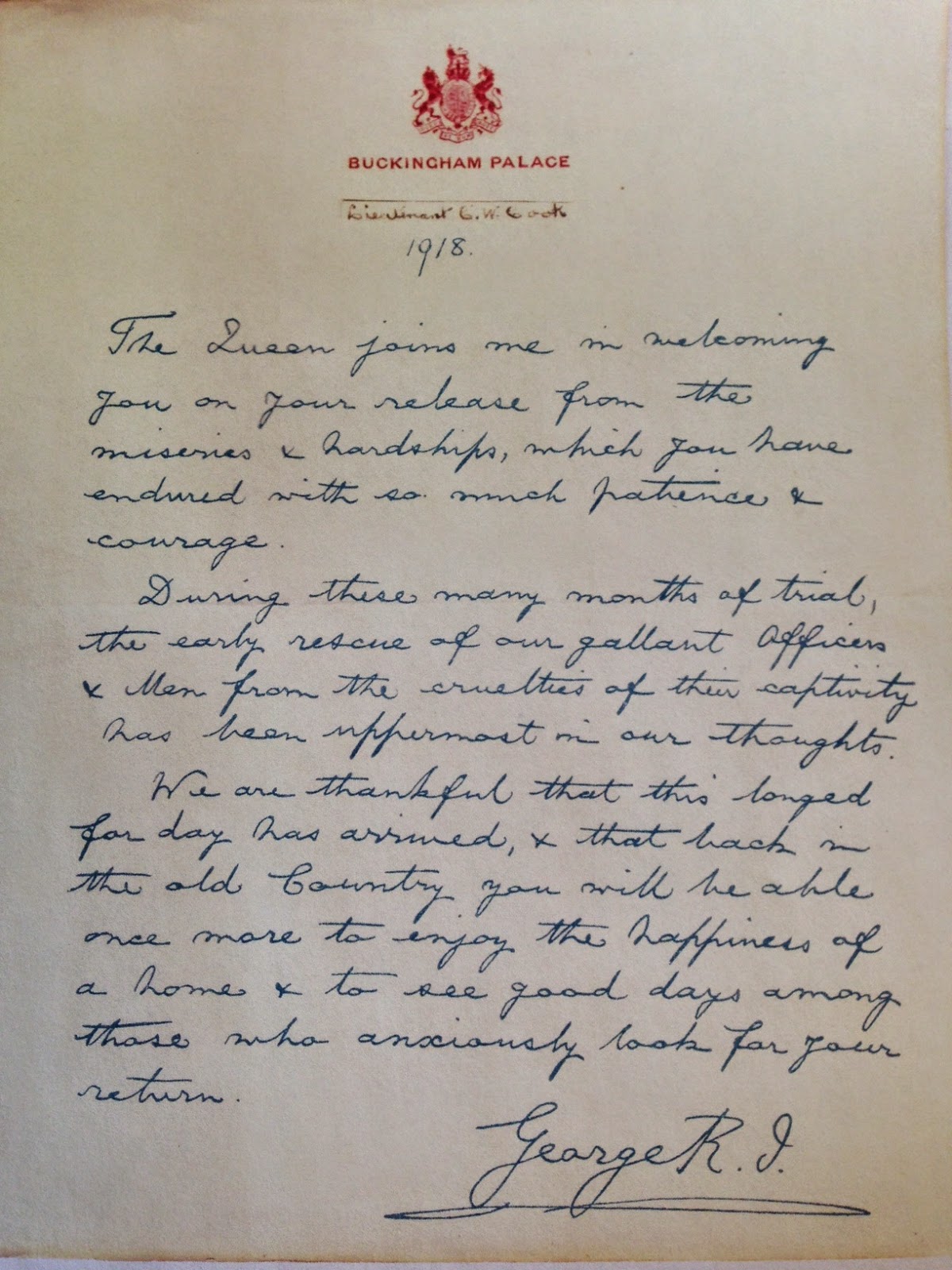
King George V's letter to Commonwealth POWs.
*****

Several post-war events suggest that Clarence quickly settled into civilian life.  On June 18, 1919, he married Gladys Henrietta Eaton, a native of Granville Centre, Annapolis County.  The ceremony took place in Gladys' hometown, after which the newlyweds settled in Parrsboro, where Clarence commenced service as a Baptist minister.

After three years in the small Minas Basin community, Clarence decided to return to school, completing studies for a Bachelor of Divinity degree at Newton Theological Seminary, Massachusetts from 1922 to 1924.  During their time in the United States, Gladys gave birth to the couple's only child, Murray Eaton Cook.

Following graduation, Clarence returned to Nova Scotia, tending to the spiritual needs of Maritime congregations for more than three decades.  He served the first three years at Milton, Queens County (1924-27), followed by eight years in Canning (1927-35) and five years in Kingston, NS (1935-40).

During the 1940s, Clarence and his family relocated to Summerside, PEI (1940-44) and Quebec City, PQ (1944-48), subsequently returning to Nova Scotian congregations at Berwick (1948-55) and Chester (1955-60).  After 36 years in ministry, Clarence retired to Canning, NS, where he was appointed Honorary Pastor of the community's United Baptist Church.

His obituary describes Clarence as "a faithful preacher of the Gospel and a devoted and conscientious pastor".  His wartime experience no doubt shaped his particular interest in conflict resolution, a task to which Clarence committed himself throughout his ministry.  He also took a special interest in the congregation's youth, often spending his brief summer vacations as a leader at youth summer camps.

Rev. Clarence William Cook in later life.
Sadly, Gladys and Clarence's later life was touched with tragedy.  Their son, Murray, followed in his father's footsteps, graduating from Acadia University in 1943.  He subsequently enlisted with the Royal Canadian Air Force upon graduation and served overseas as a pilot.

Upon returning to Canada, Murray completed a Forestry program at the University of New Brunswick and was hired by Price Brothers Pulp and Paper, a large Quebec company.  He married Alice Avery, a native of Hartland, NB, and the couple soon gave Clarence and Gladys their first grandchild, Jane, in 1948.

In November 1949, Murray and a co-worker were navigating Quebec's Chicoutimi River on a surveying expedition for Price Brothers.  Tragically, their canoe overturned and both men drowned.  Murray was laid to rest in Willowbank Cemetery, Wolfville, NS.

Clarence was also an active member of the communities in which he ministered.  A member and Past Master of Markland Masonic Lodge, Kingston, NS,  he was also a member of the Royal Canadian Legion, serving as Chaplain of its Habitant Branch at Canning, NS in his later years.

Clarence William Cook passed away at his Canning, NS hoe on July 13, 1961.  He was laid to rest beside his son, Murray, in the Cook family plot, Willowbank Cemetery, Wolfville, NS.

*****

Sources:

Hogan, David B..  "The Eventful History of the Number 9 Stationary Hospital (St. GFrancis Xavier University), Canadian Army Medical Corps (1916 - 1920)".  Annals of the Royal College of Physicians and Surgeons of Canada, Volume 28, No. 6, September 1995.

Hunt, M. S.. "No. 9 Canadian Stationary Hospital." Nova Scotia's Part in the Great War.  Halifax, NS: The Nova Scotia Veteran Publishing Co., 1920.  Available online.

Raleigh, Walter & H. A. Jones.  The War In the Air: Being the Story of the part played in the Great War by the Royal Air Force, Vol. IV.  Oxford: Clarendon Press, 1934.  Available online.

Service Record of 2nd Lieutenant Clarence William Cook.  Library & Archives Canada, Ottawa: RG 150, Accession 1992-93/166, Box 1939 - 32.  Available online.

Special thanks to Clarence's great-nephew, Chris Cook of Linwood, NS, who graciously provided a copy of Clarence's Royal Flying Corps service file, pictures and information about his post-war life.