Contact Information

E-mail: brucefrancismacdonald@gmail.com

Friday, 31 July 2015

Private Henry Scott Hart - A 193rd Battalion Soldier's Story

Date of Birth: March 24, 1896

Place of Birth: Canso, Guysborough County, NS

Mother: Ella Blanche Smith

Father: Major George Wilberforce “Will” Hart

Occupation: Insurance Clerk

Marital Status: Single

Enlistment: March 20, 1916 at Truro, NS

Regimental #: 901389

Rank: Private

Force: Canadian Expeditionary Force (Infantry)

Units: 193rd Battalion; 17th Reserve Battalion; 85th Battalion (Nova Scotia Highlanders)

Service: England & France

Next of Kin: Major George W. Hart, Canso, Guysborough County, NS (father)

Scott’s older brother, Levi Martin “Lee” Hart, enlisted with the 152nd Battalion at Weyburn, SK on June 5, 1916 and was killed in action at Vimy Ridge, France on April 9, 1917 while serving with the 5th Battalion (Western Cavalry).

*****

Henry Scott Hart was the fourth of six children—three sons and three daughters—born to George Wilberforce “Will” and Ella Blanche (Smith) Hart of Canso, NS. A native of Guysborough County, Will served with the 66th Regiment, Princess Louise Fusiliers, rising to the rank of Major before retiring to Canso, where he established a mercantile business. Will and Ella’s first two children—Levi Martin “Lee” and Louisa—were born while the couple resided in Halifax, the remaining four arriving after they moved to Canso.
Private Henry Scott Hart.
The second of Will and Ella’s three sons, Scott left school at age 12 after completing Grade 6. Despite his limited schooling, Scott’s letters to his family during military service display competent writing skills and he was an avid reader throughout his life.

Sometime after 1911, Scott took up residence on Victoria St., Truro and commenced employment with W. P. King & Company, a local insurance broker. A town of considerable size in comparison to Canso, military recruiters seeking enlistments for Nova Scotia’s earliest infantry battalions visited Truro. The 106th Battalion (Nova Scotia Rifles), authorized on November 8, 1915, actually established its headquarters in the town. Scott attempted to enlist with the unit the following month but was declared medically unfit, due to poor eyesight.

Undaunted, Scott attempted to enlist with the 193rd Battalion, authorized on January 27, 1916 and also headquartered at Truro. On this occasion, he passed the initial medical examination and formally attested for overseas service on March 20, 1916. Subsequent correspondence with his parents, however, indicated that Scott continually worried that his vision problems would prevent service at the front.

On April 4, Scott informed his older brother, Lee—now a real estate agent in Weyburn, SK—of his enlistment. Perhaps spurred on by Scott’s example, Lee joined the 152nd Battalion at Weyburn on June 5, 1916. While the siblings communicated by letter during subsequent months, they were not destined to meet again face to face.

Meanwhile, Scott wrote to his mother, Ella, on May 17, informing her that he was spending considerable time at “A” Company’s Truro headquarters, while still working in King’s insurance office. He had received his Balmoral cap but was uncertain as to when the battalion would relocate to Camp Aldershot, near Kentville, NS. When the 193rd received orders to report to Aldershot for training at month’s end, Scott became a full-time soldier.

 *****

Initially conceived as a Cumberland - Colchester County unit, the 193rd Battalion became part of the Nova Scotia Highland Brigade in February 1916, at which time its recruitment area expanded to include the remaining parts of northeastern Nova Scotia—Hants, Pictou, Antigonish and Guysborough Counties. Boasting a complement of 1459 “all ranks”, its four Companies reported to Aldershot for a summer of intense training. The Camp also hosted soldiers from the Brigade’s three other units—the 85th (Nova Scotia Highlanders), 185th (Cape Breton Highlanders) and 219th (Annapolis Valley and South Shore) Battalions.

Throughout his time in service, Scott corresponded regularly with his parents and on occasion with his younger sister, Elsie. An August 23 letter to Will stated that he was “feeling well these days, [having] marched 21 miles last Wednesday with no ill effects.” As the battalion’s impending departure for England drew near, however, Scott was admitted to Rockhead Military Hospital, Halifax for treatment of tonsillitis.

A letter to Will, written on September 12, expressed a mixture of frustration and concern with his circumstances:

“I am still here at the hospital and nothing has been done for my throat yet…. I feel anxious to get back to Aldershot before the Battn [sic] moves [to Halifax) but Gov’t [sic] employees take thier [sic] time. At any rate, I am warm, dry and well-fed and receiving $1.00 per day so ‘I should worry’ for a week or so. There are some troopships in now, one anchored right off the hospital. I wish I was aboard and am a little afraid that I may miss the 193rd[’s departure].”

A second letter, dated September 29, reported little progress in resolving Scott’s situation:

“I am going out in a day or two. I’m very much disgusted at their methods of doing business down here and am going back without having my tonsils removed. Am afraid that the Battn. [sic] will go over without me if I wait any longer…. Had a letter from Lee to-day, telling me about the same re: his expected move…. He ought to be well on his way by now. He will likely come to Halifax to embark. Western Battns. farther away than Camp Hughes {Manitoba] are passing by every few days. Hope I’ll not be rejected when it comes to the final exam, however I can’t help that.”

Scott’s closing comments reflect his ongoing fear that health concerns might prevent overseas service. As for Lee’s departure, his unit actually broke camp two days prior to Scott’s letter. Lee managed to make his way to Mulgrave, where he met with his parents and several other family members before reporting to Halifax for departure. Will and Ella later made their way to the city and watched from the dock as their first-born departed for England on board SS Missanabie.

In early October, Scott was discharged from Rockhead without having his tonsils removed and made his way back to Aldershot, where he described the 193rd’s final preparations for departure in an October 6 letter to Will:

“We are busy filling in our trenches and cleaning up to move…. We will likely leave for Halifax Wednesday and if you can manage as you did with Lee it might appeal to you as best. Would like to see mother and you before I leave, altho [sic] I think I’ll be rejected in England on account of my feet [Scott had developed a boil on his ankle several weeks earlier, while training].”

In the end, Scott passed the final medical examination and was amongst the 193rd soldiers boarding SS Olympic at Halifax, NS on October 12. Six days later, the vessel arrived in England and Scott followed the battalion to Witley Camp, Surrey. He updated his parents on his circumstances in a letter dated October 21:

“Arrived in due course and little the worse for wear considering. Proved a much better sailor than I expected. Things are rather strange here and in some ways out of date but the camp is good and I anticipate being pretty comfortable here…. The ‘warmth’ of the English climate is decidedly chilly so far and I am somewhat disappointed. Have not been out of camp yet but hope to go out tomorrow and see what is going on.”

Scott was fortunate enough to obtain a six-day pass to London, describing his visit in an October 28 letter to Ella:

“Saw quite a lot of the city this morning…. We were lost for an hour or so at times but managed to get home again without asking the way. Am a little disappointed that the streets are so narrow and that there seems to be a lack of sky scrapers to match the Yankees’ but am perfectly satisfied with the ‘Bobby’ [-] he is the last word in dignity and impressiveness. Our N. S. police would fade into insignificance alongside of him. His attitude and expression as he halts the traffic has the Sergeant-Major ‘skeen a mile’ [sic] and I watch him with awe. The buildings altho [sic] not so awfully high go down into the ground quite a piece and are artistic and solid looking…. Sometimes the number in one row is quite impressive.

“Saw some of the Home Offices of the big Ins. [sic - Insurance] Companies this morning, which was interesting. The streets are crowded with motors and big horses and in and out among them the inevitable donkey…. The streets are all darkened at night and it is wonderful how accidents are averted but the drivers are very skilful and seem to get along.”

The 193rd’s soldiers and their Highland Brigade comrades trained at Witley Camp throughout the remainder of the year, rumours constantly circulating as to their departure for the front. Significant Canadian Corps casualties at the Somme during the autumn of 1916, however, created an urgent need for reinforcements and raised questions as to the future of battalions arriving in England at that time.

Scott speculated on the 193rd’s fate in a December 5 letter to Will, written after two week’s quarantine due to a case of chicken pox in its ranks. He hoped to leave for France within a week, and was “taking [his] final shooting or rather musketry training now, expect to complete it tomorrow.” The Highland Brigade “seems to be broken up” as military officials contemplated dissolving some of its battalions and reassigning their soldiers to existing units. Scott adopted an objective perspective on the 193rd’s fate:

“It would be nice to go as a unit in some ways but I think it unwise from a military standpoint to put a lot of raw men into battle together when they could be mixed with veterans just as well as not… I applaud the War Office’s action in drafting us and feel sure that more boys will go back [home] because of it.”

Concerns about his vision still weighed heavily on Scott’s mind:

“Am a little afraid that I won’t see the front. The eye test is severe and I’ll likely get guard duty in England or France for a while at least, but hope to pass.”

The battalion spent another two weeks in quarantine as a result of a second chicken pox case in early December, being released from barracks just prior to the Christmas holiday. By that time, Scott had received news of Lee’s deployment with the 5th Battalion (Western Cavalry) in France, commenting that he “heard from him frequently.”

By year’s end, military officials decided to dissolve the 193rd, immediately transferring its most “battle ready” soldiers to several units at the front. Remaining personnel were assigned to the 17th Reserve Battalion, the unit that serviced Nova Scotian battalions at the front. Scott officially joined the 17th on January 23, 1917 and continued training, in hopes of selection for a future reinforcement draft.

A March 22 letter to his sister, Elsie, described Scott’s military routine:

“I am drilling pretty hard, have been marching 15 miles a day with pack and rifle to the ranges for the last two weeks and am feeling a great deal stronger… but don’t seem to get any fatter…. Most of the time off parade is taken up cleaning up for the next one and when I crawl into my bunk I don’t spend much time in congitation [sic - cogitation]. We have to get up at 6:30 in the morning (5:30 while going to the ranges) and between fixing up beds and blankets and equipment, shaving, washing and shining we are pretty well occupied until ‘cook house’ at 7:00 a.m.. I usually do my shining and shaving the night before and that eases matters a little. Our parade hours are 7:45 to noon and 1 to 5. I get pretty tired of it all and wish I could get away to France quick… but the discipline is good for a lazy man and so ought not to hurt me.”

Scott remarked that he was awaiting receipt of a new pair of “Kitchener” boots that would require “breaking in” before he’d be considered for “overseas service”. The new equipment must have arrived shortly afterward, as Scott was assigned to the 85th Battalion on April 21. He crossed the English Channel to the Canadian Base Depot (CBD) at Le Havre, France the following day, describing the experience in a later letter to Will:

“After a very enjoyable trip across the [English] Channel (more enjoyable than comfortable as we were pretty crowded)… we disembarked and marched to the Canadian base…. We were paid 25 francs at the base and issued with the final equipment, etc. [and] left the next day for ‘up the line’…. [We] had quite comfortable coaches and spent a couple of pleasant days in the train. France is very beautiful and the weather was fine[,] it hardly seemed possible that we were actually going to war. After we got to the rail-had we had a little walk around in a village[,] after which we marched to the Battn. [sic] billets.”

On April 25, Scott found a few minutes to update Ella on his progress:

“I’ve not been up to the firing line yet but I’m at the ‘front’ all right. We are billeted in a village or what must have been a village sometime in the past, perhaps it got hit by a cyclone or was wrecked in the war of 1870 [Franco-Prussian War]; I understand that there was some damage done at that time…. On the way over I met a chap from Lee’s Company and asked him to let Lee know that I was on my way to the 85th. I think I have a very good chance of seeing him.”

Unbeknownst to Scott, his elder brother had been killed on April 9, during the opening moments of the 5th Battalion’s advance at Vimy Ridge. It would be another month before Scott received the news in a letter from his parents. Meanwhile, he arrived in the 85th’s camp the following day. After more than one year’s training, Private Scott Hart was about to enter the trenches of the Western Front for his first “tour”.

*****

The 85th Battalion (Nova Scotia Highlanders) was authorized on September 25, 1915, under the command of Lieutenant-Colonel Allison Hart Borden. Within one month of its creation, the unit mobilized at Halifax, its ranks 200 men “over strength”. Training continued at the Halifax Armouries and on the nearby Commons throughout the autumn and winter of 1915-16.

Nova Scotian recruitment activities expanded in early 1916 with the formation of the Nova Scotia Highland Brigade, an idea first proposed by Lt.-Col. Borden. In May 1916, the 85th joined its Brigade mates at Camp Aldershot for a summer of intense training. The four battalions boarded SS Olympic at Halifax on October 12, arriving in England six days later. While military authorities dissolved two of the Brigade’s battalions—the 193rd and 219th— during the winter of 1916-17, its two remaining units—the 85th and the 185th (Cape Breton Highlanders)—were maintained.

As the Brigade’s senior unit, the 85th’s soldiers had 16 months’ training under their belt as they crossed the English Channel to France on February 10, 1917. After completing preliminary tours in the trenches near Gouy Servins and Bouvigny, France, the unit moved into “reserve” positions in support of the Canadian Corps’ scheduled attack on Vimy Ridge.

As an inexperienced unit, the 85th’s soldiers were assigned a variety of “non-combat” duties—carrying ammunition, constructing dugouts, maintaining communication trenches—during the April 9, 1917 assault. As the battle unfolded, however, German soldiers tenaciously clung to Hill 145, the ridge’s highest and most strategic location. In the early evening, two of the 85th’s Companies received orders to move forward and executed a successful attack on the position without the benefit of artillery support.

The 85th’s performance at Vimy Ridge demonstrated its readiness for combat. Shortly after retiring from the firing line on April 14, the battalion was assigned to the 4th Canadian Division’s 12th Brigade, in place of the 73rd Battalion (Royal Highlanders of Canada), which was dissolved on April 19 to provide much-needed reinforcements its two “sister” units, the 13th and 42nd Battalions. The Nova Scotia Highlanders subsequently served alongside the 38th (Ottawa), 72nd (Seaforth Highlanders of Canada) and 78th (Winnipeg Grenadiers) Battalions for the war’s duration.

At the time of Scott’s arrival on April 26, the 85th was deployed in the Zouave Valley, France, its soldiers occupying a section of the front line along the Lens - Vimy Railway. The unit was relieved two days later and moved into Brigade Support on the outskirts of Givenchy. During the afternoon, five of “D” Company’s soldiers were killed by an artillery strike, the first casualties recorded after Scott’s arrival.

Private Henry Scott Hart - 193rd Battalion Portrait.
Over the following days, the unit’s soldiers provided work parties for front line and road repair, its war diary commenting: “No training possible at all here [Givenchy] as billets are under direct observation so that there can be no movement by daylight.” Scott described his initial experiences in a later letter to Will:

“[I] had a couple of days rest before we went into the actual firing line. Of course[,] the billets are in the firing zone and exposed to artillery fire, if the enemy likes to bombard them. I was actually in the line three days. Went in on the night of April 30th, the next day I spent cleaning out German dug-outs and burying ‘Heinies’ taken from therein. We rested the next day… [and] tried to dig trenches the next night… It’s a funny feeling crouching down in a shallow trench[,] trying to dig out a little mud and chuck it out without attracting attention and every few minutes comes the ‘tack-tack-tack’ of a machine gun and up will go a German star shell for another look. The display is very beautiful and awe-inspiring and to add to the splendour, there were some large fires in nearby cities behind the enemy lines.”

Scott followed the 85th into the front trenches during the night of May 2/3, in relief of the 78th Battalion. The process was not without incident: “During the relief the enemy shelled the vicinity heavily with whizz-bangs [artillery shells].” While a subsequent war diary entry stated that “no casualties resulted”, Scott’s correspondence with Will indicates otherwise:

“I was hit at 3.30 a.m. in the morning [May 3], didn’t know I was hit at the time, had a severe pain in my side and shoulder but thot [sic] I was only bruised as I had been half buried a few minutes before by a shell; however[,] I found on enquiry that I was wounded and beat it for a dressing station.”

Scott was admitted to No. 8 Canadian Field Ambulance (CFA) and subsequently transferred to No. 12 CFA and No. 22 Casualty Clearing Station (CCS) before day’s end. The following day, 2nd Ambulance Train transported him to No. 35 General Hospital, Calais, France, where he was admitted for treatment of shrapnel wounds to his back.

On May 5—his first full day in hospital—Scott wrote to his parents, informing them of his situation:

“I was slightly wounded. I got two little bits of shrapnel in my back on the morning of the 3rd and a pretty good shaking up but there is nothing to be alarmed at…. Can move myself around in bed but can’t sit up very well. Am getting the very best of care possible.”

After recovering sufficiently to travel, Scott was invalided to England on May 14 and admitted to General Military Hospital, Colchester the following day. Medical records describe the extent of his injuries at the time of his arrival:

“GSW [gunshot wound] Back, penetrating lung…. Small wound penetrating back lt. [left] chest, haemoptysis [coughing up blood] 5 days duration. X-ray does not show any F.B. [foreign body].”

The day after admission, Scott wrote his parents, providing a more detailed account of his condition and the circumstances in which he was wounded:

“I am feeling pretty good now and I think I would be able to walk around, and hope to be up soon. My wounds are small and give practically no pain. I was hit by shrapnel in the back (was not running away, ‘Heinie’ slipped a shell over behind me), two entrances, one on each side. The one on the right side is just a skin wound and better already[,] the other no deeper and will take a little while longer to heal…. Neither one gives me much discomfort and I move all around the bed.”

Still unaware of Lee’s death, Scott planned to write his brother, describing his situation.

Ten days later, Scott received a visit from a local Red Cross volunteer, who informed the family that he was up and out of bed, “looking well and in no pain. The bullet which entered his back, also touched his left lung, but we know how thankful you must be to know that he seems to be progressing satisfactorily.”

Before month’s end, Scott told Will that he expected to move to a convalescent home in a few days and was “coming along fine”. After rising early, he passed the day on the hospital grounds, “which are very beautiful…. My wounds are practically healed now but my left chest where one piece of shrapnel penetrated is still sore and it will take a month or so to fix me up again.”

Scott was discharged to the Canadian Divisional Convalescent Hospital, Woodcote Park, Epsom on May 31. That same day, letters from home finally caught up to him and Scott learned of his older brother’s fate. He described his feelings in a letter to his parents, written the following day:

“I feel absolutely stunned and don’t know what to write… but we must keep thru [sic] it all the thot [sic] uppermost in our minds that he died as behooved a Christian and a gentleman—in defence of the principles in which he believed and for which he voluntarily offered to make the supreme sacrifice if necessary.”

By coincidence, Scott received his wounds“at Vimy, about six miles from Fresnoy and about 1 to 2 miles (likely) from where Lee was killed.”

As the days passed, Scott slowly recovered his strength, writing to Will and Ella on June 10:

“[I am] feeling much better now and am wearing my uniform again insted [sic] of Hospital ‘Blues’. Was out to the town of Epsom (about 2 miles away) today for the second time. So you can see I’m pretty strong again.”

The following day, an earlier ailment returned as Scott was “transferred to Orpington [Military Hospital, Orpington, Kent] for removal of tonsils.” A medical report shortly after his arrival indicated that he was suffering from a sore throat, cough with phlegm and “poor” lung expansion. Scott had also lost weight during his hospitalization. His tonsils were “enucleated” and a subsequent test of his sputum showed no signs of tuberculosis.

Medical personnel at Orpington also conducted a series of X-rays, successfully locating “two minute particles of metal above the eleventh rib 1/2” from the vertebral articulation” and a “piece of foreign matter of low density 1/4” x 1/4” about 1 1/2” above” the first objects. Scott provided an update on his circumstances in a July 25 letter to Will:

“I am feeling much better as the days go on. I feared for a while that I might have to have an operation to remove some particles of shrapnel from my chest, but the danger is completely past now. I think I have a couple of more weeks rest and then I’ll be able to go back to duty again, but there is a chance that I would have to go on Active Service again.”

In mid-August, Scott penned a note to his sister, Elsie:

“The doctors here are of the opinion that I will not have to have any more metal removed. I never had any taken out of my left side and the wound on the right was only superficial and was cured in about 2 weeks. There are still two minute particles and one small piece (1/2 in. x 1/4 in.) of shrapnel in my left chest but the doctors here have decided that they will give me no trouble…. I feel no pain, am not even sore in any place, in fact I never felt better in my life; except that I’m soft.”

By this time, the likelihood of his returning to the line appear to have diminished considerably: “I’m told that I won’t likely be classed fit for General Service while I have a piece of Krupps steel in my person.” In the meantime, Scott was “working in the Medicine room… ward”, where he was “ learning a lot about sterilization, drugs and dressing wounds.”

Before month’s end, hospital personnel assessed Scott’s condition as “Improved, Class C”—free from serious illness and fit for home garrison service— and discharged him to the Canadian Convalescent Home, Bromley, Kent. Scott described his new surroundings in an August 29 letter to Will:

“It used to be a Hotel and a pretty swell one…. We have a fine billiard table, a couple of pianos, books, etc. and are allowed out from 2 p.m. until 9:30 p.m. so manage to pass the time pleasantly…. [The] Hotel Chef is still on the job and consequently our food is well cooked. I have had bad cooking so much since I joined the Army that I appreciate his work.”

During Scott’s recovery, a Medical Board regularly assessed his condition, placing him into one of several categories. On September 18, Scott updated Will on the most recent report:

“[I] had a ‘Medical Board’ and am classified ‘B 3’ - Clerical Work in England or France. I will probably stay in England but would just as soon go to France [as] it would be interesting over there and amounts to precisely the same thing as far as hazard is concerned. I am not able to carry a pack or do manual labor and had I not been rated as a Clerk I would have been invalided to Canada.”

A second Medical Board, convened at Bromley on September 25, described Scott’s condition at the time: “Soldier feels well except for slight pain or soreness in left chest after exertion, shrapnel still in chest.” While he had a “slight cough”, his lungs were “normal and healthy”. The Board concluded that Scott was “not likely to be raised in category inside of six months” and classified him as “C III”—“Fit for temporary Base Duty.”

Scott remained at the Canadian Convalescent Hospital throughout the following month, taking the opportunity to visit the nearby towns of Catford and Lewisham. He described several recent experiences in an October 2 letter to Elsie:

“I can always go down… [to Catford and Lewisham] for an evening if I find the time hanging on my hands, heavy. We are in the period of the harvest moon just now and are having an air-raid nearly every night. ‘Fritz’ was over the last three nights in succession and I expect he’ll come tonight again. They give him a pretty hot reception and the sky is very pretty with bursting shells from the ‘anti-aircraft’ guns. He has to pass right over us to get to London so we see all the fun. At the same time we are in practically no danger as he does not waste his bombs on a small town.”

Scott was discharged from hospital on October 30 and reported to the Nova Scotia Regimental Depot. Apparently, military authorities had decided not to assign him to clerical duties in England or France, as five days later he was transferred to the Canadian Discharge Depot, Buxton, where he awaited “embarkation to Canada.”

Scott departed England shortly afterwards, arriving in Halifax on November 14 via SS Olympic and immediately proceeding to the Military Hospital Convalescent Center’s “B” Unit. Before day’s end, he sent a telegram to Will: “Arrived Hfx the morning more later love to all, H. Scott Hart.”

A Medical Board convened at Halifax described Scott’s disabilities: “GSW [gunshot wound] back puncturing left lung. Weak eyes.” He still experienced pain in his side when breathing deeply or after exertion. His eyes also caused severe pain when reading. While there was a small scar three inches below his left scapula, “no physical signs [are] evident. Shrapnel still present.” Scott wore glasses and had experienced visual difficulties previously, “but not to [the] same extent”.

The Board assessed Scott’s “degree of incapacity” as 30 %, stating that it was due to his military service and “indefinite” in duration. As a result, the Board concluded that Scott was “permanently unfit for Military Service” and recommended placement in a Convalescent Home, pending discharge.

After a brief visit to Canso, Scott was admitted to Camp Hill Hospital, Halifax as an “in-patient” on December 1. Five days later, Scott and his hospital mates gathered in their ward’s Common Room in the morning, having just finished breakfast. According to an account provided by family, Scott was standing near a window when he heard a whining rush of wind. Familiar with such sounds from his days in the firing zone, he instinctively covered his face with his hands and dove for cover.

A massive, explosive force struck the building, knocking out its windows. Remarkably uninjured, Scott managed to get to his feet and clamber through the debris into the street. His immediate thought was the safety of family members who lived nearby—Reuben Proctor, an uncle by marriage, lived at 192 Gottingen Street, close to North Street Station. As he made his way toward the neighbourhood, he recognized none of the familiar landmarks.

When Scott arrived at Reuben’s house, he found the structure completely flattened and apparently empty. Searching among the rubble, he came across his cousin, Ralph, who was attempting to get the family car out of the garage. Amazingly, the structure had not been damaged in the blast. Upon retrieving the vehicle, Ralph and Scott made their way along the streets, where passable, and were soon commandeered to carry wounded civilians to a first aid station hastily erected on the Commons.

All day long, the cousins made trips from the devastated areas along the waterfront to the Commons. Late in the afternoon, the sound of a baby’s cries drew them into a damaged building. Scott entered the premises and found a severely injured, five-month-old infant. As he carried the baby from the house, it died in his arms. Exhausted from the day’s physical and emotional toll, Scott collapsed on the sidewalk.

Ralph managed to load Scott into the car and the pair drove to their maternal grandmother’s home on Edward Street. They found the house intact, having sustained only a few broken windows. Mrs. Martin Smith—Ella’s mother—and her daughters, Olive and Claudia, put an exhausted Scott to bed.

Meanwhile, in Canso, Ella and her daughter, Narrie, were cleaning up after breakfast as the day began. The dishes and windows suddenly rattled, a tremor shook the floor, and the faint echo struck their ears. When news of the Halifax explosion reached the community shortly afterward, Ella frantically attempted to contact Scott and her Halifax family, without success.

For two days, the fate of her son, mother, sisters and in-laws remained unknown. Finally, a telegram arrived at the Hart household late in the afternoon of December 8: “Reuben badly cut rest of us virtually uninjured scott [sic] quite safe city virtually wrecked.” Scott carried the memory of that experience—particularly the baby’s death in his arms—for the remainder of his days.

Scott remained in Halifax following the explosion, awaiting a final decision on his future. A Case History Sheet, dated February 28, 1918, summarized the results of his most recent medical examination. Scott still experienced chest discomfort—a “dull pain over 5th rib (rt.)”—although there was no tenderness to pressure. The pain worsened after physical exertion. Doctors also noted that Scott had a “marked myopia.”

A final medical report, dated March 2, remarked that his “eyes are quite comfortable” when Scott wore his glasses. The report concluded:

“No muscular weakness can be demonstrated. This man has also a well marked myopia, which is corrected by glasses, and which does not contribute to his incapacity to any appreciable extent.”

While the report recommended that Scott be retained for military service at home, superior officers apparently did not concur. On March 13, 1918, Private Henry Scott Hart was discharged at Halifax, “being no longer physically fit for war service.”

*****

Despite an offer of employment in Halifax, Scott returned home to Canso, where he bought some cattle and—following in his father’s footsteps—operated a local general store. On January 10, 1933, he married Mary Casey, a native of Port Felix. Together, they raised a family of five children—four sons and one daughter—in their Canso home. His children have fond memories of a kind, patient father who possessed a dry sense of humour and a gigantic heart.

Mary and Scott Hart at daughter Phyllis's wedding.
Scott’s business venture struggled through the Great Depression’s hard times and he eventually accepted a position as Canso’s town clerk and magistrate. His eldest son, Sidney, eventually assumed control of the business, Scott returning to assist after he retired from his municipal position.

As a former soldier who had lost an older brother in combat, Scott was particularly interested in preserving the memory of those who served and assisting veterans who had returned to civilian life. He played a prominent role in the establishment of the Royal Canadian Legion’s Canso Branch, serving as its first President. His wife, Mary, was active in the Ladies’ Auxiliary, later earning the organization’s Meritorious Service Award.

An avid reader, Scott obtained a personal set of law books and quickly earned a local reputation as a “self-educated lawyer”. Residents regularly visited the Hart home in search of legal advice or information. All who called upon Scott received a most cordial welcome.

Scott became a respected member of the community, easily identified by his daily attire of shirt, tie and hat. His daughter, Phyllis, reports that he even kept a can of salmon in reserve for Roman Catholic visitors who might happen to arrive at mealtime on a Friday!

Henry Scott Hart passed away at Aberdeen Hospital, New Glasgow, on August 30, 1974, five months past his seventy-eighth birthday. He was laid to rest in Fourth Hill Cemetery, Canso.

*****

Sources:

Service file of Private Henry Scott Hart, number 902389. Library & Archives Canada, Ottawa: RG 150, Accession 1992-93/166, Box 4118 - 46. Attestation papers available online.

War Diary of the 85th Canadian Infantry Battalion. Library & Archives Canada, Ottawa: RG9, Militia & Defence, Series III-D-3, Volume 4944, Reel T-10751-10752, File: 454. Available online.

A special thank you to several of Scott Hart’s descendants and relatives who provided valuable resources and information for this post. His daughter, Phyllis Hart Kupsch, Drayton Valley, AB contributed a post-war photograph and information on Scott’s post-war life. Relatives Jean (McPhee) Doane, South Maitland, NS, Diana (Bushell) Geil, London, ON and Andrea (Geil) Lee, Markham, ON graciously provided access to the Hart family correspondence.

Tuesday, 30 June 2015

Private Dennis Simon Levangie - A Canal du Nord Soldier's Story

Date of Birth: April 30, 1889

Place of Birth: Port Felix, Guysborough County, NS

Mother: Bridget Gerroir

Father: Philip Levangie (Levandier)

Occupation: Stoker

Marital Status: Single

Enlistment: March 20, 1918 at Halifax, NS

Regimental #: 3181772

Rank: Private

Force: Canadian Expeditionary Force (Infantry)

Units: 1st Depot Battalion, Nova Scotia Regiment; Royal Canadian Regiment (RCR); 2nd Battalion (Eastern Ontario)

Service: England & France

Next of Kin: Philip Levangie, Port Felix, Guysborough County, NS (father)

* The 1891, 1901 and 1911 Canadian census records and Dennis’ service file list the family surname
as “Levangie”, while 1921 census records the surname as “Levandier”.

*****
 
Dennis Simon Levangie was the second of three children—two sons and one daughter—born to Philip and Bridget (Gerroir) Levangie of Port Felix, Guysborough County. According to family sources, Dennis spent several years in Boston, Massachusetts prior to the First World War. The 1911 Canadian census lists Dennis as a boarder in the New Glasgow, NS household of Ellise Gerrior—possibly a relative of his mother’s—while working in a local paint shop. It is not known whether he resided in the United States prior to or after this time.

Dennis (left) and Nellie Levangie with their youngest son Earl in Port Felix (1956).
Shortly after the outbreak of war in Europe, Dennis relocated to Halifax, where he worked for three years as a stoker on a Canadian naval ship. While his military attestation papers list his address as “Hopper Barge # 2, HMCS Dockyard, Halifax”, Dennis did not formally enlist in the Royal Naval Canadian Volunteer Reserve. As a result, he was amongst the many young men of his generation deemed eligible for conscription after the Canadian Parliament passed the Military Service Act in August 1917.

The Canadian government commenced registering eligible males before year’s end and began “calling up” conscripts in January 1918. Dennis received his medical examination at Halifax on March 19, 1918 and completed his enlistment papers the following day. In less than three weeks, he was on his way across the North Atlantic Ocean, departing Halifax aboard SS Metagama on April 7 and arriving at Liverpool, England 12 days later.

Dennis was immediately assigned to the 17th Reserve Battalion—the unit that serviced Nova Scotian battalions at the front—and reported to Bramshott Camp. He spent the summer months in England, crossing the English Channel to the Canadian Base Depot (CBD) at Le Havre, France on September 5. Dennis was initially assigned to the Royal Canadian Regiment (RCR). Within less than one week, however, he was transferred to the 2nd Battalion and left to join his new unit in the field on September 11.

*****
 
The 2nd Battalion (Eastern Ontario) was formed at Valcartier, QC in August 1914. It drew its initial members from local militia units across the entire province of Ontario and parts of Quebec. The unit boarded SS Cassandra at Quebec City on September 22, 1914 and sailed to the Gaspé Peninsula, where the vessel lay at anchor awaiting further orders. The ship finally departed for overseas on October 3 as part of the First Canadian Contingent, arriving at Plymouth, England on October 25.

The unit spent several months training in England, during which time it was assigned to the 1st Canadian Division’s 1st Brigade, alongside the 1st (Ontario Regiment), 3rd (Toronto) and 4th (Central Ontario) Battalions. The 2nd Battalion officially “mobilized for war” on February 8, 1915, crossing the English Channel to France with its Brigade mates.

The battalion first entered the trenches near Armentières, France on February 19. Shortly afterward, its personnel relocated to Belgium’s Ypres Salient, receiving their first major combat experience during the Second Battle of Ypres (April 22 - May 25, 1915). An astounding 543 of its soldiers were killed or wounded during the month’s fighting.

After rebuilding its ranks, the 2nd served on rotation in the Ypres Salient for fifteen months, following the Canadian Corps south to the Somme region of France in the autumn of 1916. During the following year, its soldiers fought at Vimy Ridge, France (April 1917) and Passchendaele, Belgium (November 1917), returning to France for the winter of 1917-18.

After Allied forces successfully withstood the massive German “Spring Offensive” (March - April 1918), the 2nd Battalion was amongst the Canadian units launching a major counter-attack at Amiens, France on August 8, 1918. Before month’s end, its soldiers once again saw action during the battle of Arras (August 26 - September 3).

Hard-hit by two major engagements in such a short time period, the 2nd retired from the firing line on September 4, relocating to Agnez-lès-Duisans, France for re-organization and training. On September 10, a group of 45 “other ranks” (OR) reinforcements arrived in its camp. Five days later, the unit relocated to Croissilles, its war diary observing: “From 9:30 [p.m.] to the early hours [of the morning] enemy machines were dropping bombs in the vicinity of the camp.”

The battalion spent the following day preparing to return to the line, once again enduring considerable German fire: “At night the enemy put over a large number of gas shells, and in addition, bombs were dropped by him. Hot and misty during day, heavy thunderstorm at night.”

2nd Battalion CEF badge.
On September 17, personnel engaged in Lewis Gun, musketry and anti-gas training as three new OR joined the battalion. Two days later, a larger party of 30 OR reinforcements arrived in camp. Private Dennis Levangie was amongst the 33 new arrivals and settled into the daily training regimen as the 2nd prepared to return to the line later in the month.

After a break for Divine Services and baths on September 22, the 2nd’s soldiers practiced attack strategies and carried out physical training the following day and attended an evening band concert. Meanwhile, the unit’s Officers visited the front area in preparation for their next assignment—an attack on the strategic Canal du Nord, on the outskirts of Cambrai, France.

During the subsequent days, “special attention was paid to the different battle formations, intervals, time, etc..” At 7:30 p.m. September 26, personnel moved off to the Assembly Area in preparation for combat. Its war diary reported “very little hostile shelling…[,] the move completed without casualties.”

Each soldier was outfitted with two bottles of water, two sandbags, 220 rounds of ammunition and two days’ rations in preparation for the following morning’s attack. The 1st Brigade’s orders instructed its battalions to “break the enemy defensive line on the Canal du Nord, east of Inchy[-en-Artois], and advancing northeast, establish a position on the high ground which runs north from the north-eastern spur of Bourlon Wood, astride the Arrras-Cambrai Road.” Dennis was about to receive his first combat experience on the Western Front.

Plans for the initial stage “resembled a trench to trench attack, but the nature of the ground and the incomplete conditions of the enemy defensive lines seemed to determine that the attack would very rapidly develop into open warfare fighting.” The 2nd Battalion was assigned a reserve role, following the advancing 4th and 1st Battalions until the latter had captured its second objective. At that point, the 2nd and 3rd Battalions were scheduled to attack the third objective and “exploit to the Yellow Line.”

Light rain fell during the night, but conditions “became clear during the morning.” At precisely 5:20 a.m. September 27, the supporting artillery barrage “fell exact to the second and the attack commenced.” The unit’s war diary described the battle’s opening moments: “The intensity of our fire and the vigorous shelling of hostile battery positions permitted only a feeble retaliation. Battalion moved forward in ‘Diamond Formation’ by Companies at 10 minutes interval commencing at 6:40 a.m..”

A report appended to the month’s war diary provided a detailed description of the day’s fighting, observing that “Bourlon Wood could be distinctly observed” as the soldiers advanced. No. 1 Company set the pace, the whole battalion managing to cross the canal “without heavy loss” and gathering in a 2nd Assembly Area, in preparation for the attack’s second phase.

By 9:00 a.m., “the advance was… being harassed considerably by enemy shelling and machine gun fire…. The battalion however passed through the 4th [Battalion], on its objective, following closely upon the heels of the 1st. The shelling and machine gun fire increased in intensity and casualties were numerous.”

The 2nd’s soldiers moved forward at 10:00 a.m. as planned, “leap-frogged through the 1st Battalion and continued [the] advance.” In response, German forces established themselves along a railway embankment. The report described the ensuing fighting:

Canal du Nord today (April 2015).
“On the low ground west of the Railroad[,] the Battalion was suffering severe casualties by the infernal machine gun and trench mortar fire. This affected No. 1 Company particularly, who, having no Officers [remaining], and very few N. C. O.’s [non-commissioned officers,] were in a difficult situation.”

The ferocious fire stalled the unit’s progress until the 72nd Battalion—on its right flank—finally caught up to the advance and sent one of its Companies across the railway embankment. Its soldiers “enfiladed [the German] guns and permitted the advance to continue.” The 2nd’s soldiers moved forward at 12:30 p.m., No. 3 Company passing through No. 1, which retired to reserve.

At 6:00 p.m., approximately 200 German soldiers assembled for a counter-attack but were quickly dispersed with Lewis Gun and rifle fire. Fifty minutes later, the battalion received orders to “stand fast on their objective, and move forward the following day.” The remainder of the night passed quietly, allowing all wounded soldiers were evacuated for treatment by 10:00 p.m..

At 6:00 a.m. the following morning, the 4th Canadian Division passed through the 2nd Battalion’s outpost line and resumed the attack. The unit reported 15 field guns, 14 machine guns, two trench mortars and 75 prisoners captured in the previous day’s action. Its casualties consisted of one Officer killed and 15 wounded, while 24 OR were killed and 175 wounded during the September 27 advance. After spending the day “reorganizing and equipping”, the 2nd Battalion retired to reserve positions on September 29.

Dennis was amongst the 175 OR wounded during the fierce fighting at Canal du Nord. After receiving initial treatment at a regimental aid post and field ambulance, he was admitted to No. 33 Casualty Clearing Station (CCS) on October 1, suffering from a gunshot wound to his right arm and shoulder. Hospital records described his condition: “Bullet entered arm near shoulder, came out past chest opp. [opposite number] 10 rib.” Dennis reportedly “spit… blood for eight days… [and] blood was drawn off [his] chest twice.”  He also experienced shortness of breath, constant pain on his right side and rapid pulse.

The following day, Dennis was transferred to No. 7 General Hospital at Le Tréport, near Étaples, where he remained for 10 days before being evacuated to England. On October 13, Dennis was admitted to Nell Lane Military Hospital, Didsbury, Manchester, where he continued his recovery. Dennis was transferred to Woodcote Military Convalescent Hospital, Bear Wood, Epsom on November 2, where medical records reporting a full recovery by month’s end: “Feels fit. G. C. [general condition] good. Cat. [category] A.”

The November 11, 1918 Armistice meant that Dennis’ days at the front were over. He was formally discharged from hospital on December 4 and assigned to the 6th Reserve Battalion, Witley Camp, one week later. Dennis reported to Military District 6, Kemmel Park, North Wales, on December 27, “pending return to Canada.”

On January 9, 1919, Dennis boarded SS Olympic for the journey home. Upon arriving in Halifax eight days later, he reported to a local “Casualty Company”. On February 16, Dennis was formally discharged from the Canadian Expeditionary Force, listing his intended address as 2 Hurd St., Halifax as he returned to his pre-service occupation of “stoker”.

*****
 
The 1921 census lists Dennis residing in his parents’ Port Felix home with his younger brother, James. He may have briefly been home for a visit, as provincial records indicate that on July 26, 1921, he married Nellie George, a native of Queensport, Guysborough County, in a ceremony held at St. Patrick’s Roman Catholic Church, Halifax. The couple eventually returned to Port Felix, where they raised a family of seven children—four sons and three daughters.

Remembered by his family as a “joker” with a great sense of humour, Dennis worked at the local Co-op store and did carpentry jobs in the area to support his growing family. During the Second World War, he once again enlisted, although age made overseas service impossible. Instead, he served as a military driver in the Halifax area.

Dennis' First & Second World War service medals.
In his later years, Dennis suffered a stroke and endured a lengthy hospitalization. He passed away at Camp Hill Hospital, Halifax on September 9, 1974 and was laid to rest in Gates of Heaven Cemetery, Lower Sackville, NS.

*****
 
Sources:

Service file of Private Dennis Levangie, number 3181172. Library & Archives Canada, Ottawa: RG 150, Accession 1992-93/166, Box 5605 - 22. Available online.

War Diary of the 2nd Canadian Infantry Battalion. Library & Archives Canada, Ottawa: RG9, Militia & Defence, Series III-D-3, Volume 4914, Reel T-10706, File: 355. Available online.

Special thanks to Dennis’ grandson, Captain Douglas Levandier of Oromocto, NB, who contributed background information, the post-war photograph and picture of Dennis’ medals.

Sunday, 31 May 2015

Lieutenant Catherine Nichols Gunn - A Nursing Sister's Story

Date of Birth: December 6, 1886

Place of Birth: East River St. Mary's, Pictou County, NS

Mother: Margaret McInnis

Father: William Gunn

Occupation: Nursing Sister

Marital Status: Single

Enlistment: January 1, 1917 at Calgary, AB

Regimental #: None (Commissioned Officer)

Rank: Lieutenant

Force: Canadian Army Medical Corps

Units: No. 1 Canadian General Hospital; No. 8 Canadian General Hospital; No. 3 Casualty Clearing Station; No. 2 Stationary Hospital

Service: England & France

Next of Kin: William Gunn, East River St. Mary's, Pictou County, NS (father)

None of Catherine's siblings enlisted for military service during the First World War. Neil—the oldest child—was born at East River St. Mary's, Pictou County, on June 23, 1882. He married Elizabeth "Libbie" (Mitchell) Fraser, daughter of Alex and Marie Mitchell, at Sherbrooke, NS on October 6, 1906. The couple was residing at Cleveland, Richmond County at the time of Neil's death on December 15, 1951. Neil was laid to rest in Aspen, Guysborough County.

*****

Catherine Mary Nichols Gunn was the third of seven children—four boys and three girls—born to William and Mary (McInnis) Gunn of East River St. Mary's, Pictou County. Catherine left home sometime before 1911, making her way to Seattle, Washington, where she completed a professional nurse's training program.

Lieutenant Catherine Nichols Gunn.
After she returned to Canada, as with so many of her generation, the outbreak of war in Europe impacted Catherine's life. She served as a Nursing Sister at a Temporary Military Hospital in Lethbridge, AB, before being "taken on strength" by the Canadian Army Medical Corps (CAMC) at Calgary on December 15, 1916.

Two and a half weeks later, Catherine attested for overseas service with CAMC. She departed Canada on February 3, 1917, arriving in England after a ten-day voyage. Four days later, Catherine commenced work at the Canadian Red Cross Hospital, Taplow, Warthanger, the first of several postings during her overseas service.

*****
As Canadian soldiers entered combat on the Western Front in late 1914 and early 1915, the Canadian Army Medical Corps developed a system to provide treatment for wounded and sick soldiers. Each battalion contained a Regimental Aid Post, staffed by its Medical Officers and Orderlies, providing immediate assistance on or near the battlefield. Once evacuated, a wounded soldier might be admitted to an Advanced Dressing Station—depending on the nature of his wounds—before proceeding to a Field Ambulance for assessment and further treatment.

Usually under cover of darkness, horse-drawn and motorized ambulances evacuated wounded soldiers to a Main Dressing Station, the first location at which medical treatment was recorded. Soldiers not requiring additional care made their way to Corps or Divisional Rest Areas for recovery. The remaining patients were transported to a Casualty Clearing Station (CCS), where they awaited evacuation to hospital.

CCS staff provided basic surgical treatment where necessary, usually evacuating patients to hospital by ambulance train within four days. CAMC operated two categories of hospital, distinguishable only in size and hence mobility. Stationary Hospitals initially housed 200 patients, while the larger General Hospitals accommodated 520 patients. By the end of 1915, CAMC officials doubled the bed capacity of both facilities. In total, CAMC staffed and operated four Casualty Clearing Stations, 11 Stationary and 16 General Hospitals in France and England by war's end, in addition to several Special Hospitals and Convalescent Depots.

Shortly after Britain declared war on Germany and Austria-Hungary on August 4, 1914, Waldorf Astor, son and heir of William Waldorf Astor, invited the Canadian Red Cross (CRC) to build a hospital on a portion of the family's Cliveden Estate, west of London, England. Initially named "Duchess of Connaught Hospital" in honour of Patricia, daughter of Canada's Governor-General, the facility opened its doors to patients in March 1915. The CRC initially staffed and equipped the hospital, which later adopted its name.

Canadian Red Cross Hospital, Taplow, England.
 The facility consisted of five pairs of wards, connected in a "butterfly pattern" by a central corridor that contained a large serving kitchen. A broad veranda on its southern side accommodated beds out of doors during the summer months, while windows allowed ample ventilation for indoor patients. The Astor family paid the cost of constructing permanent staff quarters—mostly small cottages—on the grounds. The hospital accepted its first Canadian patients in April 1915, primarily victims of the April 24 gas attack during the Second Battle of Ypres.

On April 27, No. 1 CGH's war diary recorded the arrival of its first significant convoy of 160 patients, "nine or ten simple fractures of the leg. An unusually high number of other fractures were from 3 to 4 weeks old and in bad position[,] requiring operative interference to rectify."

During its first full month of operation, staff performed 78 surgeries, including 23 "incisions and drainage of wounds", 18 "removal of shrapnel", 11 "delayed union of fibula and suture with kangaroo tendon."

Nursing Sister Catherine Nichols Gunn reported for duty to the Canadian Red Cross Hospital on February 17, 1917. An assignment in England was routine practice for new arrivals, as the patients provided experience in treating a variety of combat wounds. As might be anticipated, the workload increased with the arrival of spring and the resulting upsurge in fighting.

In May 1917, the hospital received 356 admissions—295 surgical and 61 medical—some patients arriving only three days after being wounded. The first convoy "after Vimy Ridge" involved a large number of rifle bullet cases, while succeeding convoys "contained terrific shell and shrapnel wounds of all kinds." Medical officials reported all wounds "in good condition on arrival. Wounds were well dressed."

The list of major surgeries performed during the month sheds light on the variety of injuries treated, as well as the required medical and nursing care—51 incision and drainage, 17 shrapnel removal, 13 excisions of scar and secondary nature, 20 "reamputation" of legs, arms or fingers.

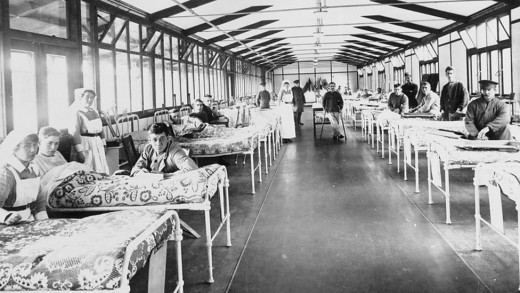
CRC Hospital Ward, Taplow, England.
 Some Nursing Sisters remained in England for the war's duration, while others moved on to facilities closer to the front lines. Such was the case for Catherine, who spend almost five months at CRC Hospital before receiving a transfer to No. 1 Canadian General Hospital on July 9, 1917. The following day, she proceeded to Folkestone, England for passage across the English Channel and reported to the hospital's facility near Étaples, France upon arrival.

*****
No. 1 Canadian General Hospital (CGH) initially assembled at Valcartier, QC and crossed the North Atlantic to England in October 1914 as part of the First Canadian Contingent. From October 20, 1914 to May 13, 1915, the unit operated a hospital on Salisbury Plain, catering to the medical needs of the Canadian soldiers encamped nearby. After crossing the English Channel, No. 1 CGH established a 1,400-bed facility—expandable in the event of a "super crisis" to 2,230 patients—at Trouville, near Étaples, France. Its patients were housed in canvas tents, a practice that quickly proved ill-suited to the coast's unpredictable weather.

The unit's July 9, 1917 war diary provided a description of the circumstances greeting Nursing Sister Gunn at the time of her arrival:

"Weather… bright and warm. The hospital grounds are looking very beautiful at this season of the year. The labours of the early spring are rewarded by the sight and fragrance of the many varieties of flowers which transform the central pieces of ground and beautify the spots for the patients who come to us."

Eight CAMC Nursing Sisters—a group that included Lieutenant Catherine Nichols Gunn—reported for duty on July 11, at which time the hospital contained 1,206 patients. The war diary described Catherine's first month at the facility as "fairly quiet…. Brilliant weather has prevailed most of the time, long warm days; cloudless blue skies; while the nights have been cool and refreshing."

During Catherine's first month in France, No. 1 CGH received a total of 1,356 "sick" and 872 "wounded" patients, 1,778 of whom were transported to England for further treatment. A total of 332 soldiers were discharged to a nearby Convalescent Depot, while 241 returned "to duty". Only eight of its patients died after arriving at the hospital. A new Canadian Red Cross 52-bed ward opened on August 1 as 948 admissions temporarily pushed numbers to 2,054 beds. The "sudden influx of patients… made the hospital very busy" for the first two weeks, numbers declining to 1,500 by mid-month.

While its coastal location provided beautiful summer weather, it also exposed the unit to occasional, intense storms. On August 29, for instance, heavy wind and rain damaged the "flys" [sic] of several tents, forcing the transfer of some patients to other wards. "Approximately 450 beds were temporarily rendered useless… from the effects of the storm."

A September 4 local air-raid revealed the dangers of operating a hospital approximately 80 kilometres of the front lines: "Bombs were dropped in the neighbourhood, but happily no damage was done in this Unit, although the throb of the engines could be distinctly heard as the Planes passed overhead. Casualties were reported from an adjoining hospital."

Late summer and early autumn statistics reveal a dramatic increase in the number of wounded admissions. In August, 1,453 "sick" and 3,282 "wounded" soldiers reported to the facility, while 1,446 "sick" and 2,173 "wounded" patients arrived the following month. The unit's October 4 diary entry described preparations for a final influx of patients before the "fighting season" concluded: "The last two days have been chiefly occupied in evacuating as many patients as possible, consequent upon an order received to have all available beds ready."

Map of No. 1 CGH, Etaples (Source: War Diary).
The orders were part of preparations for Canadian Corps' "New Push" at Passchendaele, Belgium. The first wounded soldiers—"some of the lighter cases"—arrived at No. 1 CGH the following day, when staff processed 474 admissions and administered 198 X-rays. As the fighting progressed, the pace accelerated as described in the October 11 diary entry:

"The last few days have been very busy owing to the heavy convoys and evacuations. The weather has been very unpropitious, and the tents have proved very unsatisfactory for these cold and wet days… [making the work] much heavier than would be necessary with Huts… and [favourable] working conditions."

On October 24, the situation worsened as "a very heavy wind and rain storm passed over the camp… inflicting such damage to some of the tents as to render them uninhabitable." While staff enjoyed "a perfect autumn day" at month's end, the clear night resulted in another air raid, the unit once again reporting neither damage nor casualties.

No. 1 CGH's October statistics—1,432 "sick" and 2,331 "wounded" admissions— indicate a third successive month of challenging work. A total of 3,204 patients were evacuated to England, 694 to Convalescent Depots, and 235 "to duty". The unit recorded 47 deaths—the highest number since Catherine's arrival—while medical personnel completed 824 surgeries, 1,260 X-rays and 6,784 dressings.

On November 11, the unit war diary noted a welcome development—construction of the first wooden huts, intended to gradually replace the facility's tent wards. Stormy weather during the month's last week forced the evacuation of two wards and confirmed the wisdom of such a change: "During these storms[,] which occur from time to time[,] the administration of the Hospital becomes very difficult[,] owing to the number of beds rendered vacant."

The unit's month-end statistics—1,365 "sick" and 975 "wounded" admissions—reflect the significant decline in combat brought on by winter's arrival. On December 2, staff welcomed the opening of the first of 20 wooden huts, each containing 52 patient beds. The December 16 diary entry reflected the change in seasons:

"Snow began to fall about 2 p.m. and continued steadily all afternoon. Towards evening there were three to four inches on the ground. When evening fell it was still falling."

The following day, "a wintery scene was presented to us this morning for the earth was covered with a mantle of snow." By coincidence, the entry's only other item of interest stated that Nursing Sister C. N. Gunn was "invalided [and] transferred to Villa Tino Hospital.

*****
On December 17, 1917, Nursing Sister Catherine Gunn was admitted to No. 24 British General Hospital, Étaples, with "ICT [inflammation of connective tissue] Finger". Amongst the hospital's various facilities was Villa Tino, a large château in the nearby Le Touquet forest where No. 24 CGH operated a "Sick Sisters' Hospital".

Medical records describe Catherine's condition upon admission:

"[Patient] suffering from a whitlow [infection] of index finger, right. It had been incised before admission but it still spread up the finger to palm and back of hand… [and] had to be further incised. It had now healed but she still requires a further period rest before she will be fit for duty."

Catherine spent six weeks recuperating at Villa Tino. On February 2, 1918, a Medical Board examined her case, observing: "The flexor tendon has been involved and the finger is stiff. She is also debilitated." The Board recommended three weeks' sick leave to England before a return to duty. Nine days later, Catherine was discharged from hospital and crossed the Channel to England.

Sick Sisters' Hospital, Villa Tino, France.
On March 5, Catherine "returned [to No. 1 CGH] from… sick leave to the U.K.." By that time, the facility's transformation from tents to physical structures was "nearing completion as the Hut Wards continue to grow in numbers." Nine days later, the last of the new wards opened.

Before month's end, a dramatic increase in workload would severely test Catherine's recuperation and her colleagues' stamina. While the hospital contained 615 patients at the time of her return, numbers soon rose with the arrival of several convoys, "all of which have been chiefly Gas cases, symptoms showing that Mustard Gas has been used." By March 20, the facility housed 1,142 patients, its war diary reporting: "All available beds are being prepared in anticipation of the expected German Spring Offensive."

By coincidence, the much-anticipated attack commenced the following day, amidst "glorious spring weather." The war diary's March 22 entry described its immediate impact:

"Convoys pouring down the line with the casualties of yesterday, which were very heavy. The majority of the cases having come direct from the field of battle without having passed through a CCS [casualty clearing station], owing to the latter places having been shelled, and compelled therefore to withdraw. Many of the patients are walking cases, but there are also many heavy stretcher cases."

The influx continued the following day:

"The convoys still pour in during the day and night and all ranks are working at very high pressure in order to cope with the great influx of patients. A day and night staff are working in the operating theatre[,] thus enabling the many cases for operation to be dealt with as expeditiously as possible."

The frenetic pace continued for a third day: "Our casualties are very heavy and the Hospitals are working twenty-four hours a day to meet the emergency." Patient numbers climbed to 1,654 by day's end and continued to rise throughout the month, reaching 1,983 by March 28.

The March 31 diary entry provided an explanation for the rapid increase in numbers:

"Owing to the pressure and the British line falling back many CCS were temporarily disbanded, consequently much of the work done by these Units fell to Base Hospitals. In order to cope with the rush, which has, so far, been the heaviest in the history of the Hospital[,] the operating theatres have been constantly in use during the twenty four hours of the day, with a special staff for day and night."

Authorities assigned staff from No. 8 Stationary Hospital to No. 1 CGH, to assist with its workload. Its month-end numbers reveal the demands on its service. A total of 1,466 "sick" and 2,820 "wounded" patients were admitted to the facility, while staff performed 823 operations and recorded 53 deaths.

The frenetic pace continued into the following month, the war diary's April 4 entry finally proclaiming: "A relief after the very busy strain of the last fourteen days was experienced to-day, no convoys being received." While patient numbers climbed to a record 2,218 by April 16, the workload gradually diminished as the German Spring Offensive slowly ground to a halt. The war diary's April 22 entry observed: "The last two days have been fairly quiet, owing to the lull in operations at the front."

Month's end statistics reflect the offensive's impact: a total of 1,810 "sick" and 3,363 "wounded" admissions, 119 deaths and 1,014 surgeries, the highest numbers since the hospital's arrival in France. While bed numbers remained well above 2,000 during the first two weeks of May, they gradually declined by mid-month as patients were evacuated to England or nearby Convalescent Depots.

No. 1 CGH marked the third anniversary of its arrival in France on May 14, 1918. Two days later, "enemy aircraft passed over the camp at noon today." While no bombs were dropped, the incident was an omen of events about to unfold on the tranquil hospital grounds. The detailed May 19, 1918 diary entry described the incident that forever marked No. 1 CGH's overseas service:

"At the close of what had been a peaceful Sunday evening enemy aircraft came over the camp in large numbers… at 10:00 p.m.. The hospital was wrapt [sic] in slumber, when the planes were immediately overhead. The raid was obviously planned to take place in relays, and during the first stage the part that suffered most was the sleeping quarters of the personnel, particularly that of the N. C. O.'s and men. A number of bombs, incendiary and high explosive, were dropped in the midst of the men's quarters. Fires were immediately started which offered a splendid target for the second part of the attack. The scene was immediately converted into a conflagration and charnel house of dead and wounded men. Bombs were also dropped on the Officers' and Sisters' quarters, buildings being wrecked. The south east part of the Sisters' quadrangle was completely blocked by a bomb, the inmates being killed and wounded. While the work of rescuing the wounded was going on[,] the enemy continued to drop bombs. Two of the hospital wards received direct hits and patients were killed and wounded. The portion of the Staff and personnel that had escaped injury immediately attended to the needs of those who had been hit…. The devotion to duty, with absolute disregard to personal safety, that was exhibited by all ranks is very highly commendable."

In a separate entry appended to the monthly diary, the hospital's Matron commented on the Nursing Sisters' response to the raid:

"The Sisters in quarters behaved splendidly, no noise or confusion, simply lay under beds or got what protection they could from shrapnel and falling debris. The Sisters on duty all praise to them for coolness, unselfish devotion to their duties."

One Officer, one Nursing Sister, 51 "other ranks" (OR) and eight patients were killed in the air raid, while one Officer, seven Nursing Sisters, 45 OR and 31 patients were wounded. One Nursing Sisters died of wounds on the day following the incident, as personnel buried their fallen comrades in Étaples Cemetery.

Nursing Sisters visit the grave of one of their fallen comrades.
Work parties immediately engaged in "sand-bagging the wards and making preparations for protection against enemy aircraft", while small groups of Nursing Sisters slept outside in a nearby forest, awaiting completion of a bomb-proof, underground shelter. A second, two-hour air-raid struck nearby Étaples on the night of May 30, but "no damage was done to this hospital." Earlier that day, a third Nursing Sister died of wounds received in the May 19 air raid.

On the last day of the month, "another very heavy air raid took place at 10:00 p.m… [in] three relays… [and] lasted two and a half hours." Wards "A" and "B" were "disabled", although "sand-bagging" saved the lives of several patients. The war diary commented: "Much damage of a minor nature in the form of broken windows was done…. One patient was dangerously wounded, but happily no other casualties were reported." The hospital's Administration block was struck and the laboratory was "rendered temporarily useless."

The unit's month-end statistics reflect a significant decline from the previous month's heavy workload, due in large part to the air raid. A total of 620 "sick" and 881 "wounded" patients were admitted for treatment, the diary noting that "no patients have been received since May 20."

On June 2, No. 1 CGH authorities received orders to transfer their remaining patients to other hospitals and evacuate the district. Personnel immediately commenced dismantling the facility, which had only recently reached completion. Two days later, the war diary reported the successful evacuation of all patients. General Arthur Currie, Commander of the Canadian Corps, visited the facility the following day as medical staff prepared to relocate to other medical units.

On June 6, Nursing Sister Catherine Gunn—having endured both air raids without injury—was temporarily attached to No. 8 Canadian General Hospital. Initially staffed by the University of Saskatchewan, No. 8 CGH operated as a Stationary Hospital at Shorncliffe, England and Saint Cloud, near Paris, France from September 1915 to July 1916 before being expanded to "general hospital" capacity.

Despite its status, the hospital contained significantly fewer patients than No. 1 CGH's facility. Its June 1918 statistics recorded 555 admissions, 1,007 discharges and four deaths. At month's end, its staff provided care for 69 patients, a combination of British Imperial and French soldiers, its sole Canadian patient having been discharged by month's end. Given its suburban location, it is not surprising that the hospital treated 233 civilians during the month.

As of July 1, the 520-bed facility's Staff consisted of 22 Medical Officers, 46 Nursing Sisters, 160 OR and four civilians. CAMC Matron-in-Chief Margaret Macdonald, a native of Bailey's Brook, NS, paid an informal visit to the facility on July 5, the only notable event mentioned in the month's war diary. The pace was no doubt a welcome change for Catherine and the thirteen other No. 1 CGH Nursing Sisters who were temporarily attached to the unit.

During the month of July 1918, No. 8 CGH received nine Canadian, 206 British and 67 French soldiers, discharging a total of 382 patients. At month's end, a total of 58 soldiers remaining in its care. The unit also treated 110 civilian cases and reported no deaths during the month.

Artist's depiction of No. 8 CGH, Saint Cloud, France.
The only notable event of Catherine's third month at Saint Cloud occurred in the early morning hours of August 12, when fire destroyed one of the hospital's marquee tents occupied by unit personnel. Fortunately, the war diary reported no injuries. Five days later, Catherine relocated to a Nursing Sisters House at Abbeville, northwest of Amiens, France and officially ceased to be attached to No. 8 CGH on August 27. Catherine served with No. 5 CCS at Bailleulval, near Arras, France throughout the month of September before receiving a transfer to No. 2 Stationary Hospital on October 3.

Recruited mainly from Ontario, No. 2 Stationary was the first Canadian unit to arrive in France, establishing operations at Le Touquet, near Étaples, on November 27, 1914. The unit moved northward to Outreau, southwest of Calais, in October 1915, remaining in this location throughout its overseas service. At the time of Catherine's arrival, No. 2 Stationary's 20 Medical Officers and 54 Nursing Sisters operated a 600-bed facility, largely servicing the medical needs of British soldiers.

During October 1918, No. 2 Stationary admitted 2,222 patients and discharged 2,147 to other facilities or to duty. The unit reported 33 deaths, and 350 occupants—including 20 Canadian soldiers—at month's end. A local influenza epidemic forced officials to restrict staff movement, in an effort to prevent the sickness from being transferred to patients.

On November 11, No. 2 Stationary staff received news of the impending Armistice early in the day. Personnel went about their daily business until "shortly before 5 p.m. [when] the area broke forth into celebration. We did some cheering and flew all the flags available." After the brief festivities, it was back to daily routine.

Three days after the Armistice, Catherine returned to No. 1 CHG, which had re-established facilities at Trouville, near Le Havre, France. The unit's staff of 27 Medical Officers, 41 Nursing Sisters and 228 OR assumed operation of a 1,400-bed facility, administering care to a combination of Canadian, American and mainly British soldiers. The unit's war diary stated "…nothing of special interest to report on the hospital's work during the month", recording 1,018 admissions, 808 discharges, no deaths and a total of 954 patients remaining at month's end.

For the following four weeks, Catherine worked at Trouville until symptoms of her earlier ailment returned. On December 17, she was admitted to No. 3 CCS at Le Quesnoy, west of Arras, for treatment of "whitlow" of the right index finger. Catherine spent three months at No. 3 CCS before travelling to Boulogne, France on March 13, 1919. She crossed the English Channel to Shorncliffe ten days later and was immediately admitted to No. 11 Canadian General Hospital, Moore Barracks, Shorncliffe, for further treatment.

A Medical Case Sheet included in her service record described her finger as being "in [a] position of complete flexion…[;] extension [was] impossible." On May 8, Catherine was transferred to the Canadian Red Cross Officers' Hospital, North Audley St., London West, where staff described her situation at admission: "Stiff finger following infection." Three days later, Colonel J. A. Gunn—no relation—performed surgery: "Scar tissue excised, flexor tendon lengthened [and] sutured with linen. Finger put up in fully extended position."

Staff subsequently applied a regimen of "passive movement and massage" to assist Catherine's recovery. By May 21, staff reported that "[her] finger [was still] slightly swollen". Catherine made steady progress, allowing doctors to report on June 10: "Wound healed. Having massage and passive movement. To duty."

Upon discharge from hospital, Catherine reported to No. 12 Canadian General Hospital, Camp Witley, Bramshott for duty. Two weeks later, she relocated to No. 16 Canadian General Hospital, Orpington, Kent, where she remained for three weeks before departing for Canada on board HMS Adriatic on July 28, 1919.

Catherine landed in Halifax on August 9 and was officially discharged from military service three days later. She listed her address as 2707 Wolfe St., Calgary, AB, indicating plans to return to the city where she had enlisted with CAMC more than two and a half years earlier. Several years after the war, Catherine received British War and Victory service medals, in recognition of her overseas service with the Canadian Army Medical Corps.

*****
Upon returning to Calgary, Catherine resumed her civilian health care career. In 1922, she joined the Calgary Health Department, where she worked as a Public Health Nurse. Catherine never married, devoting the next 30 years to serving the health needs of children and families in the city's north-central area before retiring in 1952.

Children from CN Gunn Elementary on the occasion of Catherine's 91st birthday.
The Calgary Board of Education publicly acknowledged her dedication to the community in 1972, naming a new elementary school located at 6625 - 4 Street N. E. in her honour. The facility continues to operate today, servicing the educational and developmental needs of children from Kindergarten to Grade 6.

Catherine Nichols Gunn passed away at Calgary, AB on May 11, 1979. Her remains were transported to Nova Scotia, where she was laid to rest in the Gunn Family Cemetery, East River St. Mary's, Pictou County.

Gunn Family Memorial Stone, Aspen, Guysborough County.
 *****
Sources:

O' Leary, Michael. "Researching Canadian Soldiers of the First World War, Part 13: Evacuation to Hospital." The Regimental Rogue. Available online.

Service file of Lieutenant Catherine Nichols Gunn. Library & Archives Canada, Ottawa: RG 150, Accession 1992-93/166, Box 3886 - 31. Attestation papers available online.

Sickness and Convalescence. The Fairest Force - Great War Nurses in France and Flanders. Available online.

War Artists: No. 8 Canadian General Hospital, Saint Cloud. Archives of Ontario, Ministry of Government and Consumer Services, Ontario. Available online.

War Diary of 1st Canadian General Hospital, CAMC. Library & Archives Canada, Ottawa: RG9, Militia & Defence, Series III-D-3, Volume 5034, Reel T-10924, File: 851. Available online.

War Diary of 2nd Canadian Stationary Hospital, CAMC. Library & Archives Canada, Ottawa: RG9, Militia & Defence, Series III-D-3, Volume 5033, Reel T-10922-10923, File: 843. Available online.

War Diary of 8th Canadian General Hospital, CAMC. Library & Archives Canada, Ottawa: Rg9, Militia & Defence, Series III-D-3, Volume 5036, Reel T-10926, File: 857. Available online.

War Diary of 15th Canadian Field Hospital [Duchess of Connaught Red Cross Hospital], Taplow. England. Library & Archives Canada, Ottawa: RG9, Militia & Defence, Series III-D-3, Colume 5036, Reel T-10927, File: 860. Available online.

Portrait of Nursing Sister Catherine Nichols Gunn courtesy of Colin MacKay, Riverton, Pictou County. Picture of Nursing Sister Gunn's grave site courtesy of Jennifer MacKay, Truro, NS. Photograph of Catherine's 91st birthday obtained from Glenbow Museum, Calgary's online archives.