Contact Information

E-mail: brucefrancismacdonald@gmail.com

Sunday, 12 February 2012

The Canadian Forestry Corps

On February 16, 1916, Andrew Bonar Law, the British Colonial Secretary, formally asked the Duke of Connaught, Governor-General of Canada, if the British colony "would assist in the production of timber for war purposes" by providing the manpower necessary to cut and process timber in England. 

Several factors led to this unusual request.  Britain had traditionally obtained its timber by water from North America, Russia and Scandinavia.  During the war, these shipping routes were under constant threat of attack from German U-boats.  In addition, there was a critical need for cargo space to transport more valuable supplies, such as food and ammunition, to England and France.  Timber was available overseas, but there was a shortage of "skilled labourers, fellers, haulers and sawyers" to harvest and process the resource. 

Timber was in great demand at the front lines.  Lumber was needed to bolster trench walls ("revetting"), line the muddy trench floors ("duck boards"), and provide stakes for barbed wire.  Railway ties and lumber for constructing corduroy roads over muddy terrain were also in demand.  Other lumber was used to construct shelters for troops, aircraft hangars and military buildings.  

By March 1, 1916, the Canadian government responded to the Colonial Secretary's request by creating the 224th Battalion, dedicated specifically to harvesting and processing timber resources overseas.  An additional three battalions - 230th, 238th and 242nd - would be organized and recruited over the next fifteen months. 

The British government initially asked for a contingent of 1000 men.  An additional 2000 men were requested in May, and another 2000 in November 1916.  By the end of the year, 11 companies of Canadian lumbermen were working in Britain, and 3 other companies had crossed the English Channel to work in France.  In total, 3038 Canadian lumbermen were serving overseas as part of the Canadian Expeditionary Force.

On March 17, 1916, the Canadian government authorized the creation of a Nova Scotia forestry contingent consisting of 525 men.  The "Nova Scotia Forestry Draft" was  organized into three companies, covering various parts of Nova Scotia and Prince Edward Island.   "A" Company was recruited from Cape Breton, Victoria, Inverness and Pictou Counties, while  "B" Company was recruited from Prince Edward Island, Halifax, Cumberland and Colchester Counties.  These two companies initially mobilized at Truro.  "C" Company, recruited from Shelburne, Queens, Lunenburg, Yarmouth and Digby Counties, mobilized at Yarmouth.

Royal Engineers use duck boards to carry telephone wire to the front lines, October 1917
In late May, the three Nova Scotia companies proceeded to Aldershot for final preparations.  On July 4, 1916, the first Nova Scotian forestry recruits embarked for England on board the White Star transport Justicia.  Within a month, these recruits were divided amongst the other forestry units operating in England, Scotland and France.

On November 14, 1916, the Canadian government officially established the Canadian Forestry Corps (CFC)to oversee the operations of forestry units in the United Kingdom and on the European continent. The CFC established its English headquarters at Smith's Lawn, Sunningdale, Berkshire, in the midst of Windsor Great Park.  This 20 square kilometre area of forested land was traditionally the private hunting grounds of the Royal Family, whose rural home, Windsor Castle, was located nearby.  Amongst the trees the Forestry Corps claims to have felled in the Park was the "William the Conqueror Oak",  38 feet in circumference and large enough to be 1000 years old.  As no saw was capable of cutting it from the outside, Canadian lumbermen dug a hole into the trunk large enough to allow one man to pull the saw from inside the tree!

The Canadian lumbermen brought machinery and equipment with them, to save time and money setting up sawmills to process the harvested timber.  One company of men built portable "Armstrong huts" to house the men in their camps.  By the end of the war, the Canadian Forestry Corps had produced almost 260 million board feet of lumber, 85 000 tones of round timber, and over 200 000 tons of fuel and slabs from English and Scottish forests.  Before departing for home, the men constructed a log cabin near Windsor Castle as a memorial to their wartime efforts.

The first forestry unit had crossed the English Channel in September 1916 and began harvesting timber in the Normandy region of France.  By November 1917, 58 CFC Companies were supplying lumber to British and French troops from various locations in France.  Production was divided into four groups:  a) the "Armies Area" immediately behind the British and French front lines; b) the Jura Group southeast of Paris, near the Swiss border; c) the Central Group south and west of Paris, including Normandy; and d) the Bordeaux Group in the southwest corner of France, along the shores of the Bay of Biscay near the Spanish border.  A large amount of lumber work took place immediately behind the British front lines.  The Forestry Corps produced over 550 million board feet of lumber, almost 225 000 tons of round timber, and over 600 000 tons of fuel and slab wood in France during its two years of operation there.

Due to their proximity to the front, Forestry Corps members in the "Armies Area" often came under enemy fire.  On at least one occasion, the 37th Forestry Company had to quickly abandon its mill, burying the valuable components to prevent them from falling into enemy hands.  Units in the Marne region, near Eclaron, came under constant threat of attack from air raids and artillery shell fire.  Other units worked timber left behind by retreating German units, placing them in locations close to combat.

On at least one occasion, Forestry Corps members were called to arms at the front.  In March 1918, German forces launched a major offensive in what proved to be a final attempt to break the stalemate on the Western Front.  When military commanders requested that the Corps provide 500 men for combat, almost 1300 volunteered for infantry duty.  By the time the German offensive had been successfully halted the following month, a significant number of Corps members had served in some capacity on the front lines.

By November 1918, the Canadian Forestry Corps consisted of 6 battalions containing 101 companies, mostly deployed in Scotland and the Jura and Normandy regions of France.  A total of 24 000 men had served in the Corps by war's end, half of whom were located in France.  It is estimated that Canadian lumbermen produced 70 % of all lumber used by Allied forces on the Western Front, a vital contribution to their successful war effort.

*****

Click here to watch a 7-minute film of the Canadian Forestry Corps at work overseas, courtesy of the National Film Board. Click here to view a gallery of photos of the Canadian Forestry Corps at work in England.

Sources:

Hunt, M. S..  Nova Scotia's Part in the Great War.  Halifax: Nova Scotia Veteran Publishing Co., 1920.  Available online.

The Canadian Forestry Corps.  Images of a Forgotten War: Images of the Canadian Expeditionary Force in the Great War.  National Film Board of Canada.

World War I: The Canadian Forestry Corps.  The 20th Engineers homepage.

Saturday, 28 January 2012

Pte. Earle Whidden Demmons - A Conscripted Soldier's Story

Date of Birth: May 10, 1894
Place of Birth: Waternish, Guysborough County, NS
Mother's Name: Mary Jane (Whidden - 1870-1930)
Father's Name: Isaac N. Demmons (1864-1936)
Date of Enlistment: June 8, 1918 at Aldershot, NS
Occupation at Enlistment: Laborer
Marital Status at Enlistment: Single
Regimental Number: 3189131
Rank: Private
Force: Canadian Expeditionary Force - Infantry
Units: 1st Depot Battalion, Nova Scotia Regiment; 17th Reserve Regiment; 85th Battalion (Nova Scotia Highlanders)
Location of service: England, France & Belgium
*****
Earle Whidden Demmons was born on May 10, 1894, the oldest of ten children (six boys and four girls) raised by Isaac N. and Mary Jane (Whidden) Demmons in their family home at Waternish, Guysborough County.  In later years, the family relocated to the nearby community of Lower Smithfield, where Earle spent his boyhood.

View from the Demmons farm, Lower Smithfield
 Over the first two years of World War I (1914-1916), the rising number of casualties and declining number of recruits made it increasingly difficult to meet Canada's manpower needs at the front.  By the spring of 1917, it was apparent that the Canadian Expeditionary Force (CEF) could no longer rely exclusively on voluntary enlistment.   In June 1917, the Canadian government of Prime Minister Robert Borden made the controversial decision to introduce conscription.  When the Canadian Parliament passed the Military Service Act in August 1917, Earle was 23 years of age and therefore registered for "the draft", as required by the law.

The call to military service came the following spring.  Earle enlisted on June 8, 1918 at Aldershot, NS, joining his fellow conscripts in the 1st Depot Battalion, Nova Scotia Regiment for medical examinations and basic training.  Like many other recruits, Earle assigned a portion of his monthly salary  - $10 - to his mother.  On August 2, he departed Halifax on the transport SS Ixion for the journey across the Atlantic, arriving in Liverpool, England on August 15.  The following day, Earle was "taken on strength" by the 17th Reserve Battalion based in Bramshott, England, and continued military training while awaiting assignment to a unit at the front.

Pte. Earle Whidden Demmons
 On November 16, the call to active duty came when Earle was assigned to the 85th Battalion, Nova Scotia Highlanders.  By this time, fighting had been brought to an end by the November 11 ceasefire.  Large numbers of Allied troops, however, remained at the front lines awaiting orders.  The 85th, part of the Canadian 4th Division, was initially assigned to the Allied "army of occupation" and scheduled to move into the German Rhineland as part of the ceasefire's terms.

By the time Earle reached the 85th on November 18th, the battalion was located near the Belgian town of Quivrechain.  Soldiers who had fought in the muddy front trenches now enjoyed comfortable accommodations - baths, hot meals, spring mattresses and clean linen - for the first time in months.  The regiment had driven German forces from Quivrechain on November 6 and therefore received an enthusiastic response upon arrival.  Residents organized a reception and dance for the soldiers, with the regiment's silver band and pipe band providing the music.

The battalion relocated to Hyon, a suburb of Mons, on November 20,  in preparation for its Rhineland assignment.  British commanders, however, decided to send only the first two Canadian divisions into Germany.  The 3rd and 4th Divisions - the latter of which included the 85th Battalion -  would remain in Belgium. 

The men maintained a busy daily schedule of military and physical training, supplemented by academic and vocational classes designed to prepare them for their return to civilian life.  Sports competitions within and among the various regiments, dances and concerts rounded out a busy schedule.

On November 20 -  the same day that the 85th relocated to Hyon - Earle was reassigned to the Canadian Divisional Reinforcement Centre (CCRC), a base in France where troops were held before being transferred to field units in need of manpower.  One month later, he returned to the 85th, arriving in the field on December 23.  His arrival was timely, as the battalion was preparing to celebrate its first peacetime Christmas.  A dance was held on Christmas Eve, followed by dinner at noon on Christmas Day.  Arrangements had been made for delivery of one half ton of turkeys by lorry from Paris!  Participating in such celebrations much have been a memorable occasion for Earle.

The New Year saw the battalion on the move once again, relocating to the Wavre District, approximately 30 kilometres from Brussels, on January 3, 1919.  30 men per day were granted 48 hours' leave and a pay advance of 100 francs spending money, so they could visit the Belgian capital.  The YMCA opened a cinema large enough to accommodate 500 at the regiment's camp, and nightly shows were presented to the delight of both soldiers and local residents.  On January 10, the battalion marched to the historic battlefield of Waterloo for an informative tour of the famous military site.

Pte. Earle Whidden Demmons

 Monday, February 10 marked the second anniversary of the 85th Battalion's arrival in France.  A memorial service for members who were killed in action or died of their wounds was held on Sunday, February 9, while the men were treated to a special dinner the following day.  Inspections, marches, physical training, educational classes, sports and concerts, inter-company and inter-platoon competitions continued to occupy the men's time while they awaited further orders.

Two special occasions took place during the battalion's last days in Belgium.  On March 25, the 85th was among the Allied troops inspected by Albert I, King of Belgium.  The following week, the 85th was invited to the Belgian city of Louvain.  The battalion had been the first British unit to enter the city after the armistice, and was invited to return for two days of celebration on April 3rd and 4th.  The soldiers were fed and billeted in local homes, while residents organized a concert, ball and sporting events for their guests.  Earle and his comrades no doubt felt honoured to participate in such festivities.

By April 1919, preparations for the battalion's return to Canada via England were underway, with officers and clerks drafting the necessary demobilization documents.  On April 25, the 85th began its journey home, travelling by train to the French port of Le Havre.  A select number of men crossed the English Channel to participate in a triumphal victory march through the streets of London, scheduled for Saturday, May 3.  As Earle left France for England on April 29, he may have taken part in - or at least witnessed - this massive celebration, as British and colonial troops marched past the Royal Family at Buckingham Palace.  By May 5, the entire battalion had arrived in Bramshott, England as preparations for their return to Canada continued.

On May 31, the battalion moved by train to Liverpool, where a total of 49 officers and 1180 other ranks boarded the SS Adriatic for the journey home.  The vessel entered Halifax Harbour to a rousing welcome on Sunday, June 8.  An estimated 20 000 people crowded the dock and city sidewalks as the native sons that constituted the 85th Battalion disembarked and marched through the streets of Halifax.  In the battalion's final official act of the war, its officers surrendered their regimental colours to the Lieutenant Governor of Nova Scotia for safekeeping on June 15, 1919.  That same day, Earle and the other members of the 85th battalion were formally discharged from military service.

While Earle's military career was brief, it had been a remarkable journey.  While he had not experienced combat, no doubt he witnessed its horrors in the damage done to the areas of Belgium he visited, as well as its human toll in the cemeteries and war wounded left behind by its battles.  He also had the opportunity to visit parts of the world distant from the small community he called home, and to witness the memorial and celebratory events that marked the end of the war.  No doubt this experience made a strong impression on a 25-year-old young man, one that would remain with him for the rest of his life.
*****
Like many other young men of his day, Earle left Guysborough County upon his return home, in search of work.  He soon found employment as a brakeman with Canadian National Railways.  On July 16, 1931, Earle married Phoebe Elizabeth Russell, a 27-year-old schoolteacher who was born and lived in New Ross, Lunenburg County.  The couple took up residence in Bridgewater, where they lived for the remainder of Earle's life.

Earle Whidden Demmons in later life
Tragically, Earle died on February 2, 1955, the victim of a heart attack while at work on a CN train at Rockingham, near Halifax.  He was buried in a Bridgewater cemetery on February 5, 1955.  He had witnessed the remarkable aftermath of the First World War and was fortunate enough to return to the tranquility of civilian life in Canada for the remainder of his years.  In recognition of his military service in England, France and Belgium, Earle was awarded the British War Medal and Victory Medal.

*****
Sources:

Hayes, Col. Joseph.  The Eighty-Fifth in France & Flanders.  Halifax: Royal Print & Litho Ltd., 1920.  Available online.

Regimental Documents of Earle Whidden Demmons.  Library and Archives Canada.  RG 150, Accession 1992-93/166, Box 2432 - 13

Photographs courtesy of Earle Whidden Demmons' nephew, Clyde McGrath.

Wednesday, 11 January 2012

Building An Army - The Canadian Expeditionary Force

Canadians were involved in two military conflicts prior to the outbreak of the First World War.  In 1885, volunteers drawn mainly from existing militia units served alongside British regular troops during the Northwest Rebellion, a military campaign in which a Métis uprising led by Louis Riel was swiftly crushed.  From 1899 to 1902, over 7000 Canadians volunteered for military service during the Boer (South African) War, the first occasion on which Canadians fought in an overseas military conflict.  In both cases, British officers were in charge of the military action.  In fact, the British government assumed complete military responsibility for the Canadian volunteers who fought in South Africa, although their sacrifice - 267 men killed in action - is acknowledged in the Book of Remembrance currently displayed on Parliament Hill.

As it was still a British colony, Canada relied on the "Mother Country" for its defense during the early years after Confederation.  In 1909, two events marked small but important changes in this relationship.  British garrisons stationed at various fortifications across Canada - such as the Citadel in Halifax - were permanently removed from Canadian soil.  In the same year, the Liberal government of Sir Wilfrid Laurier passed the Naval Service Act, establishing the Canadian Naval Service.

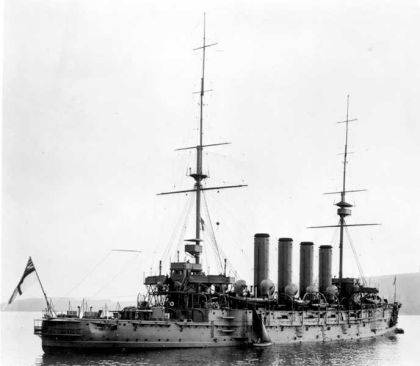
Despite these developments, Canada possessed little in the way of formal military organization in 1914. Our navy contained fewer than 400 personnel and the naval fleet consisted of two used British cruisers, HMCS Niobe and HMCS Rainbow.  The state of our land forces was not much better.  In the aftermath of the Boer War, the Canadian government recognized the need for some type of military structure, in the event that men in arms were required.  As a result, steps were taken to create two separate structures from which such a resource could be drawn when a military conflict involving Canada occurred.

HMCS Niobe in Halifax Harbor, 1910

First, Canada formally established a "Non-Permanent Active Militia" as the basis for military contingents that could be mobilized as required.  While militia units had existed throughout our history, after the Boer War, standards for organization and training were established.  The approved size of militia forces grew from a total of 36,000 in 1903 to 77,323 in July 1914, although the actual strength was less than 60,000 when war broke out the following month.  Members of urban militia units participated in 16 days training annually, while rural units trained for 12 days - hardly sufficient to prepare men for actual combat.

In addition to reorganizing its militia, the Canadian Parliament annually approved expenditures to fund a small "permanent force" of regular soldiers.  For the year 1914, Parliament authorized a standing army of 3110 men and 684 horses, although the demand for labor made it difficult to attract a full complement of soldiers.  The force's main peacetime role was to garrison fortifications located throughout Canada and assist in militia training.  By 1914, Canada possessed two regiments, each with two squadrons of cavalry - the Royal Canadian Dragoons and Lord Strathcona's Horse.  In addition, there were two batteries of Royal Canadian Horse Artillery, five companies in the Royal Canadian Garrison Artillery, one field company and two fortress companies of engineers, and one infantry battalion - the Royal Canadian Regiment. 

Equipping even this small permanent force was a challenge.  Canada possessed 200 modern artillery guns, sufficient for only one of its two artillery divisions.  Motor vehicles and horse-drawn carriages were virtually non-existent, nor were there sufficient uniforms for all members of the permanent force.  Canada had no domestic artillery industry, relying instead on British factories for such products.  This created a major problem once war erupted, as Canadian requirements took second place to British needs.

The Canadian government had developed a domestic firearms industry during the Boer War and was able to provide soldiers with a .303 rifle designed by Sir Charles Ross and manufactured by the Ross Rifle Co. in Quebec City after 1905.  The weapon, however, differed from the standard British Lee-Enfield, creating problems in terms of "weapons standardization" when Canadians were deployed in the front lines.  More controversially, the Ross Rifle proved unsuitable for combat conditions, often overheating and jamming when fired repeatedly.  Its longer barrel also created problems in the confined quarters of a muddy trench.  Despite stubborn support from Minister of Militia, Sir Sam Hughes, after two years of complaints from soldiers and officers, the Canadian government finally agreed to abandon its use and adopt the British Lee-Enfield rifle in 1916.

*****


On August 4, 1914, Great Britain formally declared war on Germany.  As a British colony, Canada was automatically at war and - as with the Boer War - it was assumed that Canada would support the British war effort by sending men to the battlefront.  The Canadian government set about hastily organizing an initial contingent of 25,000 men aged 18 to 45, volunteers who met the requirements in terms of health, physical conditioning and military expertise.  Drawn from the existing permanent forces and militia rolls, the first contingent assembled at Valcartier, near Quebec City, and began training.

The Canadian government eventually decided to send all available manpower - approximately 31,200 men - overseas as the "first contingent" of the Canadian Expeditionary Force.  The men arrived in England in mid-October and spend the fall and winter months on Salisbury Plain in southern England. where they were organized into the First Division of the Canadian Corps.  In February 1915, the First Division crossed the English Channel to France and was deployed along the front lines in the area of Ypres, Belgium.

No sooner had the first contingent departed from Quebec than the government set about recruiting a second contingent, which sailed to England in the spring of 1915 and crossed the English Channel to France as the Second Canadian Division in September 1915.  A Third Canadian Division was created in December 1915, followed by a Fourth Canadian Division in August 1916.  By the end of 1916, the Canadian Corps consisted of more 300,000 men, 80,000 of whom had made the journey overseas.  This was an amazing feat for a country that possessed virtually no standing army before the outbreak of the war.

While the growth of the Canadian Corps was impressive in the early years of the war, the pace of recruitment slowed significantly after 1916 for several reasons.  First, a significant number of the early recruits were English-born residents of Canada, men who felt a strong connection to the country of their birth and were eager to enlist.  Second, there was great demand for labor at home, both on farms and in factories, as domestic resources were mobilized in support of the war effort.  Single, able-bodied men had no difficulty finding work at a good wage, and often chose that option over military service, with its mediocre pay and inherent risk.  Finally, the early enthusiasm to enlist waned when it became apparent that the war would not be over quickly.  Moreover, descriptions of the dangers and horrible conditions of trench war, as described in soldiers' letters home, were becoming known.  All of these factors combined to create an enlistment crisis that became increasingly apparent in the early months of 1917.


At the beginning of the war, Prime Minister Robert Borden had promised that the Canadian government would not resort to compulsory military service of any kind.  Canada's army would consist entirely of volunteers.  As the conflict dragged on, the government was forced to re-assess its recruitment strategy.  At an Imperial Conference held in the spring of 1917, Britain pressured Canada to provide more manpower and urged Borden to implement conscription.  While volunteer enlistment had resulted in an estimated total of 525,000 enlistments by July 1917, increasing casualties and declining numbers of voluntary recruits as the year progressed forced Borden to abandon his earlier promise (see chart below).  In the first five months of 1917, 56,000 Canadian soldiers were either killed in action, wounded or missing in action.  There were fewer than 36,000 enlistments over the same time period.  Faced with the reality of a declining military force unable to meet the demands of Canada's role at the front lines, the Borden government introduced the Military Service Bill in the Canadian Parliament on June 11, 1917.


Borden's decision created a major political crisis at home.  The population of Quebec had never strongly supported Canadian involvement in Britain's "imperial" wars.  French Canadian voluntary enlistment lagged behind Canada's English provinces for several other reasons.  At the beginning of the war, there were no French Canadian units and very few French-speaking officers.  The few French Canadians who did enlist were placed in English speaking units commanded by English speaking officers.  Training manuals and other military documents were printed in English only.  Such practices did little to encourage French Canadians to enlist.  In response, the Canadian government made the decision to create a French Canadian regiment commanded by French Canadian officers - the 22nd or "Vandoos", as it soon became known - in October 1914.  Despite this concession, French Canadian enlistments were significantly fewer in number than English Canadian volunteers.


French Canadian politicians were openly critical of the Borden government's decision to adopt conscription.  Henri Bourassa, a French Canadian nationalist, had been an outspoken critic of Canada's involvement in "imperial wars" since the Boer War, and spoke out strongly against any form of compulsory military service.  Liberal leader and former Prime Minister Sir Wilfrid Laurier had supported Canada's involvement in the war, but opposed any form of conscription as a potential disaster for national unity.  The Military Service Act was also unpopular in western provinces, where it threatened to "rob" farmers of the much needed manual labor required to harvest their crops.  Nevertheless, the Borden government persevered and the Military Service Act became law on August 29, 1917.


To accommodate men who were called to military duty, the government organized "Depot Battalions" to which men called to military service reported for training.  Nova Scotian conscripts were assigned to the 1st Depot Battalion, Nova Scotia Regiment, based in Halifax.  Upon completing military training, conscripts were assigned to a "reserve battalion" in England for further training.  From there, conscripts could be "taken on strength" by regiments at the front in France or Belgium as needed.  As the statistics below indicate, approximately half of the men called for duty remained in Canada, where they trained and performed military duties while awaiting transport overseas.  Only one in four conscripts actually reached the front lines in France or Belgium.   


Under the terms of the Military Service Act, all Canadian men aged 20 to 45 were required to register for military service.  The first "conscripts" were ordered to report in mid-October 1917 and began military training in January 1918.  In total, over 400,000 Canadian men registered under the Act, but more than half - 220,000 - were eventually granted exemptions on medical or other grounds.  Of the 180,000 deemed "fit" for military service, almost 25,000 never reported for duty when called to do so (referred to as "defaulters") and another 25,000 were never called to report.  In total, over 130,000 reported for military service, of which 120,000 were enlisted in the Canadian Expeditionary Force.  

This number was further reduced by the fact that some were determined medically unfit for military duty or were assigned to non-combat services.  The final tally of men available for military service was 105,106, almost 9000 of whom were discharged prior to November 11, 1918 for various reasons, leaving a total of 96,379 men "fit for duty".  Of this number, a total of 47,509 conscripts proceeded overseas to England.  Over half of this group - 24,132 - were "taken on strength" by units in France and fought at the front.

As a result of conscription, the size of the Canadian Expeditionary Force at the front once again began to increase.  By January 1918, a total of 139,915 Canadians were deployed in France, with the Corps' numbers reaching a peak of just under 150,000 in July 1918.  While the majority of conscripts never saw active duty, the military commanders and Canadian government who oversaw their recruitment had no way of knowing that the war would be over by the end of the year.  Indeed, if the war had continued into 1919 - as many expected would occur during the early months of 1918 - all conscripted men would likely have found themselves at the front.

*****

A total of 611,711 men enlisted in the Canadian Expeditionary force during World War I, 418,052 of whom were transported overseas to England, France or Belgium.  These are impressive numbers, considering that the total Canadian population in 1914 was approximately 7,900,000 and that the country possessed virtually no "standing army" before the war.  Almost half of the men sent overseas were physically affected by the experience, as the numbers below indicate.  Thousands more no doubt suffered from the psychological effects of modern war at a time when little was known and even less understood about this aspect of war's effects.  Their sacrifices - physical and emotional - deserve acknowledgement.  An entire generation of Canada's population was permanently affected by the catastrophe that became known as "the war to end all wars".

Canadian Expeditionary Force War Statistics

Killed in Action: 34,496
Died of wounds: 17,182
Presumed dead from enemy action: 4,960

Total Deaths: 53,746

Missing: 4,368
Prisoners of war (repatriated): 4,500
Wounded in action: 132,550

Total missing/prisoners/wounded: 141,418

Total CEF enlistments: 611,711

Total CEF forces sent overseas: 418,052

*****
Sources:

Berton, Pierre. Marching As To War - Canada's Turbulent Years, 1899 - 1953.  Doubleday Canada, 2001.


Cook, Tim. At the Sharp End - Canadians Fighting the Great War 1914-1916.  Toronto: Penguin Canada, 2007.

Cook, Tim.  Shock Troops - Canadians Fighting the Great War 1917-1918.  Toronto: Penguin Canada, 2008.

Henderson, Ian; Lawley, Peter; Probert, Norm; and Quinlan, Don.  World Affairs: Defining Canada's Role.  Don Mills, ON: Oxford University Press, 1998.

Martinello, I. L..  Call Us Canadians.  Toronto: McGraw-Hill Ryerson, 1976.

Nicholson, Col. G. W. L..  The Canadian Expeditionary Force, 1914-19.  Ottawa: Queen's Printer, 1962.