Contact Information

E-mail: brucefrancismacdonald@gmail.com

Sunday, 31 October 2021

Guysborough County's No. 2 Construction Battalion Enlistments, Part 4

 This blog post is the fourth in a series, summarizing the information available on the life and First World War service of Guysborough County's 28 No. 2 Construction Battalion enlistments. Readers are asked to notify the blog author if there are any errors, or if a reader has additional information on any of the men profiled in these posts.


10. Private James Lavin Day:

 According to his military service file, James Lavin Day was born at Big Tracadie, Guysborough County, on June 30,1898. His death certificate lists John F. Garo [sic - Gero], son of Francis and Jane Gero, Upper Big Tracadie, as his father. James’ mother, Harriet, was the daughter of John and Elizabeth Day. The 1901 Canadian census lists Harriet E. Day living at Tracadie with her older brother, John W., farmer and head of the household. No other residents are listed in census data.

On July 16, 1907, Harriet married widower Charles Cranswick Reddick at Guysborough, NS. A farmer and native of Tracadie Road, Guysborough County, Charles was the son of William C. and Ada Ann Reddick. The 1911 census lists James “Laffin” [sic] Reddick as “son, living in the Upper Big Tracadie home of Charles C. and Harriet Reddick. Also residing in the home is Gertie, Charles’ daughter by his first marriage to Louisa Jordan.

James enlisted with No. 2 Construction Battalion at Truro, NS, on September 22, 1916. He had been on its payroll for two weeks at that time. James spent the winter of 1916-17 in Truro and was briefly hospitalized with minor ailments twice during that time. On March 25, 1917, he boarded SS Southland along with his No. 2 Construction mates for the journey across the North Atlantic, arriving at Liverpool, UK, two weeks later.

On May 17, 1917, James landed in France with a large group of No. 2 Construction personnel. The group made its way to the Jura District, near the Swiss border, where its members commenced work harvesting and processing timber alongside several Canadian Forestry Corps (CFC) Companies. James remained in the Jura District until December 30, 1917, when he was transferred to No. 1 CFC District, Alençon with 180 No. 2 Construction personnel and two officers. The group consisted largely—but not entirely—of individuals from the Caribbean Islands or southern United States. Military authorities had assumed±without any supporting evidence—that the cold winters in the mountainous Jura region might negatively impact their health.

The Alençon operation consisted of nine CFC Companies logging the Normandy forests. No. 2 Construction personnel were attached to No. 54 Company, CFC, during their time there. In late March 1918, the entire district commenced production of “pickets”—posts used to support trench walls and dugouts—as the German spring offensive commenced.

While CFC units received orders in early April 1918 to commence infantry training when personnel were not working in the forests or lumber mills, there is no evidence to suggest that any of the No. 2 Construction men participated in this activity. In early October 1918, a small detachment of six non-commissioned officers and 150 “other ranks” left Alençon for the Canadian Corps Reinforcement Camp. There were no No. 2 Construction personnel among their number.

When the November 11, 1918 Armistice brought fighting to an end, CFC timber activity ceased and harvested logs were quickly processed. No. 2 Construction personnel were the first to leave the continent, congregating at Étaples, France, in early December and crossing the English Channel to the United Kingdom as one group on December 14, 1918. The men remained there barely one month, departing for Canada aboard the Empress of Britain on January 12, 1919.

James was officially discharged from military service at Halifax, NS, on February 15, 1919, and returned home to Upper Big Tracadie. In early November 1922, military officials sent his service medals to the same address. James Lavin Day passed away at “his brother’s home in Upper Big Tracadie” on November 20, 1923. He was 25 years old at the time of his passing. “Brights disease”—known today as nephritis, a kidney ailment—was identified as the cause of death. James’ brother, Howard W., husband of Ida May Gero, was the informant. James Lavin Day was laid to rest in Hillcrest Cemetery, Tracadie.

11. Private Matthew Day:

 According to his attestation papers, Matthew Day was born at Upper Big Tracadie, Guysborough County, in January 1875, the son of Matthew Sr. and Margaret (Gero) Day. Several other documents, however, suggest that he was at least 10 years older at the time of his military enlistment. The 1871 Canadian census lists Matthew, age seven, as one of eight children living in the Day household at the time. The 1881 census gives his age as 18, while the 1901 census stated that he was born on September 5, 1868. The documents suggest that his birth likely occurred between 1863 and 1868.

Sometime between 1881, Matthew married Eliza Jane Byard, daughter of John and Rebecca (Parris) Byard, Guysborough. Over the following years,11 children joined the Day family—daughters Lily, Margaret, Rosline [also listed as Rossie in census records], Melinda, May and Gertrude, and sons Cyrus [also listed as Cylas in census records], George, Gordon, William Spurgeon and Aubrey.

Despite his age and family circumstances, Matthew enlisted with No. 2 Construction Battalion at Truro, NS, on January 20, 1917. At the time, the unit was feverishly attempting to fill its ranks prior to departing for overseas, which may explain its willingness to accept a recruit who claimed to be 42 years old at the time, and was likely at least 10 years older. Matthew was briefly hospitalized at Truro in early February for treatment of “pyrexia” [fever of unknown origin], but departed for overseas with the unit aboard SS Southland on March 25, 1917.

Matthew disembarked at Liverpool, UK, on April 8, 1917. While a large contingent of his No. 2 Construction mates departed for France in mid-May 1917, Matthew remained in England, where he was posted to the Nova Scotia Regimental Depot (NSRD), Camp Bramshott, on May 22. He remained with the Depot Company for five weeks before being posted to the 17th Reserve Battalion—the unit that provided reinforcements for the 25th (Nova Scotia Rifles) and 85th (Nova Scotia Highlanders) Battalions.

While Matthew’s record contains no reference to hospitalization during his time overseas, military officials were apparently concerned with his physical suitability for overseas duty. On September 6, 1917, a Medical Board declared that he suffered from “debility” and was therefore not fit for military service. One week later, he was transferred from the 17th Reserve Battalion to the Nova Scotia Regimental Depot. A note on his service file, dated, September 20, indicated that Matthew was “awaiting embarkation to Canada.”

On October 28, 1917, Matthew departed from Liverpool, UK, aboard SS Missanabie and arrived at Halifax, NS, on November 9. He was immediately admitted to Camp Hill Hospital, where he underwent treatment for pulmonary fibrosis and myalgia. A note in his service file provided more details on the military’s decision to return Matthew to Canada:

“Carried on in Canada fairly well[;] when he got to England[, he] complained of pain in muscles; easily fatigued and much distress about shoulders when carrying anything. Was returned to Canada Nov 1917 for overage. He is small [in] stature [Matthew was five feet five inches tall]…. Heart negative, frequency of urination at night[,] getting up several times during night. Brothers have history of T.B. [tuberculosis]…”

Matthew was discharged from military service at Halifax on February 28, 1918, and returned home. The 1921 Canadian census lists Matthew Day, age 65, occupation “plasterer,” living at Upper Big Tracadie with his wife Eliza and their five youngest children—George, age 18; Gordon, age 14; William, age 12; Gertrude, age 11; and Aubrey, age nine.

Eliza Jane Day passed away at home from “Bright’s disease”—known today as nephritis—on August 23, 1923. 58 years old at the time of her death, she was laid to rest in Upper Big Tracadie Cemetery. Matthew lived the remainder of his years in his home community, passing away on January 19, 1948. While his death certificate gives the cause as “old age” and states his age as 95, it is more likely that Matthew was in his early 80s at the time of his passing.

 12. Private Howard Cranswick Desmond:

According to the 1901 Canadian census, Howard Cranswick Desmond was born at Prospect [Sunnyville], Guysborough Co., NS, on March 7, 1897, the youngest of Cranswick Jost and Lucretia A. (Jewel) Desmond’s three children. Cranswick was the son of Richard and Violet Desmond, while Lucretia was the daughter of John and Catherine Jewel. The couple were married at Guysborough on January 1, 1890.

The family surname was spelled a variety of ways in official documents. Cranswick Jost’s 1890 marriage registration spells the surname “Dismore,” while the 1891and 1911 Canadian census records use the surname “Dismal.” Perhaps the most unusual version was the 1901 census entry, which used the spelling “Disney.” Howard Cranswick’s First World War service file followed today’s convention, recording his surname as “Desmond.”

At the time of the 1891 census, Cranswick and Lucretia were residing at Guysborough with Cranswick’s parents, Richard and Violet. During the ensuing decade, Lucretia gave birth to three children—a son Lindsay (February 15, 1893), a daughter “Gussie” (February 17, 1895), and their youngest child, Howard Cranswick.

Lucretia passed away sometime between Howard’s birth and the 1901 census, which lists Cranswick J. as a “widow.” No record of Lucretia’s passing can be located. On May 5, 1905, Cranswick Jost Desmond married Sarah Caroline Shepherd, daughter of John and Josephine Shepherd, Guysborough. By 1911, a fourth child—a daughter, Martha (August 1909)—had joined the Desmond household.

Howard Cranswick Desmond attested for service with No. 2 Construction Battalion at New Glasgow, NS, on July 25, 1916. Howard was among the unit’s earliest recruits, enlisting only three weeks after its official formation. At the time of his enlistment, documents recorded his birth year as 1896. Howard served with the unit throughout its time in Nova Scotia and departed for overseas aboard SS Southland on March 25, 1917.

Howard and his mates landed at Liverpool, UK, on April 7 and spent less than six weeks in England. On May 17, a large contingent of No. 2 Construction soldiers crossed the English Channel to France. Howard was one of the 525 men who made their way to the Jura District of France for service with the Canadian Forestry Corps (CFC). With the exception of a two-week leave to the United Kingdom in mid-September 1918, he spent the duration of his time on the continent working alongside several CFC Companies, harvesting and processing timber from the Jura forests.

For reasons that are not explained on the documents in his service file, Howard did not return to the United Kingdom with No. 2 Construction. While the vast majority of his comrades departed the continent mid-December 1918 and left for Canada on January 12, 1919, Howard remained in France until January 18, 1919, at which time he was posted to the Nova Scotia Regimental Depot, Bramshott, “for the purpose of demobilization” and remained there for more than two months. On March 30, 1919, Howard departed Glasgow, Scotland, for Canada aboard SS Saturnia. A week and a half later, he arrived at Halifax, NS, and was formally discharged from military service on April 14, 1919.

Shortly after returning to civilian life, Howard relocated to New Glasgow, NS. On March 23, 1920, he married Lillian May Clark, daughter of Charles and Martha Jane (Pelley) Clark, Guysborough, in a ceremony held in the home of Mr. Leslie Izzard, New Glasgow. The couple established residence in New Glasgow, where Howard initially worked as a “common labourer,” but later found employment in the local coal mines.

On October 5, 1931, Lillian May passed away at home after a brief illness and was laid to rest in Lorne St. Cemetery, New Glasgow. She was 32 years old at the time of her death. Following his wife’s death, Howard remained in the community, working in the mines. On December 25, 1951, he perished in an automobile accident when a truck in which he was a passenger “crashed through the railing of the Toney River Bridge, and dropped into the Toney River.” His son Walter, Reservoir, New Glasgow, was the informant on his death certificate. Howard Cranswick Desmond was laid to rest in New Glasgow, NS. (Photograph courtesy of Kathy Grant, The Legacy Voices Project.)

Wednesday, 29 September 2021

Guysborough County's No. 2 Construction Battalion Enlistments, Part 3

 This blog post is the third in a series, summarizing the information available on the life and First World War service of Guysborough County's 28 No. 2 Construction Battalion enlistments. Readers are asked to notify the blog author if there are any errors, or if a reader has additional information on any of the men profiled in these posts.


 7. Private John Clarke:

According to the 1901 Canadian census, John P. Clarke was born on January 18, 1895. While his military attestation identifies his birthplace only as “Guysborough County,” his mother, Ellen Emma Clark (sometimes recorded as Clyke), was the daughter of John Clark and Eliza Izzard, Boylston, suggesting that this may have been John’s birthplace as well. John’s service file identifies his father as George Clark, although his younger brother Andrew’s marriage license lists his name as “William Clark,” a native of South America.

At the time of the 1901 census, six-year-old John was living at Halifax with a younger sister, one-year-old Maggie, and his mother Ellen, age 28, who was listed as head of the household. By 1911, the family had relocated to Curry’s Lane, Sydney, where Ellen—still listed as family head but now identified as a widow—worked as a “washerwoman.” A younger brother, Andrew, born in March 1905, and a boarder—28-year-old Samuel Carter, a native of Barbados—also resided in the home. The presence of an immigrant from a Lesser Antilles island in the household and an adjacent structure containing eight labourers from Barbados raises the possibility that John’s father may have been from this South American location.

John enlisted with No. 2 Construction Battalion at Sydney, NS, on August 11, 1916. His stated occupation was “labourer,” although another document in his service file lists his civil occupation as “mechanic.” John assigned a portion of his pay to his widowed mother Ellen, who was living at Tupper St., Whitney Pier, at the time of his enlistment

On March 25, 1917, John departed for the United Kingdom with No. 2 Construction Battalion aboard SS Southland and arrived at Liverpool two weeks later. He was part of a large contingent of No. 2 Construction personnel who landed in France on May 17, 1917, and proceeded to the Canadian Forestry Corps’ for Jura District, where the men harvested, processed and shipped timber alongside several CFC Companies.

John spent his entire time overseas in the Jura District. On December 12, 1918, he returned to the United Kingdom with his No. 2 Construction comrades and departed for Canada aboard SS Empress of Britain one month later. John was formally discharged from military service at Halifax, NS, on February 13, 1919.

At the time of his discharge, John gave his intended place of residence at Tupper St., Sydney, NS. At the time of the 1921 census, John, age 24, was living with his mother Ellen, age 44, at 10 Buckley’s Lane, Sydney.  Also in the home was Ellen’s daughter Vivian, age nine.

While John’s First World War medals were dispatched to the Tupper St. address several years later, by 1959, he had returned to Boylston, where a replacement set of medals was sent on January 29, 1959. John Clarke died on July 18, 1975, and was laid to rest in St. Paul’s Anglican Cemetery, Boylston.

John’s younger brother, Andrew William, married Sarah Lawrence, daughter of Nathaniel and Susan Lawrence, Boylston, in a ceremony held at the United Baptist Parsonage, Boylston, on April 14, 1925. Andrew passed away at New Glasgow, NS, on August 29, 1997, and was laid to rest in Lorne St. Cemetery, New Glasgow. According to available records, Andrew and Sarah had one daughter, Vivian.

Andrew and John’s mother, Ellen Emma Clark, passed away at Mulgrave, NS, on July 4, 1949, at 79 years of age. According to her death certificate, she was born at Boylston, Guysborough County, on March 9, 1870. Mrs. Maggie Small, Mulgrave—Ellen’s daughter—is listed as informant.

8. Private Joseph Palmer Clyke:

According to his military attestation, Joseph Palmer Clyke was born at Sherbrooke, Guysborough County, on May 24, 1881. While Joseph’s 1908 marriage license identifies his parents as Martin and Elizabeth Clyke, the couple’s marriage record suggests that Joseph was a child of a previous marriage. Martin, son of James and Elizabeth Clyke, Tracadie, was a widower at the time of his January 3, 1888 marriage to Elizabeth Elms, daughter of Alex and Johanna Elms, also residents of Tracadie.

The 1901 census identifies Joseph Clyke, age 20, as residing at Truro, the stepson of Elizabeth Clyke, widowed head of the household. On February 8, 1908, Joseph married Rachel Annie Borden, widow and daughter of Robert and Sarah (Brodie) Connolly (Conley), in a ceremony held at Truro. The couple was still residing in the community in 1911, in the company of three young children—Sidney (1908), Susie (1908) and Edna (1910)—and two older children, Aubrey (1900) and Roland (1902)—possibly from Rachel’s first marriage.

Joseph enlisted with No. 2 Construction Battalion at Truro on August 22, 1916. Three months later, however, he was discharged as “medically unfit (defective vision).” Undaunted, Joseph re-enlisted at Truro on February 2, 1917. At the time, the unit was struggling to complete its ranks and was perhaps willing to overlook the earlier discharge. Joseph departed for overseas with No. 2 Construction aboard SS Southland on March 25, 1917, and disembarked at Liverpool, UK, on April 7.

On May 17, a large contingent of No 2 Construction personnel proceeded to France for service with the Canadian Forestry Corps (CFC). Joseph was among their ranks and travelled with his comrades to the Jura District of France, close to the border with Switzerland, where the unit worked alongside members of several CFC companies in harvesting timber from the area’s forests.

Joseph served with No. 2 Construction in the Jura District for 18 months and returned to the United Kingdom with his comrades on December 14, 1918. One month later, he returned to Canada aboard HMT Aquitania, arriving at Halifax on January 24, 1919. Joseph was discharged from military service at Halifax on February 18, 1919, and returned home to Truro, where Rachel and his children had resided during his absence.

Shortly after Joseph’s return, the Clyke family had relocated to Springhill, where Joseph found employment as a “fireman” in the local coal mines. The 1921 census data lists a household of five, consisting of Joseph, Rachel and three children—Susie, and 13, Edna, age 11, and Robert, age eight. The house also contained seven individuals of various ages—four adults and one three-person family, all of whom were identified as “boarders.”

On November 18, 1925, tragedy struck the family when 51-year-old Rachel suffered a cerebral haemorrhage and passed away. The following year, Joseph married Eliza Bell Churnley, a 38-year-old widow and native of Amherst. Joseph remained in Springhill for the remainder of his life, retiring from work in the local mines in 1945. He passed away there on April 17, 1953, and was laid to rest in Hillside Cemetery, Springhill, NS.

9. Private George Edward Conley (Connolly):

According to his military attestation, George Edward Conley was born at Glace Bay, NS, on February 10, 1899. A second item in his service file gives his birth place as New Glasgow, NS, while his death certificate states that he was born at Mulgrave, Guysborough County. While the spelling of the family surname varies throughout available documents—Connolly, Connelly, Conley—the vast majority in George’s service file use the spelling “Conley.”

Available sources indicate that George was the son of Thomas and Ada (Somers) Connolly. According to George’s marriage record, Thomas was a Barbados native, while Ada was the daughter of John and Sarah Jane Somers, Melford, Guysborough County. Thomas and Ada were married at Truro on May 6, 1893.

At the time of the 1901 census, Thomas and Ada were living in New Glasgow. No children were recorded as living in the household. By 1911, the couple had relocated to Glace Bay, where Thomas worked in the local coal mines. One child, 13-year-old George, was also living in the home, listed as “adopted son.”

On September 8, 1916, George enlisted with No. 2 Construction Battalion at its Pictou, NS headquarters. He identified his mother, Mrs. Thomas Conley, Mulgrave, NS, as next of kin on his attestation form. George departed for overseas with the unit on March 25, 1917, and disembarked at Liverpool, UK, on April 7. He was part of a large contingent of 525 No. 2 Construction personnel who departed for France on May 17 for service with the Canadian Forestry Corps (CFC).

George spent 18 months working alongside CFC units in the Jura District of France before returning to the United Kingdom with his comrades on December 14, 1918. One month later, he departed for Canada aboard SS Empress of Britain. The vessel arrived at Halifax, NS, on January 22, 1919. George was discharged from military service on February 15, 1919, and gave  his intended address at the time as Box 36, New Aberdeen, NS.

The 1921 Canadian census lists George Connolly, occupation miner, living in the Glace Bay home of Jennie Walcutt, age 39. While the entry identified George as Jennie’s step-son, she was actually his sister, Maudie Jane Connolly, who had married Edward Christopher Walcott, a Barbados native, at Mulgrave, NS, in August 1917.

George remained in the Glace Bay area for several decades. During that time, his mother, Ada Ann, passed away there on March 15, 1925, and was laid to rest in St. Mary’s Cemetery. On June 22, 1929, George married Ida Jean Talbot, daughter of Fred Albert and Delia (Parris) Talbot, Glace Bay. 

In later life, George and Ida relocated to Mulgrave, George joined Mulgrave Branch of the Royal Canadian Legion on July 12, 1955. His membership sponsored by fellow No. 2 Construction Battalion veteran Joe Parris and seconded by W. N. Meagher.  

George passed away suddenly at Mulgrave on March 26, 1963, the result of a stroke. He had been “under medical care” since September 1956 and last worked as a “general labourer” in 1960. George was laid to rest in Mulgrave.

Sunday, 13 June 2021

Guysborough County's No. 2 Construction Battalion Enlistments, Part 2

 This blog post is the second of a series of posts, summarizing the information available on the life and First World War service of Guysborough County's 28 No. 2 Construction Battalion enlistments. Readers are asked to notify the blog author if there are any errors, or if a reader has additional information on any of the men profiled in these posts.


4. Private George Borden:

George Borden was born at Goldenville, Guysborough County, the son of James and Alice (Parris) Borden. While his attestation papers list his year of birth as 1896, a medical document in his service file records the date as September 20, 1899. George’s father James was a native of Guysborough, the son of James Frederick and Mary Borden. His mother Alice was born at Goldenville, the daughter of Jeremiah and Jane (Dismal) Parris.

George was a late enlistment with No. 2 Construction Battalion, joining the unit at Truro, NS, on February 10, 1917. At the time, he claimed that both of his parents were deceased, although genealogical sources indicate that this was not the case. George listed his aunt—his mother’s sister, Mrs. Norman (Rosa Ann Parris) Parris, Grammar St., New Glasgow, NS—as his next of kin.

Six weeks after his enlistment, George departed from Halifax aboard SS Southland and disembarked at Liverpool, UK, with his No. 2 Construction mates in early April. On May 25, George proceeded to France as part of a large group of No. 2 Construction personnel assigned to the Canadian Forestry Corps’ Jura District.

No. 2 Construction’s men worked in aspects of timber harvesting operations—logging, sawmill, lumberyard and shipping—alongside CFC personnel. While small groups of No. 2 Construction men were transferred to two other CFC locations in France in late 1917, George spent his entire overseas service at Jura.

In February 1918, shortly after the first anniversary of his enlistment, George was granted three weeks’ leave. In mid-June, he was “admonished and placed under stoppage of pay to make good the value of missing articles,” specifically “one pair puttees [and] one jacket” that he had lost “by neglect.” With the exception of a brief stay in hospital in late July, the remainder of George’s time at Jura was uneventful.

On December 12, 1918, George returned to the UK with his comrades and was attached to the Nova Scotia Regimental Depot, Camp Bramshott, two days later. While the remainder of No. 2 Construction’s personnel departed for Canada on January 12, 1919, George remained in the UK, were he was promoted to the rank of “Acting Corporal without pay and allowances while specially employed.”

On February 1, George was “taken on strength” for sentry duty at No. 6 Military District, Rhyl. The location contained thousands of Canadian soldiers awaiting orders to return to Canada. Five days after reporting for duty, George was placed in the camp’s isolation unit with a case of mumps. Discharged on March 1, he served at Rhyl for four weeks, at which time he proceeded by train to Glasgow, Scotland, and boarded SS Saturnia for the return journey to Canada.

George was discharged at Halifax on April 14, 1919. Three months later, he crossed into the United States at McAdam, NB, and proceeded to Boston, MA. George found employment as a cook and established residence in the suburb of Roxbury. Two years later, he travelled by train from Boston to New Glasgow, and visited family in Goldenville before returning to the US.

On June 21, 1928, George married Hilda Wilson, a native of The Crawl, Hamilton, Bermuda, who had immigrated to the US with her family in 1910. The couple established residence at 7 Copeland St., Roxbury, where George was building custodian. Three children soon joined the Borden family—a daughter Lois (November 22, 1930) and twin boys Donald and Douglas (October 8, 1932).

Six years into George’s and Hilda’s marriage, a routine incident spiralled out of control, resulting in tragedy for the Borden family. At 1:30 pm Sunday, July 8, 1934, Registry of Motor Vehicles Inspector Everett T. Gardner and Special Officer William R. Harmon arrived at the Borden residence at 7 Copeland St., Roxbury. While on official business, neither was in uniform at the time.

Apparently, Inspector Gardner had attempted to stop George for a motor vehicle infraction, but he sped away. Gardner and Harmon intended to serve George with an arrest warrant for three motor vehicle infractions: operating a motor vehicle after his license was revoked, failing to stop when signalled by a motor vehicle inspector, and driving in a manner that endangered the lives and safety of the public.

While Harmon went into the building, Gardner guarded a rear entrance. Harmon knocked on the door of the Borden family apartment and identified himself as a police officer. At first, George denied that he was the man they were seeking, but soon acknowledged his identity and asked permission to make a phone call from a suite on the second floor. As he made his way up the stairs, he attempted to flee, exiting the building and running across the street into another tenement with Harmon in pursuit.

As George entered the second building, Harmon fired two warning shots, one into the air and a second into the ground. Gardner, hearing the shots, made his way into the street and remained there while Harmon followed George into the building. A few minutes later, Gardner heard the sound of glass breaking. Peering down an alley beside the building, he saw George climb out of a basement window and attempt to flee.

Harmon aimed his weapon at George and fired three shots, striking him in the left side, right ankle and right wrist. George managed to make his way to the rear of the building, where he collapsed. He was rushed to City Hospital, where he immediately received a blood transfusion and was placed on the “serious condition” list. According to the Boston Globe, the incident was believed to have been the first time that a motor vehicles inspector fired his weapon in an attempt to execute an arrest.

Events in the aftermath of George’s shooting followed a predictable pattern. Police claimed that Borden had placed his right hand in a rear trouser pocket after climbing out of the cellar and appeared to be drawing a weapon when Gardner fired. A later statement claimed that George had a “black object” in his hand. While a search of the area behind the building failed to locate a weapon of any kind, police later claimed that a knife found in the cellar belonged to George.

Two days after the incident, The Boston Globe reported that a Roxbury Court would examine the facts surrounding the incident, to determine whether Inspector Gardner acted in self-defence. The news item also reported that George, in “fair” condition in hospital, was interviewed by a Motor Vehicles Inspector and Boston Police Lieutenant. He denied owning a revolver and declared that he did not have a weapon in his possession when he was shot. Meanwhile, the Roxbury Court ruled that Inspector Gardner had acted in self-defence and absolved him from all responsibility.

On the night of Friday, July 13, 1934, George Borden passed away at City Hospital. His death had a dramatic impact on an already tense situation. Several community organizations—the League of Struggle for Negro Rights, the Boston branch of the National Association for the Advancement of Coloured People, and the National Equal Rights League—had already held meetings, demanding a full public inquiry into the shooting.

Under considerable pressure to act, Boston Police announced that an investigation into the incident would take place before a magistrate in Roxbury Court on July 16. When the hearing convened, Inspector Gardner was formally charged with manslaughter pending the outcome of the investigation, and released on $1,000 bail.

The following day, George’s funeral took place at the International Hall, Shawmut Ave., Roxbury. A total of 14 automobiles and more than 200 friends and sympathizers, consisting of white and black citizens, formed a parade behind his casket as it traveled from the funeral home to the hall. Amplifiers broadcast the service to a crowd of 500 who stood outside the packed hall. Several representatives of the Boston Police also attended the ceremony.

George Borden was laid to rest in Mount Hope Cemetery, Boston, MA. A Boston Globe article, dated October 31, 1934, indicated that the inquiry into George’s death continued for more than three months. The news item reported that Special Officer William R. Harmon saw a “dark object” in George’s hand shortly before he was shot, suggesting that the manslaughter charges brought against Inspector Gardner were likely to be dismissed, on “self-defence” grounds.

George’s widow Hilda never re-married. Predeceased by her twin sons, she passed away at Roxbury on October 22, 1983.

Special thanks to Marie Terese, Redican, Allentown, PA, who provided a series of Boston Globe articles concerning George's tragic shooting and information on George's wife, Hilda Wilson.

5. Private Norman Arthur Bowden:

Norman Arthur Bowden was born at Guysborough, Nova Scotia, on October 26, 1885, the son of William Arthur and Margaret A. (Skinner) Bowden. William was the son of Levi and Elizabeth Bowden, while Margaret was the daughter of George and Eliza Skinner. Norman was living in his parents’ household in the 1891 and 1901 censuses, but had left home by 1911. His whereabouts at that time are unknown, but by 1915 he was residing at Victoria, British Columbia, where he was employed as a “bootblack” and porter at a saloon operated by Scottish proprietors.

After relocating to Victoria, Norman met Della Daisy (Gibson) Bishop, a widow and native of San Angelo, Texas. Della was the oldest of 13 children—her son later described her as a “go-getter” who “could see that there was no future at that time for black people in Texas.” Della made her way to Victoria, BC, where she met Norman at a weekly Sunday gathering held in one of the local black community’s homes.

Norman and Della established residence at 1009 Fort St., where their son, Norman Leland, was born during the summer of 1915. Life continued as normal for more than a year, until Norman made a decision that significantly impacted his young family. On November 6, 1916, he attested for service with No. 2 Construction Battalion at Victoria.

Unlike other military units, No. 2 Construction Battalion received official permission to conduct a nation-wide recruitment campaign. Norman was one of a small number of British Columbia enlistments. Leaving his 14-month-old son in Della’s care, he traveled across the country by rail to Truro, NS, where he joined the unit’s ranks.

After spending the winter of 1916-17 training at Truro, No. 2 Construction’s personnel made their way to Halifax in late March 1917, boarded SS Southland and departed for overseas. The unit arrived in the United Kingdom on April 7 and remained there for six weeks. On March 17, 1917, Norman departed for France with a large detachment of No. 2 Construction personnel. The group made its way to the Canadian Forestry Corps’ Jura District, where Norman and his comrades served alongside CFC units, participating in all aspects of harvesting and processing timber, as well as shipping lumber products to the forward area.

Norman’s time overseas was largely uneventful. On February 12, 1918, he was granted 14 days’ leave to the United Kingdom and rejoined his unit on March 3. On June 1, 1918, he was hospitalized at La Joux, Jura, with a case of mumps and discharged to duty three weeks later.

A second 14-day leave to the United Kingdom on November 25, 1918 was somewhat more eventful. On December 7, Norman was admitted to 5th London General Hospital, Lambeth, suffering from a “concussion of [the] brain.” The brief note stated that he had been “injured in [the] street” and was “brought in suffering from concussion.” Norman’s service file contains no other details on the incident.

Norman was discharged from hospital on December, but remained in the United Kingdom as his No. 2 Construction mates departed France that same day. Instead of rejoining the unit’s ranks, Norman was posted to the Nova Scotia Regimental Depot, Bramshott, where he was attached to the Depot Company. As a result, he did not depart for Canada with his former unit, which returned to Canada on January 12.

Norman remained overseas for another month, departing the United Kingdom aboard the Empress of Britain on February 17, 1919. Upon arriving in Canada eight days later, he made the long train journey to Vancouver, where he was discharged from military service on March 22, 1919. He then returned to his Victoria residence.

Norman’s young son later recalled his father’s return home:

“I don’t remember when he left for the war, but I do remember when he came back. All the time he was overseas, my mother used to constantly show me a picture of ‘your father.’ When the soldiers came back, they’re all in a mess hall—this was 1918 [actually March 1919]—all there drinking coffee, and I took one look and I could recognize him from the picture that my mother kept showing me.”

Norman and Della were formally married at Christ Church Cathedral, Victoria, BC, on August 19, 1919. His son Norman Jr. later recalled their family home on Fort St. and the nearby Empress Hotel on waterfront, where “you can sit right there on the bench and look out over the ocean where the boat [from the British Columbia mainland] comes in.”

Several years after Norman Sr.’s return from overseas, the family relocated to Los Angeles, California, in stages. According to Norman Jr.:

“My mother had got her mother and her baby sister up from Texas to take care of them in Canada. Then we all left and came to the States. This was December 22, 1921. My auntie and her mother came here first, my mother and I came second, and 10 months or a year later, my father came last. [Later immigration records indicate that Norman Sr. arrived in California in 1923.] We all came at different times. When my mother and I got here, her younger sister was already here and married and was established so we lived with them until we sorted ourselves.”

Della insisted that her son receive a proper education. Norman Jr. started his schooling in Victoria, where most of his classmates were white. After arriving in Los Angeles, he continued his studies in a segregated school. He described the experience as “a strange thing for me,” as “I’d never gone to school with black children before.” It was in this new school setting that Norman Jr. was introduced to the world of music, an experience that was life-altering.

The school’s music teacher, a Welshman, was a violinist and introduced his students to the instrument. Norman Jr. described him as a marvelous musician—“He’d take a violin and make it sound like magic”—and a “wonderful teacher.” However, the two “did not get along… too well because I was wanting to improvise and play jazz. He didn’t like that. He’d tap me on the fingers and say, ‘That kind of music you play, you’ll never amount to a thing; you’ll never amount to nothin.’ He was always telling me that. He didn’t want to let jazz into the school.”

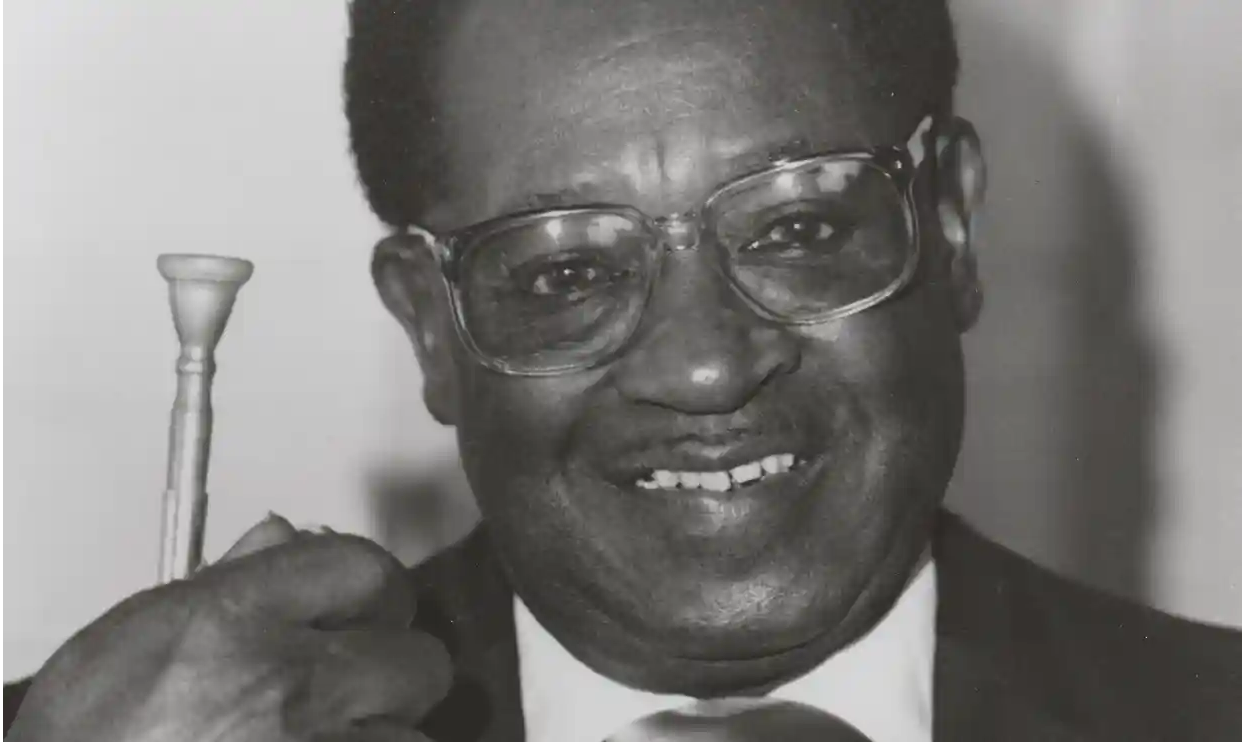
The spark did not take long to become a fire. Inspired by American jazz legend Louis Armstrong, “Norm”—as he was known in music circles—took up the trumpet in his mid-teens and as a young man frequented the jazz clubs located along Los Angeles’ Central Avenue. By the 1940s, he was a fixture in the vibrant music scene known as “West Coast Harlem.” Norm played at dance halls and after-hour clubs, and toured with several bands, covering such musical genres as big band, rhythm and blues and Dixieland.

Norman Leland Bowden

Meanwhile, Norman Sr. settled into life in Los Angeles, where he found work as a machinist. While far from his Guysborough County roots, he made at least one trip to Nova Scotia, visiting his younger sister, Mabel Augusta (Mrs. George Howard Lawrence) in New Glasgow during the summer of 1947. Norman returned to Los Angeles in early August, and spent his remaining years there.

Norman Arthur Borden passed away at Los Angeles on May 19, 1964. His son Norm lived a long and productive life in the city’s music scene, his final public performance taking place at La Louisanne Creole Restaurant, Los Angeles, in 2007 at the age of 91. Norman Leland Borden passed away at Los Angeles on June 1, 2017.

Special thanks to Marie Terese Redican, Allentown, PA, who provided valuable information on Norman's wife Della.

6. Private Joseph Clyke (aka Brodie):

Joseph “Joe” Clyke (aka Brodie) was born at Guysborough, Nova Scotia, on February 14, 1900. His parents’ names are unknown. Joe was the grandson of John and Eliza (Skinner) Brodie. John, a mariner by occupation and the son of William and Eunice Brodie, married Eliza, the daughter of William and Ellen Skinner, at Guysborough on May 14, 1870.

John passed away sometime before 1901, as that year’s census records list Eliza Brodie, widow, age 50, as head of the family, residing at Guysborough with her daughters Mary, Annie, Sarah, and Harly, son Burton, and grandson Joseph, age one. In 1907, Eliza married Archibald “Archie” Clyke, a 54-year-old widower and son of William and Johanna Clyke.

The 1911 census lists 58-year-old Archibald Clyke as head of a household that included his wife Eliza, age 61, and “adopted son” Joseph Brodie, age 11. Living next door to the Clyke family were Eliza’s son Burton, his wife Nellie (Clyke), and their children Gertie, age seven, and Annie, age four.

On September 22, 1916, Joe enlisted with No. 2 Construction Battalion at Truro, NS. At the time, he gave his birth year as 1899, exaggerating his age by one year—he was actually 16 years old at the time. Joe also gave his last name as “Clyke” and listed his grandmother, Elizabeth “Eliza” (Mrs. Archie) Clyke, as his next of kin.

Joe departed for overseas with No. 2 Construction Battalion on March 25, 1917, and disembarked at Liverpool, United Kingdom, 12 days later. On May 17, 1917, he departed for France with a large group of No. 2 Construction personnel, who made their way to the Canadian Forestry Corps (CFC) Jura District, near the France - Switzerland border.

Throughout the remainder of 1917, No. 2 Construction personnel served alongside men from several CFC companies, working in the Jura area’s forests, the mill that processed harvested logs, and the shipping facility that loaded lumber onto rail cars for transport to the forward area. One of the mill’s major products was railroad ties for small-gauge lines constructed immediately behind the front trenches.

On December 30, 1917, Joe was among a group of No. 2 Construction men transferred to the CFC’s Alençon District, west of Paris and north of Le Mans, France, where several CFC companies harvested and processed timber from the nearby Forêt d’Écouvres. The majority of the transfers were natives of the Caribbean Islands and authorities at Jura were concerned that the colder weather at Jura might have a harmful impact on their health.

The fact that these men had worked throughout the months of November and December without any health issues raised questions as to whether such a move was necessary. CFC authorities, however, decided to follow the recommendations of Jura District’s medical officer and relocated the selected men to the area, where winter conditions were considerably less harsh.

Joe worked in the Alençon District for the remainder of his time overseas. Several entries in his service file suggest that youthful exuberance may have resulted in several discipline infractions. In mid-November 1918, he was confined to barracks for two weeks for “creating a disturbance.” As this punishment expired, Joe earned another 10 days’ confinement for being “AWL [absent without leave] from 22.00 26-11-18 to 07.00 27-11-18,” a fairly common occurrence among personnel at CFC camps.

On December 14, Joe returned to the United Kingdom with the rest of No. 2 Construction’s personnel. One month later, he and his comrades departed for Canada aboard the Empress of Britain. Joe disembarked at Halifax on January 22, 1919, and was formally discharged from military service on February 15, 1919.

Joe listed “Guysborough” as his address on discharge and his British War and Victory service medals were dispatched to that location on December 12, 1922. Unfortunately, no further information is currently available on his later life.