Date of Birth: December 6, 1886
Place of Birth: East River St. Mary's, Pictou County, NS
Mother: Margaret McInnis
Father: William Gunn
Occupation: Nursing Sister
Marital Status: Single
Enlistment: January 1, 1917 at Calgary, AB
Regimental #: None (Commissioned Officer)
Rank: Lieutenant
Force: Canadian Army Medical Corps
Units: No. 1 Canadian General Hospital; No. 8 Canadian General Hospital; No. 3 Casualty Clearing Station; No. 2 Stationary Hospital
Service: England & France
Next of Kin: William Gunn, East River St. Mary's, Pictou County, NS (father)
None of Catherine's siblings enlisted for military service during the First World War. Neil—the oldest child—was born at East River St. Mary's, Pictou County, on June 23, 1882. He married Elizabeth "Libbie" (Mitchell) Fraser, daughter of Alex and Marie Mitchell, at Sherbrooke, NS on October 6, 1906. The couple was residing at Cleveland, Richmond County at the time of Neil's death on December 15, 1951. Neil was laid to rest in Aspen, Guysborough County.
*****
Catherine Mary Nichols Gunn was the third of seven children—four boys and three girls—born to William and Mary (McInnis) Gunn of East River St. Mary's, Pictou County. Catherine left home sometime before 1911, making her way to Seattle, Washington, where she completed a professional nurse's training program.
 |
| Lieutenant Catherine Nichols Gunn. |
After she returned to Canada, as with so many of her generation, the outbreak of war in Europe impacted Catherine's life. She served as a Nursing Sister at a Temporary Military Hospital in Lethbridge, AB, before being "taken on strength" by the Canadian Army Medical Corps (CAMC) at Calgary on December 15, 1916.
Two and a half weeks later, Catherine attested for overseas service with CAMC. She departed Canada on February 3, 1917, arriving in England after a ten-day voyage. Four days later, Catherine commenced work at the Canadian Red Cross Hospital, Taplow, Warthanger, the first of several postings during her overseas service.
*****
As Canadian soldiers entered combat on the Western Front in late 1914 and early 1915, the Canadian Army Medical Corps developed a system to provide treatment for wounded and sick soldiers. Each battalion contained a Regimental Aid Post, staffed by its Medical Officers and Orderlies, providing immediate assistance on or near the battlefield. Once evacuated, a wounded soldier might be admitted to an Advanced Dressing Station—depending on the nature of his wounds—before proceeding to a Field Ambulance for assessment and further treatment.
Usually under cover of darkness, horse-drawn and motorized ambulances evacuated wounded soldiers to a Main Dressing Station, the first location at which medical treatment was recorded. Soldiers not requiring additional care made their way to Corps or Divisional Rest Areas for recovery. The remaining patients were transported to a Casualty Clearing Station (CCS), where they awaited evacuation to hospital.
CCS staff provided basic surgical treatment where necessary, usually evacuating patients to hospital by ambulance train within four days. CAMC operated two categories of hospital, distinguishable only in size and hence mobility. Stationary Hospitals initially housed 200 patients, while the larger General Hospitals accommodated 520 patients. By the end of 1915, CAMC officials doubled the bed capacity of both facilities. In total, CAMC staffed and operated four Casualty Clearing Stations, 11 Stationary and 16 General Hospitals in France and England by war's end, in addition to several Special Hospitals and Convalescent Depots.
Shortly after Britain declared war on Germany and Austria-Hungary on August 4, 1914, Waldorf Astor, son and heir of William Waldorf Astor, invited the Canadian Red Cross (CRC) to build a hospital on a portion of the family's Cliveden Estate, west of London, England. Initially named "Duchess of Connaught Hospital" in honour of Patricia, daughter of Canada's Governor-General, the facility opened its doors to patients in March 1915. The CRC initially staffed and equipped the hospital, which later adopted its name.
 |
| Canadian Red Cross Hospital, Taplow, England. |
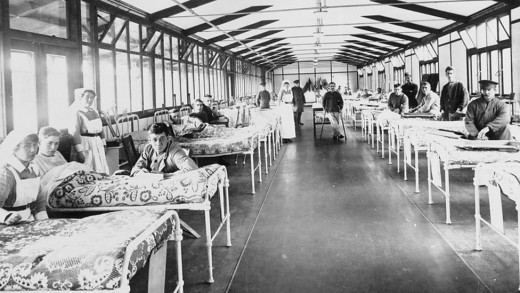
The facility consisted of five pairs of wards, connected in a "butterfly pattern" by a central corridor that contained a large serving kitchen. A broad veranda on its southern side accommodated beds out of doors during the summer months, while windows allowed ample ventilation for indoor patients. The Astor family paid the cost of constructing permanent staff quarters—mostly small cottages—on the grounds. The hospital accepted its first Canadian patients in April 1915, primarily victims of the April 24 gas attack during the Second Battle of Ypres.
On April 27, No. 1 CGH's war diary recorded the arrival of its first significant convoy of 160 patients, "nine or ten simple fractures of the leg. An unusually high number of other fractures were from 3 to 4 weeks old and in bad position[,] requiring operative interference to rectify."
During its first full month of operation, staff performed 78 surgeries, including 23 "incisions and drainage of wounds", 18 "removal of shrapnel", 11 "delayed union of fibula and suture with kangaroo tendon."
Nursing Sister Catherine Nichols Gunn reported for duty to the Canadian Red Cross Hospital on February 17, 1917. An assignment in England was routine practice for new arrivals, as the patients provided experience in treating a variety of combat wounds. As might be anticipated, the workload increased with the arrival of spring and the resulting upsurge in fighting.
In May 1917, the hospital received 356 admissions—295 surgical and 61 medical—some patients arriving only three days after being wounded. The first convoy "after Vimy Ridge" involved a large number of rifle bullet cases, while succeeding convoys "contained terrific shell and shrapnel wounds of all kinds." Medical officials reported all wounds "in good condition on arrival. Wounds were well dressed."
The list of major surgeries performed during the month sheds light on the variety of injuries treated, as well as the required medical and nursing care—51 incision and drainage, 17 shrapnel removal, 13 excisions of scar and secondary nature, 20 "reamputation" of legs, arms or fingers.
 |
| CRC Hospital Ward, Taplow, England. |
Some Nursing Sisters remained in England for the war's duration, while others moved on to facilities closer to the front lines. Such was the case for Catherine, who spend almost five months at CRC Hospital before receiving a transfer to No. 1 Canadian General Hospital on July 9, 1917. The following day, she proceeded to Folkestone, England for passage across the English Channel and reported to the hospital's facility near Étaples, France upon arrival.
*****
No. 1 Canadian General Hospital (CGH) initially assembled at Valcartier, QC and crossed the North Atlantic to England in October 1914 as part of the First Canadian Contingent. From October 20, 1914 to May 13, 1915, the unit operated a hospital on Salisbury Plain, catering to the medical needs of the Canadian soldiers encamped nearby. After crossing the English Channel, No. 1 CGH established a 1,400-bed facility—expandable in the event of a "super crisis" to 2,230 patients—at Trouville, near Étaples, France. Its patients were housed in canvas tents, a practice that quickly proved ill-suited to the coast's unpredictable weather.
The unit's July 9, 1917 war diary provided a description of the circumstances greeting Nursing Sister Gunn at the time of her arrival:
"Weather… bright and warm. The hospital grounds are looking very beautiful at this season of the year. The labours of the early spring are rewarded by the sight and fragrance of the many varieties of flowers which transform the central pieces of ground and beautify the spots for the patients who come to us."
Eight CAMC Nursing Sisters—a group that included Lieutenant Catherine Nichols Gunn—reported for duty on July 11, at which time the hospital contained 1,206 patients. The war diary described Catherine's first month at the facility as "fairly quiet…. Brilliant weather has prevailed most of the time, long warm days; cloudless blue skies; while the nights have been cool and refreshing."
During Catherine's first month in France, No. 1 CGH received a total of 1,356 "sick" and 872 "wounded" patients, 1,778 of whom were transported to England for further treatment. A total of 332 soldiers were discharged to a nearby Convalescent Depot, while 241 returned "to duty". Only eight of its patients died after arriving at the hospital. A new Canadian Red Cross 52-bed ward opened on August 1 as 948 admissions temporarily pushed numbers to 2,054 beds. The "sudden influx of patients… made the hospital very busy" for the first two weeks, numbers declining to 1,500 by mid-month.
While its coastal location provided beautiful summer weather, it also exposed the unit to occasional, intense storms. On August 29, for instance, heavy wind and rain damaged the "flys" [sic] of several tents, forcing the transfer of some patients to other wards. "Approximately 450 beds were temporarily rendered useless… from the effects of the storm."
A September 4 local air-raid revealed the dangers of operating a hospital approximately 80 kilometres of the front lines: "Bombs were dropped in the neighbourhood, but happily no damage was done in this Unit, although the throb of the engines could be distinctly heard as the Planes passed overhead. Casualties were reported from an adjoining hospital."
Late summer and early autumn statistics reveal a dramatic increase in the number of wounded admissions. In August, 1,453 "sick" and 3,282 "wounded" soldiers reported to the facility, while 1,446 "sick" and 2,173 "wounded" patients arrived the following month. The unit's October 4 diary entry described preparations for a final influx of patients before the "fighting season" concluded: "The last two days have been chiefly occupied in evacuating as many patients as possible, consequent upon an order received to have all available beds ready."
 |
| Map of No. 1 CGH, Etaples (Source: War Diary). |
The orders were part of preparations for Canadian Corps' "New Push" at Passchendaele, Belgium. The first wounded soldiers—"some of the lighter cases"—arrived at No. 1 CGH the following day, when staff processed 474 admissions and administered 198 X-rays. As the fighting progressed, the pace accelerated as described in the October 11 diary entry:
"The last few days have been very busy owing to the heavy convoys and evacuations. The weather has been very unpropitious, and the tents have proved very unsatisfactory for these cold and wet days… [making the work] much heavier than would be necessary with Huts… and [favourable] working conditions."
On October 24, the situation worsened as "a very heavy wind and rain storm passed over the camp… inflicting such damage to some of the tents as to render them uninhabitable." While staff enjoyed "a perfect autumn day" at month's end, the clear night resulted in another air raid, the unit once again reporting neither damage nor casualties.
No. 1 CGH's October statistics—1,432 "sick" and 2,331 "wounded" admissions— indicate a third successive month of challenging work. A total of 3,204 patients were evacuated to England, 694 to Convalescent Depots, and 235 "to duty". The unit recorded 47 deaths—the highest number since Catherine's arrival—while medical personnel completed 824 surgeries, 1,260 X-rays and 6,784 dressings.
On November 11, the unit war diary noted a welcome development—construction of the first wooden huts, intended to gradually replace the facility's tent wards. Stormy weather during the month's last week forced the evacuation of two wards and confirmed the wisdom of such a change: "During these storms[,] which occur from time to time[,] the administration of the Hospital becomes very difficult[,] owing to the number of beds rendered vacant."
The unit's month-end statistics—1,365 "sick" and 975 "wounded" admissions—reflect the significant decline in combat brought on by winter's arrival. On December 2, staff welcomed the opening of the first of 20 wooden huts, each containing 52 patient beds. The December 16 diary entry reflected the change in seasons:
"Snow began to fall about 2 p.m. and continued steadily all afternoon. Towards evening there were three to four inches on the ground. When evening fell it was still falling."
The following day, "a wintery scene was presented to us this morning for the earth was covered with a mantle of snow." By coincidence, the entry's only other item of interest stated that Nursing Sister C. N. Gunn was "invalided [and] transferred to Villa Tino Hospital.
*****
On December 17, 1917, Nursing Sister Catherine Gunn was admitted to No. 24 British General Hospital, Étaples, with "ICT [inflammation of connective tissue] Finger". Amongst the hospital's various facilities was Villa Tino, a large château in the nearby Le Touquet forest where No. 24 CGH operated a "Sick Sisters' Hospital".
Medical records describe Catherine's condition upon admission:
"[Patient] suffering from a whitlow [infection] of index finger, right. It had been incised before admission but it still spread up the finger to palm and back of hand… [and] had to be further incised. It had now healed but she still requires a further period rest before she will be fit for duty."
Catherine spent six weeks recuperating at Villa Tino. On February 2, 1918, a Medical Board examined her case, observing: "The flexor tendon has been involved and the finger is stiff. She is also debilitated." The Board recommended three weeks' sick leave to England before a return to duty. Nine days later, Catherine was discharged from hospital and crossed the Channel to England.
 |
| Sick Sisters' Hospital, Villa Tino, France. |
On March 5, Catherine "returned [to No. 1 CGH] from… sick leave to the U.K.." By that time, the facility's transformation from tents to physical structures was "nearing completion as the Hut Wards continue to grow in numbers." Nine days later, the last of the new wards opened.
Before month's end, a dramatic increase in workload would severely test Catherine's recuperation and her colleagues' stamina. While the hospital contained 615 patients at the time of her return, numbers soon rose with the arrival of several convoys, "all of which have been chiefly Gas cases, symptoms showing that Mustard Gas has been used." By March 20, the facility housed 1,142 patients, its war diary reporting: "All available beds are being prepared in anticipation of the expected German Spring Offensive."
By coincidence, the much-anticipated attack commenced the following day, amidst "glorious spring weather." The war diary's March 22 entry described its immediate impact:
"Convoys pouring down the line with the casualties of yesterday, which were very heavy. The majority of the cases having come direct from the field of battle without having passed through a CCS [casualty clearing station], owing to the latter places having been shelled, and compelled therefore to withdraw. Many of the patients are walking cases, but there are also many heavy stretcher cases."
The influx continued the following day:
"The convoys still pour in during the day and night and all ranks are working at very high pressure in order to cope with the great influx of patients. A day and night staff are working in the operating theatre[,] thus enabling the many cases for operation to be dealt with as expeditiously as possible."
The frenetic pace continued for a third day: "Our casualties are very heavy and the Hospitals are working twenty-four hours a day to meet the emergency." Patient numbers climbed to 1,654 by day's end and continued to rise throughout the month, reaching 1,983 by March 28.
The March 31 diary entry provided an explanation for the rapid increase in numbers:
"Owing to the pressure and the British line falling back many CCS were temporarily disbanded, consequently much of the work done by these Units fell to Base Hospitals. In order to cope with the rush, which has, so far, been the heaviest in the history of the Hospital[,] the operating theatres have been constantly in use during the twenty four hours of the day, with a special staff for day and night."
Authorities assigned staff from No. 8 Stationary Hospital to No. 1 CGH, to assist with its workload. Its month-end numbers reveal the demands on its service. A total of 1,466 "sick" and 2,820 "wounded" patients were admitted to the facility, while staff performed 823 operations and recorded 53 deaths.
The frenetic pace continued into the following month, the war diary's April 4 entry finally proclaiming: "A relief after the very busy strain of the last fourteen days was experienced to-day, no convoys being received." While patient numbers climbed to a record 2,218 by April 16, the workload gradually diminished as the German Spring Offensive slowly ground to a halt. The war diary's April 22 entry observed: "The last two days have been fairly quiet, owing to the lull in operations at the front."
Month's end statistics reflect the offensive's impact: a total of 1,810 "sick" and 3,363 "wounded" admissions, 119 deaths and 1,014 surgeries, the highest numbers since the hospital's arrival in France. While bed numbers remained well above 2,000 during the first two weeks of May, they gradually declined by mid-month as patients were evacuated to England or nearby Convalescent Depots.
No. 1 CGH marked the third anniversary of its arrival in France on May 14, 1918. Two days later, "enemy aircraft passed over the camp at noon today." While no bombs were dropped, the incident was an omen of events about to unfold on the tranquil hospital grounds. The detailed May 19, 1918 diary entry described the incident that forever marked No. 1 CGH's overseas service:
"At the close of what had been a peaceful Sunday evening enemy aircraft came over the camp in large numbers… at 10:00 p.m.. The hospital was wrapt [sic] in slumber, when the planes were immediately overhead. The raid was obviously planned to take place in relays, and during the first stage the part that suffered most was the sleeping quarters of the personnel, particularly that of the N. C. O.'s and men. A number of bombs, incendiary and high explosive, were dropped in the midst of the men's quarters. Fires were immediately started which offered a splendid target for the second part of the attack. The scene was immediately converted into a conflagration and charnel house of dead and wounded men. Bombs were also dropped on the Officers' and Sisters' quarters, buildings being wrecked. The south east part of the Sisters' quadrangle was completely blocked by a bomb, the inmates being killed and wounded. While the work of rescuing the wounded was going on[,] the enemy continued to drop bombs. Two of the hospital wards received direct hits and patients were killed and wounded. The portion of the Staff and personnel that had escaped injury immediately attended to the needs of those who had been hit…. The devotion to duty, with absolute disregard to personal safety, that was exhibited by all ranks is very highly commendable."
In a separate entry appended to the monthly diary, the hospital's Matron commented on the Nursing Sisters' response to the raid:
"The Sisters in quarters behaved splendidly, no noise or confusion, simply lay under beds or got what protection they could from shrapnel and falling debris. The Sisters on duty all praise to them for coolness, unselfish devotion to their duties."
One Officer, one Nursing Sister, 51 "other ranks" (OR) and eight patients were killed in the air raid, while one Officer, seven Nursing Sisters, 45 OR and 31 patients were wounded. One Nursing Sisters died of wounds on the day following the incident, as personnel buried their fallen comrades in Étaples Cemetery.
 |
| Nursing Sisters visit the grave of one of their fallen comrades. |
Work parties immediately engaged in "sand-bagging the wards and making preparations for protection against enemy aircraft", while small groups of Nursing Sisters slept outside in a nearby forest, awaiting completion of a bomb-proof, underground shelter. A second, two-hour air-raid struck nearby Étaples on the night of May 30, but "no damage was done to this hospital." Earlier that day, a third Nursing Sister died of wounds received in the May 19 air raid.
On the last day of the month, "another very heavy air raid took place at 10:00 p.m… [in] three relays… [and] lasted two and a half hours." Wards "A" and "B" were "disabled", although "sand-bagging" saved the lives of several patients. The war diary commented: "Much damage of a minor nature in the form of broken windows was done…. One patient was dangerously wounded, but happily no other casualties were reported." The hospital's Administration block was struck and the laboratory was "rendered temporarily useless."
The unit's month-end statistics reflect a significant decline from the previous month's heavy workload, due in large part to the air raid. A total of 620 "sick" and 881 "wounded" patients were admitted for treatment, the diary noting that "no patients have been received since May 20."
On June 2, No. 1 CGH authorities received orders to transfer their remaining patients to other hospitals and evacuate the district. Personnel immediately commenced dismantling the facility, which had only recently reached completion. Two days later, the war diary reported the successful evacuation of all patients. General Arthur Currie, Commander of the Canadian Corps, visited the facility the following day as medical staff prepared to relocate to other medical units.
On June 6, Nursing Sister Catherine Gunn—having endured both air raids without injury—was temporarily attached to No. 8 Canadian General Hospital. Initially staffed by the University of Saskatchewan, No. 8 CGH operated as a Stationary Hospital at Shorncliffe, England and Saint Cloud, near Paris, France from September 1915 to July 1916 before being expanded to "general hospital" capacity.
Despite its status, the hospital contained significantly fewer patients than No. 1 CGH's facility. Its June 1918 statistics recorded 555 admissions, 1,007 discharges and four deaths. At month's end, its staff provided care for 69 patients, a combination of British Imperial and French soldiers, its sole Canadian patient having been discharged by month's end. Given its suburban location, it is not surprising that the hospital treated 233 civilians during the month.
As of July 1, the 520-bed facility's Staff consisted of 22 Medical Officers, 46 Nursing Sisters, 160 OR and four civilians. CAMC Matron-in-Chief Margaret Macdonald, a native of Bailey's Brook, NS, paid an informal visit to the facility on July 5, the only notable event mentioned in the month's war diary. The pace was no doubt a welcome change for Catherine and the thirteen other No. 1 CGH Nursing Sisters who were temporarily attached to the unit.
During the month of July 1918, No. 8 CGH received nine Canadian, 206 British and 67 French soldiers, discharging a total of 382 patients. At month's end, a total of 58 soldiers remaining in its care. The unit also treated 110 civilian cases and reported no deaths during the month.
 |
| Artist's depiction of No. 8 CGH, Saint Cloud, France. |
The only notable event of Catherine's third month at Saint Cloud occurred in the early morning hours of August 12, when fire destroyed one of the hospital's marquee tents occupied by unit personnel. Fortunately, the war diary reported no injuries. Five days later, Catherine relocated to a Nursing Sisters House at Abbeville, northwest of Amiens, France and officially ceased to be attached to No. 8 CGH on August 27. Catherine served with No. 5 CCS at Bailleulval, near Arras, France throughout the month of September before receiving a transfer to No. 2 Stationary Hospital on October 3.
Recruited mainly from Ontario, No. 2 Stationary was the first Canadian unit to arrive in France, establishing operations at Le Touquet, near Étaples, on November 27, 1914. The unit moved northward to Outreau, southwest of Calais, in October 1915, remaining in this location throughout its overseas service. At the time of Catherine's arrival, No. 2 Stationary's 20 Medical Officers and 54 Nursing Sisters operated a 600-bed facility, largely servicing the medical needs of British soldiers.
During October 1918, No. 2 Stationary admitted 2,222 patients and discharged 2,147 to other facilities or to duty. The unit reported 33 deaths, and 350 occupants—including 20 Canadian soldiers—at month's end. A local influenza epidemic forced officials to restrict staff movement, in an effort to prevent the sickness from being transferred to patients.
On November 11, No. 2 Stationary staff received news of the impending Armistice early in the day. Personnel went about their daily business until "shortly before 5 p.m. [when] the area broke forth into celebration. We did some cheering and flew all the flags available." After the brief festivities, it was back to daily routine.
Three days after the Armistice, Catherine returned to No. 1 CHG, which had re-established facilities at Trouville, near Le Havre, France. The unit's staff of 27 Medical Officers, 41 Nursing Sisters and 228 OR assumed operation of a 1,400-bed facility, administering care to a combination of Canadian, American and mainly British soldiers. The unit's war diary stated "…nothing of special interest to report on the hospital's work during the month", recording 1,018 admissions, 808 discharges, no deaths and a total of 954 patients remaining at month's end.
For the following four weeks, Catherine worked at Trouville until symptoms of her earlier ailment returned. On December 17, she was admitted to No. 3 CCS at Le Quesnoy, west of Arras, for treatment of "whitlow" of the right index finger. Catherine spent three months at No. 3 CCS before travelling to Boulogne, France on March 13, 1919. She crossed the English Channel to Shorncliffe ten days later and was immediately admitted to No. 11 Canadian General Hospital, Moore Barracks, Shorncliffe, for further treatment.
A Medical Case Sheet included in her service record described her finger as being "in [a] position of complete flexion…[;] extension [was] impossible." On May 8, Catherine was transferred to the Canadian Red Cross Officers' Hospital, North Audley St., London West, where staff described her situation at admission: "Stiff finger following infection." Three days later, Colonel J. A. Gunn—no relation—performed surgery: "Scar tissue excised, flexor tendon lengthened [and] sutured with linen. Finger put up in fully extended position."
Staff subsequently applied a regimen of "passive movement and massage" to assist Catherine's recovery. By May 21, staff reported that "[her] finger [was still] slightly swollen". Catherine made steady progress, allowing doctors to report on June 10: "Wound healed. Having massage and passive movement. To duty."
Upon discharge from hospital, Catherine reported to No. 12 Canadian General Hospital, Camp Witley, Bramshott for duty. Two weeks later, she relocated to No. 16 Canadian General Hospital, Orpington, Kent, where she remained for three weeks before departing for Canada on board HMS Adriatic on July 28, 1919.
Catherine landed in Halifax on August 9 and was officially discharged from military service three days later. She listed her address as 2707 Wolfe St., Calgary, AB, indicating plans to return to the city where she had enlisted with CAMC more than two and a half years earlier. Several years after the war, Catherine received British War and Victory service medals, in recognition of her overseas service with the Canadian Army Medical Corps.
*****
Upon returning to Calgary, Catherine resumed her civilian health care career. In 1922, she joined the Calgary Health Department, where she worked as a Public Health Nurse. Catherine never married, devoting the next 30 years to serving the health needs of children and families in the city's north-central area before retiring in 1952.
 |
| Children from CN Gunn Elementary on the occasion of Catherine's 91st birthday. |
The Calgary Board of Education publicly acknowledged her dedication to the community in 1972, naming a new elementary school located at 6625 - 4 Street N. E. in her honour. The facility continues to operate today, servicing the educational and developmental needs of children from Kindergarten to Grade 6.
Catherine Nichols Gunn passed away at Calgary, AB on May 11, 1979. Her remains were transported to Nova Scotia, where she was laid to rest in the Gunn Family Cemetery, East River St. Mary's, Pictou County.
 |
| Gunn Family Memorial Stone, Aspen, Guysborough County. |
*****
Sources:
O' Leary, Michael. "Researching Canadian Soldiers of the First World War, Part 13: Evacuation to Hospital." The Regimental Rogue.
Available online.
Service file of Lieutenant Catherine Nichols Gunn. Library & Archives Canada, Ottawa: RG 150, Accession 1992-93/166, Box 3886 - 31.
Attestation papers available online.
Sickness and Convalescence. The Fairest Force - Great War Nurses in France and Flanders.
Available online.
War Artists: No. 8 Canadian General Hospital, Saint Cloud. Archives of Ontario, Ministry of Government and Consumer Services, Ontario.
Available online.
War Diary of 1st Canadian General Hospital, CAMC. Library & Archives Canada, Ottawa: RG9, Militia & Defence, Series III-D-3, Volume 5034, Reel T-10924, File: 851.
Available online.
War Diary of 2nd Canadian Stationary Hospital, CAMC. Library & Archives Canada, Ottawa: RG9, Militia & Defence, Series III-D-3, Volume 5033, Reel T-10922-10923, File: 843.
Available online.
War Diary of 8th Canadian General Hospital, CAMC. Library & Archives Canada, Ottawa: Rg9, Militia & Defence, Series III-D-3, Volume 5036, Reel T-10926, File: 857.
Available online.
War Diary of 15th Canadian Field Hospital [Duchess of Connaught Red Cross Hospital], Taplow. England. Library & Archives Canada, Ottawa: RG9, Militia & Defence, Series III-D-3, Colume 5036, Reel T-10927, File: 860.
Available online.
Portrait of Nursing Sister Catherine Nichols Gunn courtesy of Colin MacKay, Riverton, Pictou County. Picture of Nursing Sister Gunn's grave site courtesy of Jennifer MacKay, Truro, NS. Photograph of Catherine's 91st birthday obtained from Glenbow Museum, Calgary's
online archives.